How to Choose Natural Aquarium Decorations for Tanks

Choose natural-looking freshwater decor by putting fish behavior first: pick rounded, non-toxic pieces with hiding spaces, open swimming room, and a size that leaves about 50% or more of the tank floor open for active species. Poor decor can tear fins, hold waste, increase stress, and make cleaning harder. This guide covers a fish-safe checklist for rocks, wood, plants, layout, and maintenance.
Start with fish behavior
Natural-looking decor works best when it matches how your fish move and rest. Shy fish need cover and broken sightlines. Territorial fish need boundaries that do not crowd the tank. Active swimmers need clear lanes, especially across the front and open middle of the aquarium.
Shy fish need cover
For catfish, rasboras, many tetras, and other nervous species, add caves, plant clumps, and wood branches that create dark retreats. The goal is to let fish step out of view without forcing them into dead-end spaces where waste builds up.
Territorial fish need sight breaks
Cichlids, bettas, and some gouramis often settle better when decor interrupts direct lines of sight. Use rock piles, driftwood forks, or tall plant groups to divide territory. Leave enough room that fish can retreat without being pinned against glass or trapped behind a stack.
Active swimmers need open lanes
Danios, many barbs, rainbowfish, and similar swimmers need open front space and long paths through the tank. Avoid filling every gap. A natural layout can still leave broad swimming lanes across the center and along the glass.
How much decor should you add?
Add enough decor to give shelter and structure while keeping the tank easy to clean. A good layout balances hiding places with open water, and it keeps equipment access simple.
Scale decor to tank size and fish size
Large hardscape pieces can overwhelm a small aquarium fast. In smaller tanks, one main focal piece and a few smaller supporting items usually looks calmer than several competing objects. In larger tanks, use grouped decor to create depth instead of scattering pieces everywhere.
Leave room for cleaning and water flow
Keep front glass, intake areas, and vacuum access clear. If decor blocks a siphon, traps mulm behind it, or stops water from moving through planted zones, maintenance gets harder and algae usually follows. Open space is part of a natural look.
A simple placement check
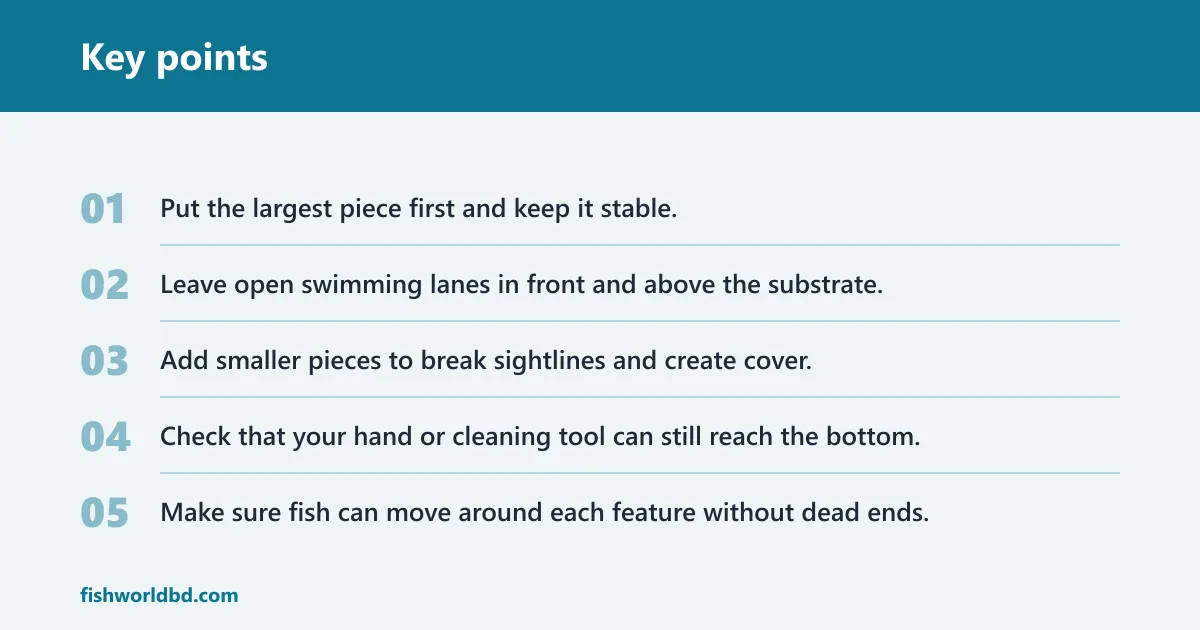
- Put the largest piece first and keep it stable.
- Leave open swimming lanes in front and above the substrate.
- Add smaller pieces to break sightlines and create cover.
- Check that your hand or cleaning tool can still reach the bottom.
- Make sure fish can move around each feature without dead ends.
Say your 20-gallon tank holds small schooling fish and one cave. If the cave sits too close to the front glass, the tank can look cluttered and the front siphon path becomes awkward. Move the cave back, add plants beside it, and the layout usually looks calmer at once.
Choose safe materials first
Natural-looking decor still has to be freshwater-safe. Use non-toxic materials with no sharp edges, no loose parts, and no coating that can flake into the water. Safety problems often come from shape and finish, not just the base material.
What makes decor freshwater-safe
Safe decor should stay stable in water, keep its shape, and avoid leaching unknown coatings. Inert stone, aquarium-safe ceramic, and clean driftwood are common choices. If an item smells strongly of paint, sheds color, or chips when rubbed, leave it out of the tank.
Why sharp edges and loose parts are a problem
Sharp corners can tear fins, scrape scales, and trap fish in tight turns. Loose pebbles, glued-on parts, and hollow ornaments with weak seams can break or shift when fish dig under them. That risk is higher with bottom-dwelling fish and strong diggers.
When painted or coated items should be avoided
A painted shell, ornament, or rock may look natural at first, but flaking paint is a real failure case. If the finish is not clearly freshwater-safe and durable, skip it. Do the same for bright coatings that fight the natural look anyway.
Aquarium decor matrix
This matrix compares common decor choices by look, safety, maintenance, algae risk, and fit for shy or territorial fish. Use it as a quick filter, then match the choice to your tank size and stocking plan.
| Decor option | Natural look | Fish safety | Maintenance effort | Algae risk | Fit for shy fish | Fit for territorial fish | Short recommendation |
|---|---|---|---|---|---|---|---|
| Rounded inert rock | High | High if stable and smooth | Low | Low to medium | Medium | High | Best for caves, borders, and strong structure. |
| Branching driftwood | High | High if soaked and sanded | Medium | Low to medium | High | Medium | Best for shelter, soft lines, and a forested feel. |
| Live plants | High | High for most tanks | Medium to high | Low if healthy | High | High | Best for cover, depth, and equipment screening. |
| Artificial plants | Medium | Medium if soft and non-toxic | Low | Low | High | Medium | Best when you want cover with less pruning. |
| Painted ornament | Low | Low if paint can flake | Low | Medium | Medium | Low | Usually skip it in a natural-looking tank. |
Rock options compared by look and function
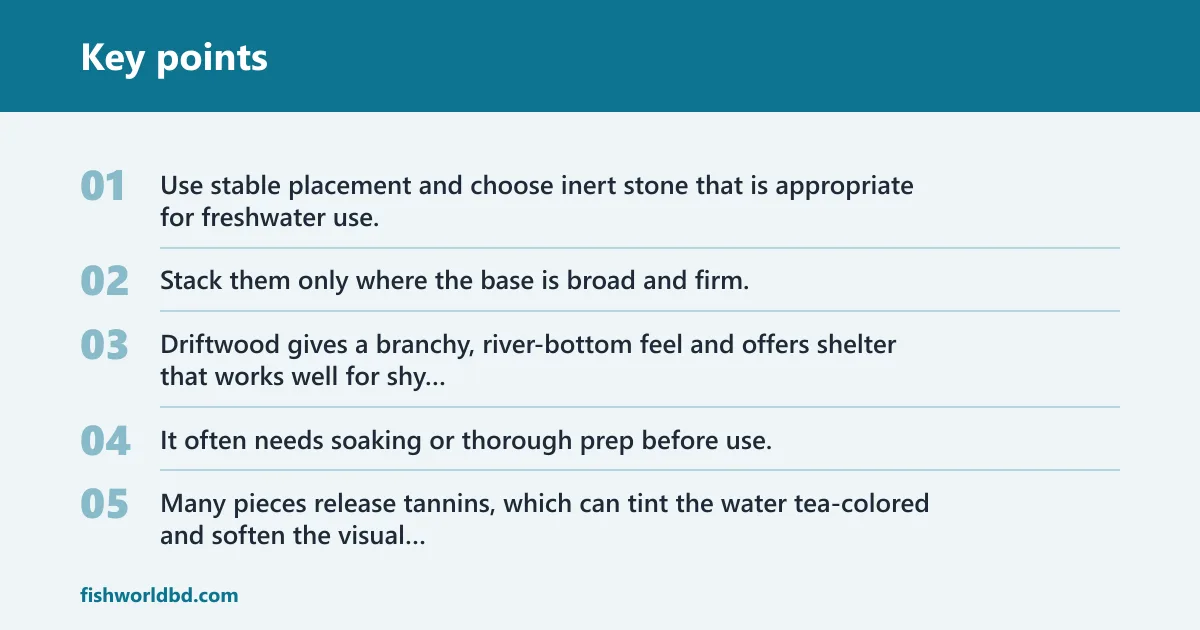
Rocks give structure, caves, and crevices. Use stable placement and choose inert stone that is appropriate for freshwater use. Stack them only where the base is broad and firm, because a leaning pile can shift when fish dig or when substrate settles.
Driftwood compared by prep, shelter, and tannins
Driftwood gives a branchy, river-bottom feel and offers shelter that works well for shy fish. It often needs soaking or thorough prep before use. Many pieces release tannins, which can tint the water tea-colored and soften the visual contrast of the scape.
Plants and artificial plants compared for cover and upkeep
Live plants can be arranged in foreground, midground, and background layers, which helps shape the tank and hide equipment. Artificial plants can also provide cover if they are soft, aquarium-safe, and tall enough to break sightlines. Live plants usually fit a more natural scape, while artificial plants are easier to trim and reposition.
What substrate looks most natural?
Substrate is part of the overall look, and it also affects fish comfort and maintenance. Gravel and sand can both work, but the best choice depends on the fish, the scape you want, and how much cleaning you want to do later.
Gravel vs sand for different bottom-dwelling fish
Sand usually suits many bottom-dwelling fish that sift or rest on the floor, while gravel often works for mixed community tanks and planted layouts. Choose a grain size that does not trap fish food too deeply and does not feel harsh on barbels or bellies.
How substrate color changes the final look
Dark substrate often makes fish colors and green plants stand out, while pale substrate gives a brighter, more open feel. Colored gravel can make the aquarium bright but not natural, so it usually works against this goal.
Using substrate to hide cables and intake parts
Substrate can help hide lower cable runs and the base of intake parts, but do not bury equipment in a way that blocks flow or makes service difficult. Gentle slopes at the back can also create depth without crowding the front glass.
Rocks, driftwood, or plants?
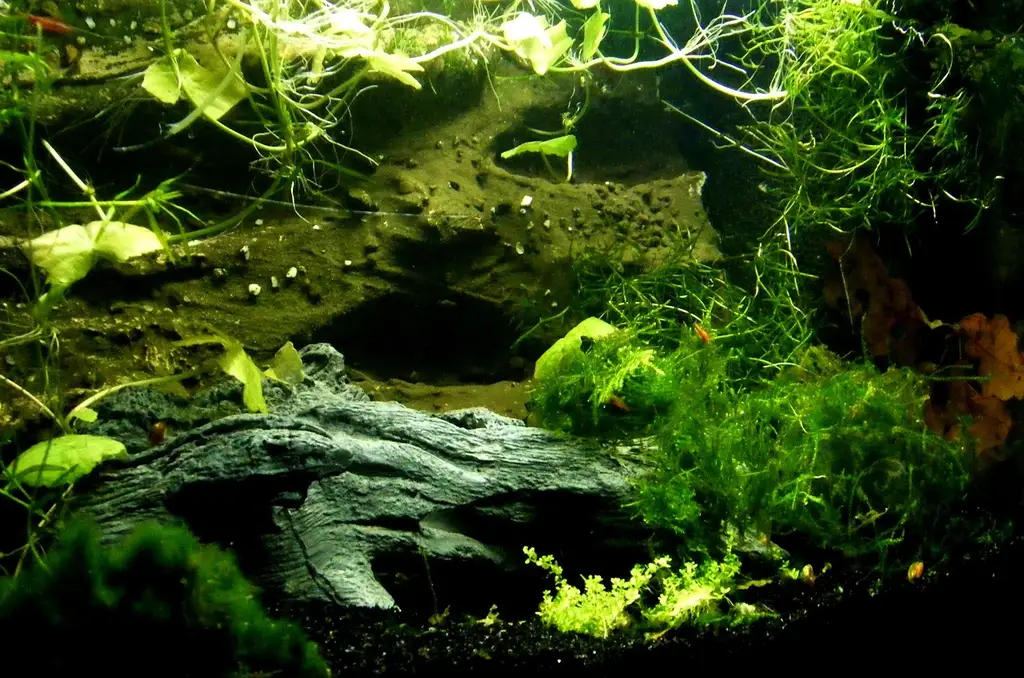
Most natural-looking freshwater tanks use all three, but each one does a different job. Rocks build shape. Driftwood adds shelter and softer lines. Plants fill gaps, hide hardware, and make the layout feel finished.
When rocks fit best
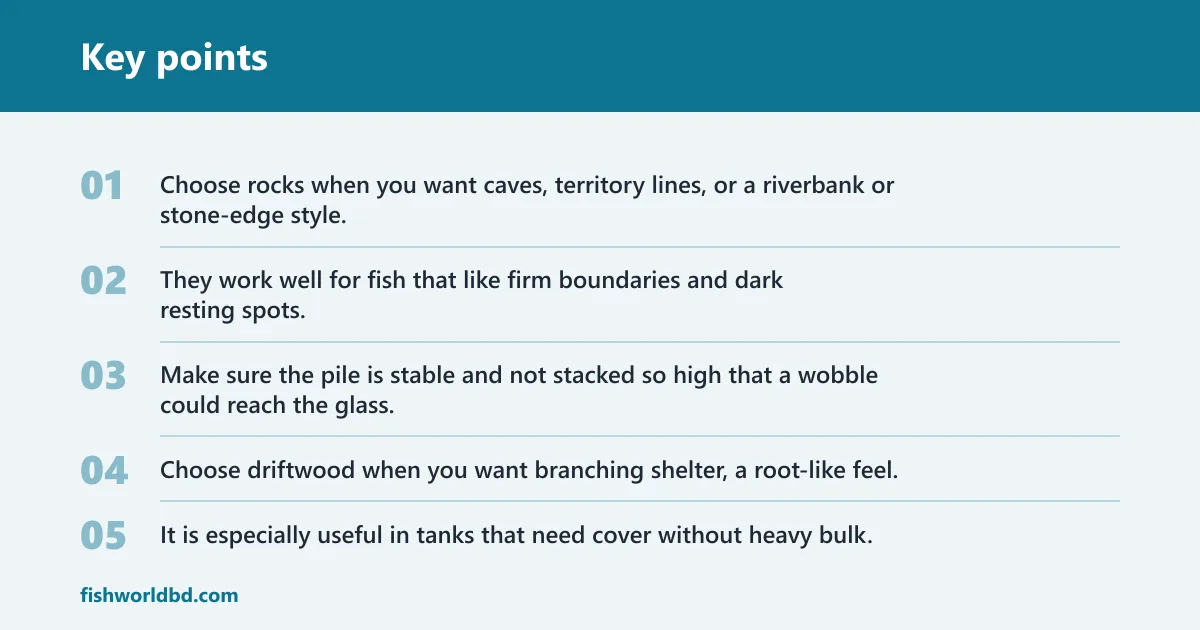
Choose rocks when you want caves, territory lines, or a riverbank or stone-edge style. They work well for fish that like firm boundaries and dark resting spots. Make sure the pile is stable and not stacked so high that a wobble could reach the glass.
When driftwood gives a better natural shape
Choose driftwood when you want branching shelter, a root-like feel, or a softer forest look. It is especially useful in tanks that need cover without heavy bulk. The branching shape helps break sightlines without sealing off the whole layout.
How plants soften the layout and fill gaps
Plants connect the hardscape and stop the tank from looking empty between large objects. Use taller plants in the background, medium plants in the middle, and shorter growth near the front. That layering hides gear and gives fish more usable space.
Picture a 29-gallon community tank with active midwater fish and one shy bottom fish. A tall driftwood piece, a few rocks at the base, and a planted back corner can keep the center open while still giving the shy fish a place to retreat.
How do you hide equipment naturally?
Hide filters, heaters, and lighting hardware with plants, hardscape, and background choices, but keep enough access to clean and service them. The tank should look calm without turning maintenance into a struggle.
Hide filters with background plants or hardscape
Place tall background plants or a rock-and-wood cluster in front of the filter body, leaving the intake and outflow unobstructed. This keeps the equipment out of direct view while preserving flow. Aqua-Fish.net notes that equipment such as bulbs, filters, and heaters is part of aquarium setup, and that plants can hide equipment easily.
Use plants and layout to screen heaters
Heaters can sit behind plant groups or beside a hardscape wall if water can still circulate around them. Do not bury a heater where debris collects against it. Heat needs water movement, and service access matters if the heater has to be removed later.
Keep access open for maintenance and cleaning
Leave a service lane for your hand, scraper, and siphon. If the layout blocks access to the heater, intake, or bottom corners, the tank will be harder to clean and more likely to collect waste. Natural does not mean inaccessible.
Frequently asked questions
How do I choose natural looking aquarium decorations for a freshwater tank?
Start with fish behavior, then choose stable, non-toxic pieces that fit the tank size. Use rocks, driftwood, and plants to create cover and open lanes at the same time. Avoid sharp edges, unstable stacks, and clutter that blocks cleaning or water flow.
What materials are safe for natural aquarium decor?
Safe choices are freshwater-safe, non-toxic materials with smooth edges and no flaking finish. Inert rock, properly prepared driftwood, aquarium-safe ceramics, and soft artificial plants are common picks. Avoid items with loose paint, brittle glue, or unknown coatings.
Should I use rocks, driftwood, or plants for a natural aquarium look?
Use rocks for structure, driftwood for shelter and branchy shape, and plants for softness and cover. Most natural-looking tanks work best with a mix. If you choose only one, match it to the fish: rocks for territory, driftwood for hiding, plants for screening and depth.
How many decorations should be in a freshwater aquarium?
Use enough decor to create shelter and break sightlines, but keep open water and service access. A common guide is to leave about 50% or more of the tank floor open for active species. Smaller tanks need even tighter control so the layout does not feel crowded.
How do I make aquarium decor look natural instead of fake?
Use a limited color palette, vary height and texture, and group items instead of spacing them evenly. Avoid bright colored gravel and painted ornaments if you want a natural result. Layer substrate, rocks, wood, and plants so the setup looks like one scene rather than a collection of objects.
What decorations are best for shy fish in a freshwater tank?
Shy fish do best with caves, dense plant groups, driftwood branches, and broken sightlines. Give them more than one retreat so they do not get trapped in a single hiding spot. Leave enough open water that bolder tankmates cannot pin them into corners.
Can I use shells, colored gravel, or painted ornaments in a freshwater aquarium?
Colored gravel and painted ornaments usually work against a natural look, and painted surfaces can flake. Shells are not a general freshwater default; some species and water-chemistry setups are special cases. If you use any of these, check safety, chemistry, and finish quality first.
How do I hide equipment so the tank still looks natural?
Use plants, wood, and rock placement to screen the filter, heater, and cables while keeping access open. Tall background plants hide the back wall well, and a hardscape cluster can mask hardware without choking flow. Do not block the intake, outflow, or cleaning path.