What Size Fish Tank Is Best for Beginners with Limited Space?

For many beginners with limited space, a 10-gallon tank is the smallest practical starting size; if a 20-gallon long fits, it is often easier to keep stable. A larger water volume gives ammonia, pH, and temperature more room to settle, while a smaller tank can shift faster and demands more frequent water changes. This guide ranks practical tank sizes by footprint, maintenance burden, and fish choices so you can pick the smallest setup that still stays manageable.
Why tank footprint matters
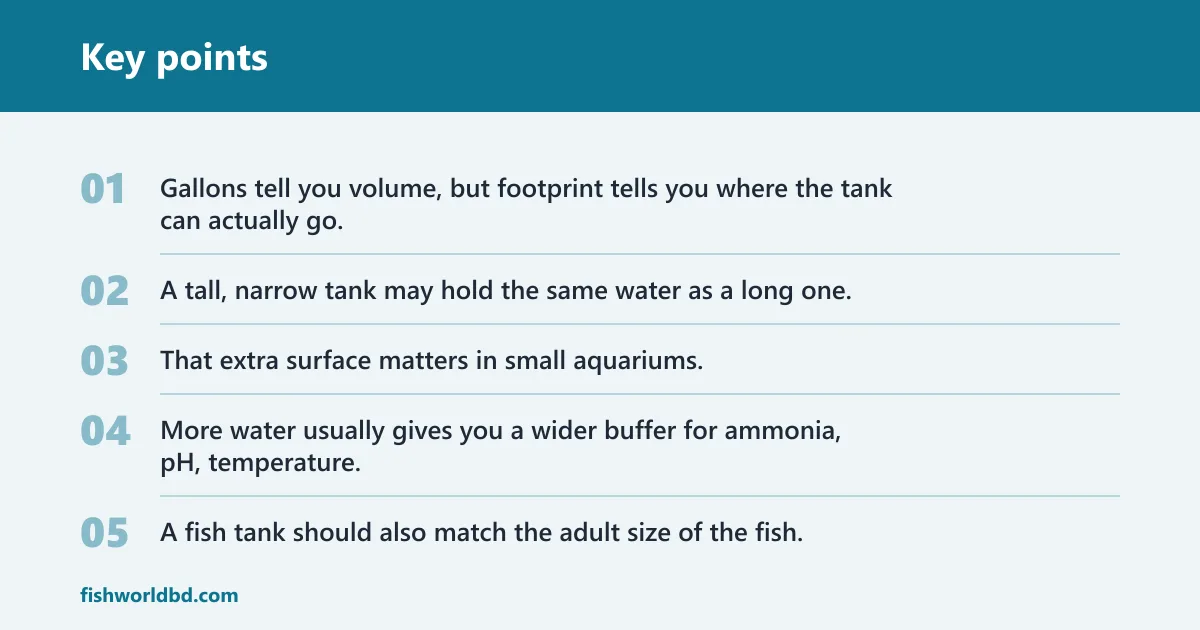
Gallons tell you volume, but footprint tells you where the tank can actually go. A tall, narrow tank may hold the same water as a long one, yet the long one often gives better surface area for oxygen exchange and more room for decorations, heater placement, and filter flow.
That extra surface matters in small aquariums. More water usually gives you a wider buffer for ammonia, pH, temperature, and oxygen exchange, while smaller tanks need closer attention to water changes and stocking levels. A fish tank should also match the adult size of the fish, not the juvenile size sold at the store.
A 5-gallon tank can work as a very small starter setup. A 10-gallon tank is more forgiving. A 20-gallon tank gives you more room for beginner fish, steadier water conditions, and less stress when a small mistake happens.
Tank size decision table
| Space scenario | Common footprint example | Recommended gallon range | Expected maintenance frequency | Suitable fish types | Red flags |
|---|---|---|---|---|---|
| Desk-sized footprint | About 5 gallons; many models are roughly 16 x 8 inches at the base, but check the listing for your model | 5 gallons | At least weekly water changes; smaller tanks in the 3 to 5 gallon range often need 25 to 40 percent weekly changes | One betta, or a very limited species setup that fits the tank and filter | Do not buy a bowl, a novelty tank, or a school of fish. Avoid fish that need more swimming room, and do not choose species that outgrow the tank quickly. |
| Small furniture footprint | About 10 gallons; many standard models are roughly 20 x 10 inches at the base, but verify the manufacturer listing | 10 gallons | Weekly water changes are still normal, but the tank is easier to keep steady than a 5-gallon setup | Beginner-friendly small fish such as tetras, guppies, and Rasboras, if the species and group size fit the tank | Do not buy fish that need a much larger home as adults. Do not overcrowd with too many fish, and do not pick a filter that cannot match the bioload. |
| Room-corner footprint | About 20 gallons; a 20-gallon long often uses a base near 30 x 12 inches, but model sizes vary | 20 gallons | Weekly or every 7 to 10 days for many beginner setups, depending on stocking and filtration | Small community fish, a species tank, or a betta with compatible tankmates only if the setup is sized correctly | Do not assume the extra size means you can stock heavily. Do not choose tall-only fish without checking shape and swimming style needs. |
For most beginners in limited space, the best answer is often 10 gallons, with 20 gallons as the easier long-term choice if the furniture and room can support it.
Is a 5-gallon tank enough for a beginner?
A 5-gallon tank is enough for a beginner only if you want a very small, carefully managed setup. It gives you a compact footprint and can work for one compatible fish, but it leaves little room for stocking mistakes, weak filtration, or skipped maintenance. It is better than a 1- or 3-gallon setup, but it is still small.
Who a 5-gallon tank fits
This size fits a beginner who wants one fish, a simple layout, and very limited equipment. It also fits a small bedroom, desk, or other tight space where a larger tank will not physically work. Home Aquarium Tips says 3 gallons or more helps balance ease of maintenance and fish welfare, which is why 5 gallons is a more reasonable floor than ultra-small novelty tanks.
What it limits
A 5-gallon tank limits stocking, filter choice, and the margin for error. If ammonia rises, if the heater is inconsistent, or if oxygen exchange is weak, the tank can move from stable to stressed quickly. It is also a poor choice for fish that need a school, because school fish need group sizes that fit the species and still need enough room for movement.
Picture a 5-gallon tank on a narrow desk with one betta and a small filter. That can be manageable. Put a school of active fish in the same tank, and the bioload rises faster than the tank can absorb without frequent water changes.
Red flags that point to a larger tank
If you want more than one fish, a fish that grows large, a planted community tank, or a setup with a heater and stronger filtration, choose a larger tank. Fishkeeping Advice lists tetras, guppies, and Rasboras as beginner-friendly fish, but those are still best matched to tank size and species needs, not bought because they are small in the store.
Fish Tank Focus recommends beginners avoid fish bowls and really small tanks. That advice matters most when the tank is too small to support steady water quality, not when the fish is young and looks tiny at purchase.
Is a 10-gallon tank the best starter size?
For many beginners with limited space, a 10-gallon tank is generally more forgiving than a 5-gallon tank. A 10-gallon tank is a better starter size than a 5-gallon tank because it is more forgiving, supports more beginner-friendly fish choices, and gives you more room for a filter, heater, lid, and simple aquascape without crowding the tank.
Why 10 gallons is more forgiving
A larger tank is easier to keep steady because waste is spread through more water. In practical terms, a 10-gallon tank dilutes waste better than a nano tank, so ammonia spikes and pH swings are less abrupt. Temperature also changes more slowly, which matters a lot when the room gets warm during the day and cool at night.
The same source recommends 3 to 5 gallon tanks for 25 to 40 percent weekly changes, while 6 gallons and larger can use 20 to 30 percent weekly changes. That shift shows why 10 gallons feels easier: you still maintain it, but you are not fighting the tank every few days.
Which beginner fish fit better here?
Small community fish usually fit better in 10 gallons than in 5, especially if the species stays small and the group size is appropriate for that fish. Tetras, guppies, and Rasboras are often used as beginner fish, but schooling fish should be kept in a species-appropriate group, not a token pair or trio.
Suppose you want a small school instead of a single fish. A 10-gallon tank gives you more room to match fish behavior with tank size, but it still does not turn every small species into a good fit. Adult size, activity level, and the filter’s ability to handle bioload still matter.
When a 10-gallon still feels cramped
A 10-gallon tank can still feel cramped if you want a planted community, more than one type of fish, or a fish that needs extra swimming space. It can also feel tight if you want larger hardscape, a tall tank shape that limits swimming room, or equipment that takes up a lot of interior space.
The same source notes that some fish need taller tanks because of their shape or swimming style. That is a reminder to check body shape and behavior before buying, not just the fish’s length.
Should beginners jump to 20 gallons?
A 20-gallon tank is often a good step-up size for beginners who have the space. It gives you more water stability, more room for plants and decor, and more flexibility with fish choices. If your room can handle the footprint, a 20-gallon long is usually easier to keep steady than a smaller tank.
Why 20 gallons helps with stability
In a 20-gallon tank, waste has more water to dilute into, temperature changes more slowly, and small errors in feeding or maintenance are less punishing. That makes it easier to keep ammonia and nitrite under control while the tank cycles and after it is stocked.
Fish Tank Focus calls a 30-gallon fish tank an ideal choice, which fits the same logic: more water usually means more stability. A 20-gallon tank is not tiny, but it is still manageable for a beginner who wants a better balance between footprint and forgiveness.
How it helps with schooling fish and plants
A 20-gallon tank gives school fish more room to move, which makes it easier to keep a proper group without crowding the filter intake or hardscape. It also leaves more space for live plants, which can help with oxygen exchange and general tank balance when they are chosen and maintained well.
This is also the size where matching filter and stocking becomes easier. You can size the filter to the bioload more realistically, add a heater for tropical species, and still leave open water for the fish to swim.
When the extra footprint is worth it
If you want one fish plus a few tankmates, a small school, or a planted layout, the extra footprint is usually worth it. A 20-gallon tank also gives you a better buffer if your maintenance routine is not perfect yet. That is a big advantage for a first aquarium.
What equipment a small tank needs
A beginner tank needs a filter, a heater for tropical species, and a light. Those three pieces are not optional if the livestock needs them. In small tanks, equipment choice matters because the tank has less water volume to absorb mistakes.
Filter flow and bioload match
Choose a filter that matches the tank’s bioload, not just the gallon label. Flow rate is usually listed in GPH by the manufacturer, and adjustable flow is useful for small tanks and calm-water fish. A pre-filter sponge can help protect small fish and reduce direct suction.
If the flow is too weak, waste builds up. If it is too strong, fish can get stressed and avoid the current. The best choice is the one that gives steady circulation without blasting the tank.
Heater choice for tropical fish
Use a heater if the species needs warm water. Tropical fish depend on temperature stability, and small tanks lose that stability faster than larger ones. A heater that is too large or too weak can both cause problems, so check the manufacturer’s listing for the tank size and species needs.
Light, lid, and air exchange basics
A lid helps reduce evaporation and keeps fish from jumping. Lighting should match the plants and fish, but it should not trap heat or prevent surface movement. Oxygen exchange happens at the water surface, so some movement there is useful even in a quiet small tank.
Follow the manufacturer’s manual for each product, and check local laws where they apply. Keep equipment clear of the tank’s electrical risks and the room layout that could cause spills or blocked access.
Stocking a small aquarium is about restraint. Understocking is usually safer than overstocking at first, because it gives the filter and maintenance routine room to catch up. Overstocking creates stress, water-quality problems, and faster swings in ammonia and nitrite.
Betta setups in limited space
A betta is the clearest single-fish option for a small room, especially in a 5-gallon or larger tank with gentle filtration and stable heat. The best tank size for a betta in a small room is usually 5 gallons at minimum, with 10 gallons giving more flexibility if the space allows it.
Do not pair a betta with tankmates just because the fish looks peaceful at the store. Compatibility depends on temperament, tank layout, and available room. A crowded small tank can turn a calm setup into a stress problem fast.
Small schools and species-specific group size
Schooling fish should be kept in groups that fit the species, not a one-size-fits-all number. The same source says school fish should be kept in groups of at least 5, but many species do better in larger groups than that. The tank must also be large enough to support the group long term.
That is why 10 gallons can feel like a ceiling for some species and a floor for others. The same fish that looks tiny as a juvenile may need more room as an adult, especially if it is active or lives in a group.
Why adult size matters more than juveniles
Buy for the adult fish, not the juvenile fish on the sales rack. A tiny fish can still become a large fish, and a small tank does not stop growth in a healthy way. Poor water quality and crowding are the real problems, and they often begin when the tank was stocked for the fish’s current size instead of its future size.
The same source says buying a 10-gallon tank for Oscar fish is not smart, and it says Oscar fish need at least 100 gallons. That is an extreme example, but the lesson applies to every species: check the adult requirement before you buy.
- Measure the surface area where the tank will sit, not just the free corner in the room.
- Decide whether you want one fish or a small school.
- Confirm whether the fish needs a heater and steady tropical temperatures.
- Check the adult size and group size for the species you want.
- Choose the smallest tank that still gives the filter and maintenance routine room to work.
Frequently asked questions
What size fish tank is best for beginners with limited space?
A 10-gallon tank is the best starting point for most beginners with limited space. It is still compact, but it is more forgiving than a 5-gallon tank. If your room can handle the footprint, a 20-gallon long is even easier to keep steady and gives you more stocking flexibility.
Can beginners start with a small aquarium?
Yes, but small aquariums demand more discipline. They swing faster in ammonia, pH, and temperature, and they need more frequent water changes. Beginners can succeed with a small tank if they keep the stocking light, match the filter to the bioload, and stay consistent with maintenance.
What is the best tank size for a betta in a small room?
For a betta in a small room, 5 gallons is the minimum practical size, and 10 gallons is better if the space allows it. The tank should have gentle filtration, stable heat, and enough surface area for oxygen exchange. Avoid tiny novelty tanks and bowls.
How big should a beginner fish tank be for stability?
For stability, more water is better. A 10-gallon tank is usually the smallest size that feels reasonably forgiving for beginners, and a 20-gallon tank is better still. More water volume helps buffer ammonia, pH, temperature, and oxygen changes, which reduces the impact of small mistakes.
What should I choose if my desk only fits a tiny aquarium?
If your desk only fits a tiny aquarium, the safest choice is to stop at a 5-gallon tank or skip fish until you can fit more water volume. Use a sturdy stand or furniture rated for the load, and check the manufacturer listing for the tank footprint before you buy. Tiny tanks leave very little margin for stocking or maintenance errors.