How to Test Aquarium Water for Nitrite and Nitrate Levels

Test aquarium water with a liquid kit, aim for nitrite to read 0 ppm, and treat any detectable nitrite as urgent; nitrate should stay low, with action often needed around 20–40 ppm depending on the stock. High nitrite can poison fish fast, and high nitrate adds chronic stress, poor growth, and algae problems. This guide shows how to test both, read the numbers correctly, and choose the right next step today.
Choose the right test kit and use it correctly
Use a liquid reagent kit for primary testing. Add the exact number of drops, cap the tube, mix as directed, wait the full time, then compare the result to the chart under neutral light. Test strips are quicker, but they give less precise readings, especially for ammonia and nitrite at low levels.
Liquid kits are the standard home method. A liquid freshwater master test kit is a common example because it covers ammonia, nitrite, nitrate, and pH in one box. Digital testers and colorimeters can read more precisely, but they cost more and are usually worth it only if you test often or need tighter control.
Choose the right tool
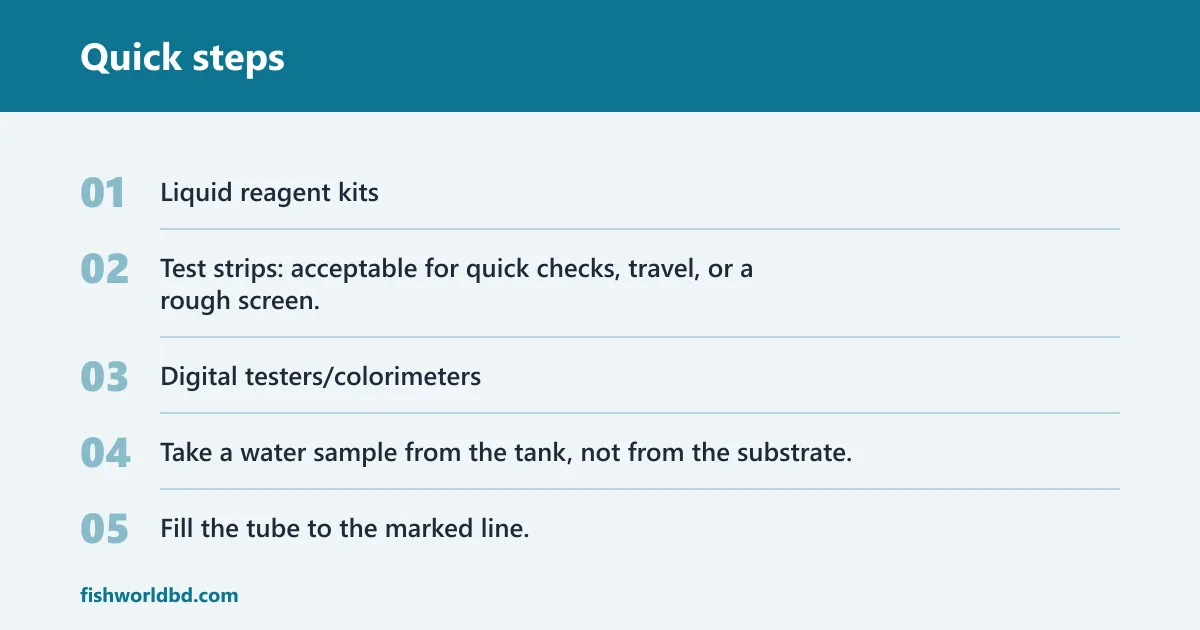
- Liquid reagent kits: best for routine home testing and the most reliable choice for nitrite and nitrate.
- Test strips: acceptable for quick checks, travel, or a rough screen, but not the main tool for troubleshooting.
- Digital testers/colorimeters: useful when visual color matching is difficult or when you want higher precision at a higher cost.
Run the test the same way each time
- Take a water sample from the tank, not from the substrate.
- Fill the tube to the marked line.
- Add the reagent drops exactly as the instructions state.
- Cap and shake for the listed time.
- Wait the full reaction time before reading the chart.
- Hold the tube against a white background under steady indoor light.
A common first-timer mistake is reading the tube in direct sunlight or by a warm lamp. Both can shift the color enough to make a low reading look higher or make a faint change look like “zero.”
Which kit should you use?
For nitrite and nitrate, a liquid reagent kit is the best default. It is more accurate than strips, especially when the goal is to detect small but important changes. A strip can be good enough for a quick check, but a liquid kit should be the main reference for fish health decisions.
Liquid reagent kits
Liquid kits cost more up front than strips, but each test is usually still inexpensive enough for regular use. They are the best choice for new tanks, stocked tanks with sensitive fish, and any aquarium that has had a filter issue, medication, or a recent stocking change.
Test strips
Strips are fast and convenient. They are useful when you need a broad check before a water change, but they are not the best choice for fine distinctions between 0 and a low but harmful nitrite reading. For routine troubleshooting, a strip should not be the only result you trust.
Digital testers and colorimeters
Digital tools can reduce guesswork when matching colors, which helps if lighting is poor or if you have difficulty separating close shades. They make sense for advanced keepers, breeding setups, or systems where precision matters more than purchase price.
How to run a liquid nitrite and nitrate test
Use the same sample volume, the same light, and the same wait time every time. Nitrite and nitrate tests can look simple, but small handling errors change the result. For nitrate, the reagent bottle must be shaken vigorously for at least 30 seconds, because poor mixing is a common reason the test reads falsely low.
Follow the kit instructions exactly. Do not guess at drop counts. Do not shorten the wait time. Do not read the color before the reaction is complete. The nitrate test is the most error-prone test in many aquarium kits, and under-shaking the bottle is a major reason people think their nitrate is 0 ppm when it is not.
Say your 40-gallon tank looks clear, the fish are eating, and the nitrate tube keeps reading near zero while algae keeps returning. If the bottle was not shaken hard enough, the result may be wrong even though the tank looks calm. The fix is simple: shake the nitrate reagent for the full 30 seconds, repeat the test, and compare it under the same light.
What do nitrite and nitrate readings mean?
Nitrite should read 0 mg/L in an established freshwater aquarium. Any detectable nitrite means the aquarium needs attention. Nitrate is the end product of nitrification, so some nitrate is expected, but a practical freshwater target is often below about 20 mg/L. Higher nitrate is less acutely toxic than ammonia or nitrite, but it still needs control.
Nitrite reading: what it means
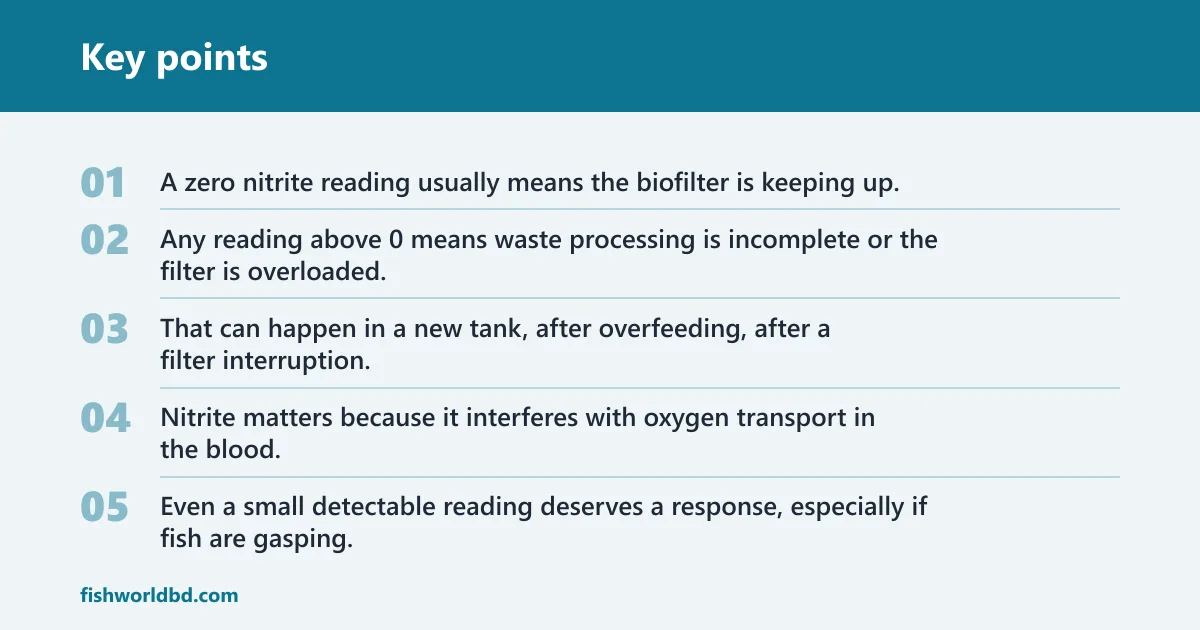
A zero nitrite reading usually means the biofilter is keeping up. Any reading above 0 means waste processing is incomplete or the filter is overloaded. That can happen in a new tank, after overfeeding, after a filter interruption, or after a sudden stocking increase.
Nitrite matters because it interferes with oxygen transport in the blood. Even a small detectable reading deserves a response, especially if fish are gasping, hanging near the surface, or acting stressed.
Nitrate reading: what it means
A low nitrate reading usually means routine maintenance is on track. A higher reading points to ongoing waste production, too much feeding, too many fish for the system, weak plant uptake, or water changes that are too infrequent. Water changes, sensible stocking, feeding, and plant uptake are the main ways to control nitrate.
Picture a 20-gallon tank with guppies and a sponge filter. Nitrite is 0, but nitrate has climbed above the conservative target. That is usually a maintenance issue, not a crisis. A water change and a review of feeding and stocking are the first moves.
Nitrite nitrate troubleshooting matrix
| Reading range | Likely cause | Immediate action | Retest timing | Classification |
|---|---|---|---|---|
| Nitrite 0 mg/L; nitrate below about 20 mg/L | Filter is keeping up and waste load is manageable | Keep normal feeding and maintenance | Weekly | Maintenance |
| Any detectable nitrite | Biofilter not fully processing waste, new tank syndrome, or overload | Do an immediate partial water change, reduce feeding, check filter flow and media | Same day or next day | Emergency |
| Nitrite low but detectable, nitrate rising quickly | Cycle still stabilizing or stocking increased too fast | Pause new additions, feed lightly, test ammonia too | Daily until stable | Cycling-related |
| Nitrate about 20 to 40 mg/L | Normal waste buildup between water changes | Plan a water change and review feeding | Within a few days after action | Maintenance |
| Nitrate above 40 mg/L | Infrequent water changes, heavy stocking, heavy feeding, weak plant uptake | Do a larger water change and adjust husbandry | After the water change, then weekly | Maintenance |
| Nitrate reads zero but fish or algae suggest otherwise | Reagent bottle under-shaken or test not run correctly | Repeat the test with full reagent mixing and proper timing | Immediately | Maintenance |
How often should you test?
Weekly testing is the minimum recommendation for core aquarium parameters in an established tank. During cycling, after stocking changes, after a filter problem, or after illness treatment, test more often. If nitrite is present, a common rule of thumb is to check daily or every other day until it returns to 0.
New tanks and cycling tanks
New tank syndrome can cause ammonia and nitrite spikes. During that period, test ammonia, nitrite, and nitrate more often than once a week. This is when a liquid kit matters most, because you need to see small changes before fish show obvious stress.
Ammonia should also be 0 mg/L. Its toxicity rises as pH and temperature increase, so a tank with warm water and a higher pH can become dangerous faster than a cool, acidic one. Any detectable ammonia or nitrite reading means the aquarium needs attention.
Established tanks
Once the tank is stable, weekly testing is usually enough for a normal freshwater setup. Test sooner if fish start gasping, if the filter stops or slows, if you add a lot of fish at once, or if you change the maintenance routine.
What should you do if nitrite or nitrate is high?
High nitrite calls for immediate action. High nitrate usually calls for routine correction. Those are not the same problem, and they should not be treated the same way. Nitrite is an emergency because it can injure fish quickly; nitrate is a longer-term management issue.
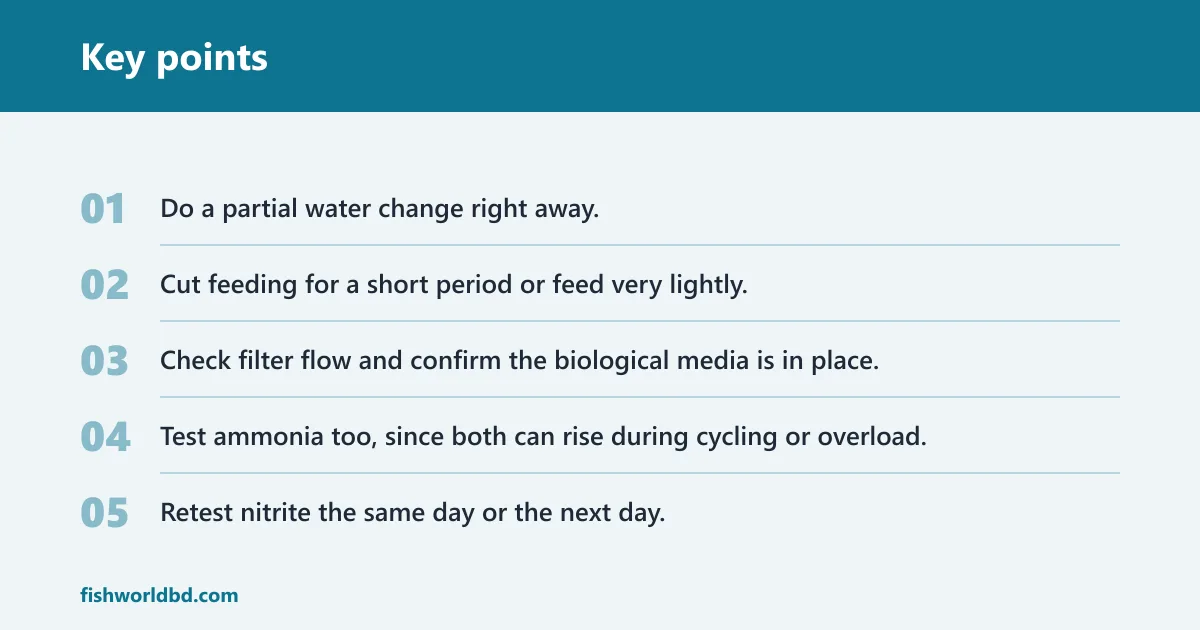
If nitrite is high
- Do a partial water change right away.
- Cut feeding for a short period or feed very lightly.
- Check filter flow and confirm the biological media is in place.
- Test ammonia too, since both can rise during cycling or overload.
- Retest nitrite the same day or the next day.
Any detectable nitrite is urgent because the biofilter is likely not fully handling the waste load. The next step is to lower the concentration in the water and reduce waste input while the filter catches up.
If nitrate is high
- Do a water change.
- Review feeding amounts and frequency.
- Check stocking density.
- Increase plant uptake if the setup supports live plants.
- Retest after the change to confirm the new level.
Nitrate is much less acutely toxic than ammonia or nitrite, but it should not be ignored. If the tank holds species that prefer lower nitrate, aim below the general freshwater guideline and keep changes more frequent.
Some fish do better with lower nitrate than the general target. Sensitive species, fry, and heavily stocked tanks often benefit from keeping nitrate well below about 20 mg/L, even if the water still looks clean and the fish are active.
Why is my nitrite still showing after cycling the tank?
Persistent nitrite after cycling usually means the biofilter is not fully matched to the waste load, or the cycle was disrupted by a new stocking increase, filter cleaning, medication, or low oxygen in the filter media. A detectable reading after “cycling” means the system is still not stable enough for the current load.
Check whether the tank was stocked too fast, whether the filter was rinsed in tap water, whether the media was replaced all at once, or whether feeding increased. Retest ammonia and nitrate as well. If nitrite appears after a major change, treat the tank as cycling again until readings settle.
Can test strips accurately measure nitrite and nitrate?
Test strips can give a useful quick check, but they are less accurate than liquid kits, especially for ammonia and nitrite at low concentrations. For a true troubleshooting decision, a liquid reagent kit is the better primary tool. Strips are fine for convenience, not for fine readings that affect fish safety.
If a strip suggests nitrite is present, confirm with a liquid kit before deciding the tank is safe. If a strip says nitrate is zero but the tank has obvious waste buildup or recurring algae, repeat the test with a liquid reagent kit and make sure the nitrate bottle was shaken properly.
Why does my nitrate test keep reading wrong?
The most common reason is poor reagent mixing. The nitrate test in many kits is the most error-prone test, and the bottle should be shaken vigorously for at least 30 seconds. If the reagent is not mixed well, the color can read falsely low and hide a real nitrate problem.
Other causes include short wait time, inconsistent lighting, dirty test tubes, or reading the chart against a colored wall instead of a white background. Repeat the test carefully before assuming the tank is at zero.
Frequently asked questions
How do I test aquarium water for nitrite and nitrate?
Use a liquid reagent kit, not a strip, for the main result. Fill the tube with tank water, add the correct drops, cap and shake for the listed time, then wait the full reaction time before comparing the color under neutral light. Follow the kit instructions exactly each time.
What is the best way to read a nitrite and nitrate test kit?
Read the result in steady indoor light against a white background, and use the chart only after the full wait time. Nitrite should be read as 0 mg/L in an established tank. Nitrate should be read with extra care because under-shaking the reagent can make the color seem lower than it really is.
How often should I test nitrite and nitrate in a freshwater aquarium?
Weekly testing is the minimum for an established aquarium. Test more often during cycling, after adding fish, after a filter disruption, or when fish show stress. If nitrite is detectable, retest daily or every other day until it returns to 0.
What nitrate level is safe for my aquarium fish?
For a general freshwater aquarium, keeping nitrate below about 20 mg/L is a useful conservative target. Some fish can tolerate more, but lower is better for sensitive species, fry, and crowded tanks. Water changes are the main tool for keeping nitrate under control.