
Cheap Aquarium Decorations DIY: Safe Home Ideas

Use inert materials, smooth every edge, and soak-rinse for about 24–72 hours before adding DIY aquarium decor. If a piece flakes, floats, smells, or changes water, skip it. Bad decor can leach toxins, injure fins, trap waste, and trigger fights over territory. This guide gives cheap at-home decor ideas plus a strict prep checklist for fish-safe use.
Cheap aquarium decor ideas
Fish-safe DIY decor works best when it supports fish behavior, not when it simply fills space. Start with materials that stay stable, stay plain, and clean up easily, then shape them into caves, tunnels, and barriers that fit how the fish move and claim space.
What counts as fish-safe DIY decor
Fish-safe decor is inert, smooth, and stable under water. That means no flaking paint, no sharp seams, no loose glitter, and no material that softens, smells, or bleeds color after soaking. Decorations should hold their shape and should not change the water in ways the fish do not need.
Cheap options usually come from common household materials: terracotta pots, plain PVC pipe, coconut shell, driftwood, and rocks or stone stacks. These work because they can form caves, ledges, and visual breaks without a high price tag.
Best low-cost materials to start
Terracotta pots can make low-cost hiding spots if the edges are smoothed and the pot is placed so it cannot roll. PVC pipe is a cheap tunnel material when it is plain, unpainted, rinsed well, and sanded at cut edges. Coconut shell is useful for small fish and shrimp when cleaned and smoothed.
Driftwood adds cover and a natural anchor point for layout, but it may change water chemistry, so it needs extra prep. Rocks and stone stacks can create caves and territory breaks, but the stack must be stable and the stone choice should match the water you keep. Yard rocks can be free if scrubbed first, but only if they are safe for the tank and do not crumble.
Ideas that work for beginners
A beginner-safe build commonly needs one piece of cover and one open lane. For example, place a terracotta half-pot at one end, a short PVC tunnel near the back, and a few smooth stones to break the line of sight. That gives fish a place to hide without filling the tank.
Another easy build is a coconut shell hide for shrimp or small fish, paired with a branch of cleaned driftwood. A common first-timer mistake is adding several decorations at once, then losing all swimming space. Start with one main structure and add only if the fish still have room to move freely.
What materials are safe or unsafe?
Safe materials stay inert after cleaning and soaking. Unsafe materials peel, rust, soften, crack into sharp pieces, or leach dye. If a material is uncertain, treat it as unsafe until it passes soak, smell, and edge checks.
Safe household materials to consider
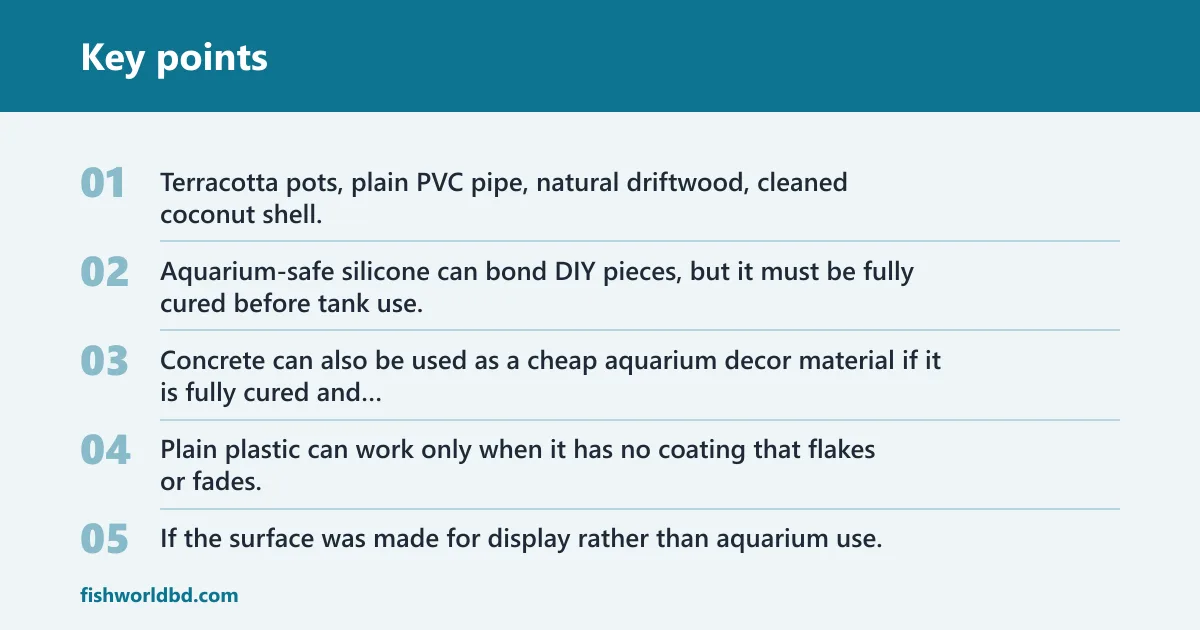
Terracotta pots, plain PVC pipe, natural driftwood, cleaned coconut shell, and stable rocks are the most common low-cost choices. Aquarium-safe silicone can bond DIY pieces, but it must be fully cured before tank use, and it should be labeled fish-safe or aquarium-safe. Concrete can also be used as a cheap aquarium decor material if it is fully cured and appropriate for the water.
Plain plastic can work only when it has no coating that flakes or fades. If the surface was made for display rather than aquarium use, assume the coating is the weak point until proven otherwise. The rough internal seams on cheap resin can tear fins on bettas and other slow-moving fish.
Materials to avoid or modify
Avoid painted items unless the coating is clearly aquarium-safe. Cheap painted resin can leach dye as it fades, and that risk rises when the piece is scratched or left in water for a long time. Avoid metal, plated parts, brittle glass edges, scented sealants, soap residue, and foam that is not sealed for aquarium use.
If a household item has glue, labels, foil, or a glossy coat that starts to lift after soaking, it does not belong in the tank. Modify only when the core material is sound and the unsafe layer can be removed completely.
Common failure signs to watch
Watch for clouding soak water, a chemical smell, chips in the edge, floating, cracking, or color transfer to a paper towel. Any one of these means the item needs more work or should be discarded. If a stack shifts with a light push, it is not ready.
Picture a 20-gallon tank with a rock pile built on soft gravel. It looks fine on day one. A week later, a fish burrows under the base and the pile leans. That is why stability must be checked before water goes in, not after.
DIY decor safety matrix
This matrix gives a quick screen for common low-cost materials. Use it before you cut, glue, or place anything in the tank. The prep column matters more than the price, because an unsafe finish can ruin an otherwise good material.
| Material | Estimated cost band | Prep steps | Drying/curing time | Fish-type suitability | Red-flag failure modes |
|---|---|---|---|---|---|
| Terracotta pot | Low | Wash, inspect for glaze, break or flip if needed, sand all edges | Air-dry fully after washing | Good for bettas, cichlids, shrimp, fry | Sharp rim, wobble, hidden glaze, trapped debris |
| PVC pipe | Low | Use plain, unpainted pipe; rinse hard; sand cut ends smooth | Dry after rinsing | Good for cichlids, shy fish, shrimp, small fish | Paint, burrs, solvent smell, floating pieces |
| Driftwood | Low to none if foraged | Scrub, boil or soak, rinse again, check for rot | Several hours to multiple days of soaking | Good for most fish; watch shrimp and soft-water species closely | Tannin spike, mold, rot, unstable placement |
| Rocks and stone stacks | Free to low | Scrub, rinse, test for stability, choose non-calcareous stone if soft water is desired | Dry after rinsing | Good for territorial fish, less ideal if you need very soft water with reactive stone | Tipping, crumbling, trapped gaps, water change from calcareous stone |
| Coconut shell | Low | Remove meat and fiber, scrub, rinse, smooth edges and hole openings | Air-dry fully after cleaning | Good for shrimp, bettas, small catfish, fry | Sharp fiber edges, trapped gas, mold, shell fragments |
| Plastic ornament | Low to medium | Use only if coating is sound; rinse, check seams, reject fading paint | Dry after rinsing | Limited use for hardy fish if finish is stable | Paint peeling, dye leach, sharp seams, split joins |
| Aquarium-safe silicone bond | Low to medium | Apply to clean, dry pieces only; label must say fish-safe or aquarium-safe | Fully cure before tank use | Good for all fish when used as a hidden bond | Uncured odor, soft bead, peeling joint, trapped residue |
How do you prep decor before use?
Prep is the step that keeps cheap decor from becoming a tank problem. Clean off dust, remove sharp points, rinse out loose residue, and give each piece enough time to dry, soak, or cure before it goes near fish. Never skip edge work on hard materials.
Cleaning, sanding, and smoothing edges
Wash the item with plain water first, then scrub away dirt and loose material. Use sandpaper or a file on every cut edge, crack, and seam. On terracotta, PVC, coconut shell, and stone, the hand should glide over every edge without catching.
For resin or plastic ornaments, inspect the inside as well as the outside. Rough internal seams can tear fins on bettas and other slow-moving fish, so those seams need sanding only if the material can be made smooth without breaking apart. If not, discard the piece.
Boiling, soaking, and curing steps
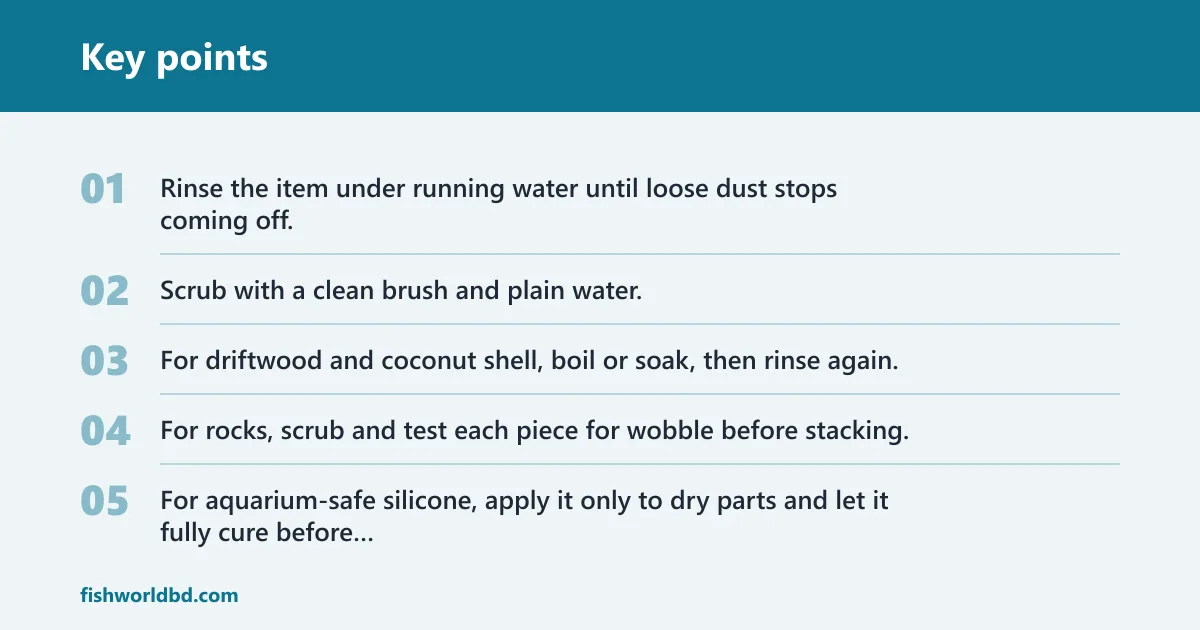
- Rinse the item under running water until loose dust stops coming off.
- Scrub with a clean brush and plain water.
- For driftwood and coconut shell, boil or soak, then rinse again.
- For rocks, scrub and test each piece for wobble before stacking.
- For aquarium-safe silicone, apply it only to dry parts and let it fully cure before water contact.
- Soak-rinse the finished piece for 24–72 hours, changing the water if it clouds or smells.
Boiling is useful for small driftwood and coconut pieces, but larger wood often needs soaking instead. Driftwood may also alter water chemistry, so monitor the tank after placement. If the water darkens from tannins and the fish dislike it, remove the wood or use a smaller piece.
When silicone is ready for water
Aquarium-safe silicone should be fully cured before tank use. The bead should no longer smell like vinegar or solvent, should feel firm, and should not leave a tacky mark when touched lightly with a clean dry fingertip. If any part stays soft, wait longer.
Do not seal wet wood, dusty stone, or oily plastic with silicone and expect a safe bond. The contact surfaces need to be clean and dry first, or the joint can fail later.
How do you make a cave or hide?
A good hide is dark, smooth, stable, and sized for the fish that will use it. The opening should fit the species, the walls should not pinch fins, and the piece should stay in place if a fish bumps it or digs near it. Cheap caves are easy to make with terracotta, PVC, coconut shell, or stone.
Terracotta pot caves
Flip a terracotta pot on its side for a simple cave. If the rim is rough, sand it until it feels smooth. If the pot has a drainage hole that is too sharp or too large, soften the edge and place it where it cannot roll. This is one of the cheapest cave options for bettas and cichlids.
PVC tunnels
Use plain, unpainted PVC pipe and cut it to length with a clean edge. Sand both ends until the cut is smooth. Rinse thoroughly before use. PVC works well for shy fish, bottom dwellers, and fish that like a tunnel they can pass through rather than a wide cave they must turn inside.
Coconut shell hides
Clean the shell until no fiber or meat remains, then smooth the cut edge and any drilled opening. Coconut shells can be used as aquarium dens for small fish and shrimp. Keep the opening large enough for easy entry, but not so large that it loses the feeling of cover.
Suppose a shrimp tank has one shell hide with a jagged lip. The shrimp may still use it, but molts can snag on that edge. A few minutes of sanding prevents that kind of failure.
Stone and wood shelters
Stone and driftwood can form a shelter when they are locked together without wobble. Use the largest stone as the base, then place wood or smaller stones so the structure cannot rock side to side. Stable shelters are better than tall ones that look impressive but tip under a fish’s weight or a burrowing nudge.
How much decor should a tank have?
A common target is to keep no more than 40% of tank volume filled with hardscape and decorations. That leaves room for swimming, feeding, and maintenance while still giving fish cover. The exact layout should change with the species, but open space always matters.
Leave open swimming lanes
Think in lanes, not in objects. A fish should be able to cross the front or middle of the tank without weaving through a maze. Leave a clear route from end to end, especially in tanks for schooling fish that need room to move together.
Build visual barriers without crowding
Use decor to break up sightlines, not to wall off the entire tank. One cave, one branch, and one rock cluster can create several separate zones if they are placed well. That matters for territorial fish because a fish cannot challenge every other fish at once if it cannot see every other fish.
Match layout to shy and territorial fish
Shy fish need cover at the edges and in the back, where they can rest without constant attention from tank mates. Territorial fish need clear borders, meaning a cave here, a stone pile there, and enough distance between them to reduce disputes. Bettas and cichlids especially benefit from distinct zones.
For schooling fish, keep the center open and use decor as perimeter cover. For shrimp, add small gaps and low shelters instead of large blocking pieces. The layout should help each species feel safe without turning the tank into a cluttered box.
What works for bettas, cichlids, and shrimp?
Different fish need different kinds of cover. Bettas usually want gentle, low-pressure hides with smooth edges. Cichlids often need stronger territory breaks. Shrimp do best with small shelters, surface texture for grazing, and no sharp seams that can trap legs during a molt.
Bettas and gentle hides
Bettas benefit from dark caves, smooth plants, and calm routes near the surface. Terracotta pots, coconut shell pieces, and rounded stone breaks work well if they do not have rough internal seams. Avoid anything with sharp corners or narrow cuts that could scrape fins.
Cichlids and territory breaks
Cichlids often need more visual separation than many beginners expect. Rock stacks, tunnel clusters, and multiple caves can keep one fish from controlling the whole tank. Use stable stone and keep each hide anchored so a fish cannot shift it while digging.
Shrimp-safe small spaces
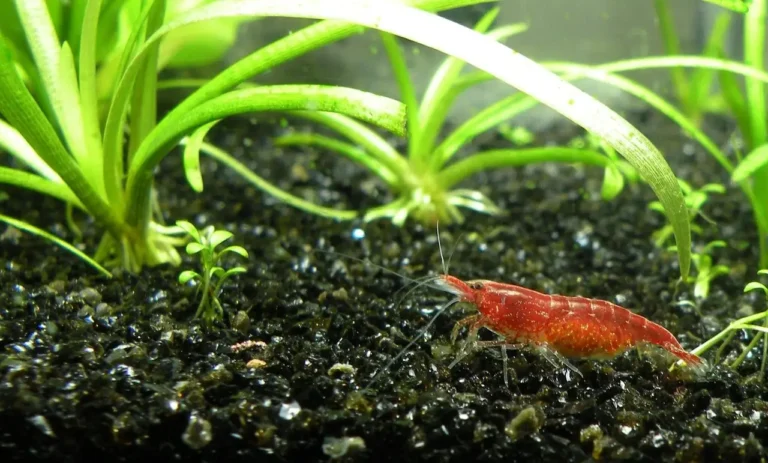
Shrimp like low shelters, micro-caves, and surfaces with texture, but they also need safe edges. Coconut shell, small PVC rings, and tiny gaps under stable wood can all work. Avoid heavy toppers that can collapse or ornaments with peeling paint, because shrimp spend time on every surface and find weak points fast.
Frequently asked questions
What household items can I safely turn into aquarium decorations?
Common safe choices include terracotta pots, plain PVC pipe, cleaned coconut shell, driftwood, and stable rocks. Use them only after washing, smoothing edges, and checking for coatings or smells. If a household item has paint, plating, glitter, or soft glue, leave it out unless every unsafe part is removed.
How do I make cheap aquarium decor without hurting fish?
Pick inert materials, sand every cut edge, and soak-rinse the finished piece before use. Keep decor stable so it cannot tip, and reject anything that leaks color, smells odd, or sheds flakes. Cheap decor becomes safe through prep, not through price alone.
What materials are unsafe for homemade aquarium decorations?
Unsafe materials include flaking painted resin, rusty metal, brittle plastics, scented sealants, and anything that sheds dye or crumbs after soaking. Sharp seams are also a problem because they can tear fins, especially on bettas and other slow-moving fish. When in doubt, choose plain terracotta, PVC, wood, or stone instead.
How long should DIY aquarium decorations cure before going in the tank?
Aquarium-safe silicone should be fully cured before tank use, and the safe answer is to wait until it is firm, odor-free, and no longer tacky. For any finished piece, a soak-rinse period of 24–72 hours helps reveal leaching, floating, or clouding before fish are exposed.
How do I make a cave or hiding spot for fish at home?
Use a terracotta pot on its side, a sanded PVC tunnel, a smoothed coconut shell, or a stable rock-and-wood shelter. The opening should fit the fish, the inside should be smooth, and the whole piece should stay put. For bettas and cichlids, caves matter especially because they need defined resting and territory space.
How much of the tank should be filled with decor?
Keep no more than 40% of tank volume filled with hardscape and decorations. That leaves open swimming lanes and easier maintenance. Use decor to make zones and cover, not to pack every gap. Schooling fish need more open water, while shy and territorial fish need a balance of hides and clear routes.
What cheap aquarium decor works best for bettas or cichlids?
Bettas usually do best with smooth terracotta hides, coconut shell caves, and low, gentle barriers that do not snag fins. Cichlids usually need sturdier rockwork, multiple caves, and clear territory breaks. In both cases, stable placement matters more than the number of pieces, because a shifting cave is a hazard.