What Does an Aquarium Test Kit Measure and Why Does It Matter?

Aquarium test kits measure water chemistry such as ammonia, nitrite, nitrate, pH, and often hardness; for freshwater tanks, any detectable ammonia or nitrite is a warning sign, while nitrate should stay low, often under about 20–40 ppm. Ignore those numbers, and you invite stress, gill damage, algae blooms, or fish losses. This guide explains what each test means, what the kits can miss, and when fish behavior should matter more than a safe-looking reading.
Core water readings every beginner should know
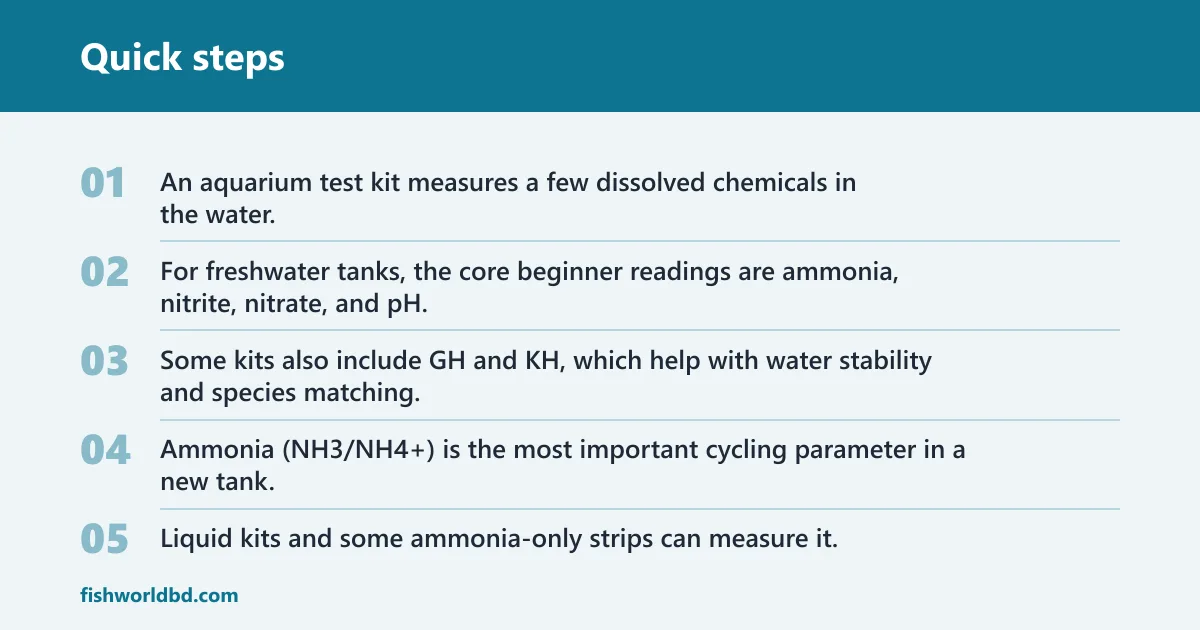
An aquarium test kit measures a few dissolved chemicals in the water, not fish health directly. For freshwater tanks, the core beginner readings are ammonia, nitrite, nitrate, and pH. Some kits also include GH and KH, which help with water stability and species matching, but they still leave out several problems that can stress fish.
The beginner parameters
Ammonia (NH3/NH4+) is the most important cycling parameter in a new tank. Liquid kits and some ammonia-only strips can measure it, and its toxicity is generally said to rise as pH and temperature rise. Nitrite (NO2-) is the intermediate compound in the nitrogen cycle. In an established freshwater tank, it should be near zero.
Nitrate (NO3-) is the end product of that cycle. Use it to judge maintenance and water-change needs, and manage it rather than eliminate it completely. pH measures acidity or alkalinity. It affects ammonia toxicity and biological processes, but stability matters more than chasing a perfect number.
Which water parameters matter most in a freshwater tank?
The first readings to watch are ammonia, nitrite, nitrate, and pH. If you are setting up a tank, ammonia and nitrite show whether the filter is processing waste yet. If the tank is already stocked, nitrate shows how well maintenance is keeping up. pH matters because it changes how toxic ammonia can be.
Why these numbers come first
Fish react to the chemistry around them long before a tank looks dirty. Clear water can still contain harmful ammonia or nitrite. A tank can look stable and still be wrong for the fish if pH swings hard, if nitrate climbs, or if mineral levels do not suit the species.
Why does ammonia matter more than the other readings for a new tank?
Ammonia matters most early because it is the first waste product that builds up before the biological filter is ready. In a cycling tank, ammonia may rise before nitrite appears, then nitrite rises before nitrate becomes the main reading. A new tank is not safe just because the water looks clean.
Why ammonia changes fast
Ammonia is the parameter most likely to hurt fish during cycling. Its toxicity depends on pH and temperature, so the same reading can be more dangerous in one tank than another. That is why a “low” number is not always low enough if pH is high.
Say your 20-gallon tank shows 0 ammonia one day, then 0.5 ppm the next after a heavier feeding. That small rise matters more than the clear water does, because the filter is still catching up to the waste load.
What’s the difference between ammonia, nitrite, and nitrate tests?
These three tests track different steps of the nitrogen cycle. Ammonia comes first and is the most toxic to fish. Nitrite appears next and is a key sign of an uncycled or disrupted tank. Nitrate comes after that and is usually the final product that maintenance removes with water changes.
How each one behaves in a tank
- Ammonia: first warning in a new or stressed tank; should stay at zero in a mature, stocked tank.
- Nitrite: dangerous to fish and should be near zero in an established freshwater tank.
- Nitrate: usually rises as the tank matures and is controlled with routine water changes.
AquariumsWorld notes that ammonia and nitrite are dangerous to fish, while nitrate is generally managed by maintenance. That is the practical order to remember when a result looks off.
Why nitrate is managed, not driven to zero
Nitrate is the signal that waste has made it through the first part of the cycle. Many tanks will always produce some nitrate. The goal is to keep it from climbing too high for the species you keep, not to chase an impossible zero unless your setup specifically calls for it.
How do pH, GH, and KH affect aquarium water quality?
pH, GH, and KH do different jobs. pH affects how acidic or alkaline the water is, which changes ammonia toxicity and many biological processes. GH measures dissolved mineral content and matters when matching tap water to species needs. KH measures buffering capacity and helps resist sudden pH swings.
Why pH stability matters
Do not treat pH as a number to chase. A steady pH that fits the fish is better than a perfect number that keeps changing. A tank with unstable pH can stress fish even when ammonia and nitrite are low, because chemistry shifts make the water harder on gills and internal regulation.
Why GH and KH still matter
GH is useful when you want to match tap water to the needs of livebearers, tetras, cichlids, or shrimp kept in freshwater systems. KH matters where pH stability is a concern. If KH is too low, pH can swing more easily after feeding, stocking changes, or filter disruption.
Picture a planted 29-gallon tank with soft tap water and a fish species that prefers harder water. The ammonia and nitrite may read zero, yet the fish may still struggle because the mineral balance is wrong for long-term comfort.
Aquarium test matrix
This matrix turns common readings into a plain interpretation. It is not a diagnosis by itself. Use it with fish behavior, stocking level, feeding, and recent changes to the filter or water change routine.
| reading/condition | what it usually means |
|---|---|
| 0 ammonia + 0 nitrite + rising nitrate | The nitrogen cycle is working, and the tank is producing waste that the filter is processing. Nitrate is accumulating, so maintenance and water changes are due. What this does not rule out: low oxygen, overfeeding residue, or a stocking level that is still too high. |
| Any detectable nitrite in a stocked tank | The tank is likely uncycled, disrupted, or overloaded. Nitrite should be near zero in an established freshwater tank. What this does not rule out: a recently changed filter, a dead biological stage in the filter, or hidden stress from poor oxygen levels. |
| Ammonia present with unstable pH | This is a higher-risk situation because ammonia toxicity can increase as pH rises or swings. What this does not rule out: a filter that is partly working, a new tank still cycling, or a second problem such as overfeeding that keeps adding waste. |
| Clear water but fish gasping | The water can look clean and still be unsafe. Gasping often points to low oxygen, ammonia stress, nitrite stress, or another issue that hobby kits do not show well. What this does not rule out: overnight oxygen drop, surface agitation problems, or dissolved waste. |
| Strip kit that does not test ammonia | The strip may look reassuring while missing the most important reading for a new tank. Many common multi-strips omit ammonia entirely. What this does not rule out: cycling problems, toxic ammonia spikes, or a tank that is still unsafe even with “good” strip results. |
Do strips and liquid kits give the same answer?
No. Liquid reagent kits use a drop-based color change and usually give better resolution, especially in cycling tanks where small shifts matter. Test strips are faster, but their color bands are broader and many common multi-strips do not test ammonia. That makes strips useful for quick checks, not for every decision.
Liquid reagent kits versus test strips
Liquid kits are slower, but they are typically more precise. Strips are convenient for routine checks and can help spot a broad problem fast. Aquarium Source says the Tetra strips can test in 60 seconds, and common Tetra EasyStrips 6-in-1 do not include ammonia, which is a major limit for new tanks.
API Freshwater Master Test Kit covers five parameters, including ammonia, nitrite, nitrate, pH, and high-range pH, and it is described as providing over 800 tests. That makes it a broader starter option when you need to follow a cycling tank closely.
Why many strip kits omit ammonia
Ammonia testing is more chemistry-sensitive than many strip formats can handle well in a fast dip-and-read setup. That is why many general-purpose strips leave it out. If you keep a new tank, a strip kit that omits ammonia can miss the reading you most need.
Why color cards can be hard to read
Color matching is a weak point for both formats, but it is especially tricky with strips because the bands are broad. Lighting, timing, and wetness can change how the card looks. If a reading sits between colors, treat it as uncertain and retest before acting.
When numbers look fine but fish still struggle
Fish behavior is the reality check. If fish are gasping, hiding, clamped up, or lethargic, do not trust the kit alone. Clear water and acceptable numbers do not rule out low oxygen, dissolved organic waste, or another stressor that hobby kits usually cannot measure.
Behavior to watch
- Gasping at the surface: often points to oxygen stress or a chemistry problem that needs immediate attention.
- Clamped fins: a common sign of stress, even when a test card looks normal.
- Hiding more than usual: can mean the tank is stressful, crowded, or unstable.
- Lethargy: often signals something is wrong before chemistry changes become obvious.
Hidden problems kits may miss
Oxygen and dissolved organic waste are common blind spots. Oxygen stress can worsen overnight or after overfeeding, especially in warm water or tanks with poor surface movement. Dissolved waste can also irritate fish before the simple nitrate reading looks alarming. The same source notes that a mature aquarium can still develop problems after filter failure, death, overfeeding, or replacing biological media.
How to use a test kit in a freshwater tank
Use a test kit during cycling, after any major change, and whenever fish behavior changes. In a new tank, test often enough to see the ammonia and nitrite curve. In an established tank, test when you change the filter, add fish, clean heavily, miss a water change, or notice stress.
- Test ammonia, nitrite, nitrate, and pH first.
- Add GH and KH if you need species matching or pH stability checks.
- Compare the result with fish behavior, not just the color card.
- If ammonia or nitrite is detectable, act before adding more fish.
- If numbers look normal but fish are gasping or fading, check oxygen movement, waste buildup, and recent changes.
A common first-timer mistake is to see clear water and a neat color card, then stop testing. A better habit is to test after feeding changes, filter changes, new stock, and any unexplained behavior. That is how the numbers become useful.
Frequently asked questions
What does an aquarium test kit actually measure?
It measures dissolved water chemistry, not fish health directly. The most useful beginner readings are ammonia, nitrite, nitrate, pH, and sometimes GH and KH. Those numbers help you see whether the tank is cycling, stable, and suitable for the fish, but they do not reveal every stressor in the water.
Can a test kit say water is safe when fish are still stressed?
Yes. Kits can miss low oxygen, dissolved organic waste, or a recent problem that has not changed the basic chemistry much yet. Fish behavior matters here. Gasping, hiding, clamped fins, or lethargy should override a reassuring strip or liquid reading until you find the cause.
Why do some aquarium test strips not test ammonia?
Many strip kits are built for speed and convenience, and ammonia is harder to include in a fast multi-parameter format. That is why common multi-strips can omit it entirely. If you are cycling a tank, a strip without ammonia is incomplete for the most important early reading.
What can aquarium test kits miss?
They can miss oxygen stress, dissolved organic waste, and some fast-changing problems after overfeeding or filter disruption. They also do not tell you whether fish are already in distress. Use the kit as a chemistry screen, then confirm with behavior, recent tank changes, and basic husbandry checks.