
How Often Should You Test Aquarium Water With a Kit?

For most freshwater tanks, test ammonia and nitrite daily during cycling, then weekly in new or unstable tanks and monthly in mature, stable tanks; test anytime fish act stressed, die, or after a major change. Skipping testing can let ammonia or nitrite spike before fish loss or algae problems become obvious. This guide gives a parameter-by-parameter schedule for weekly, monthly, and immediate water testing.
Why testing schedule matters
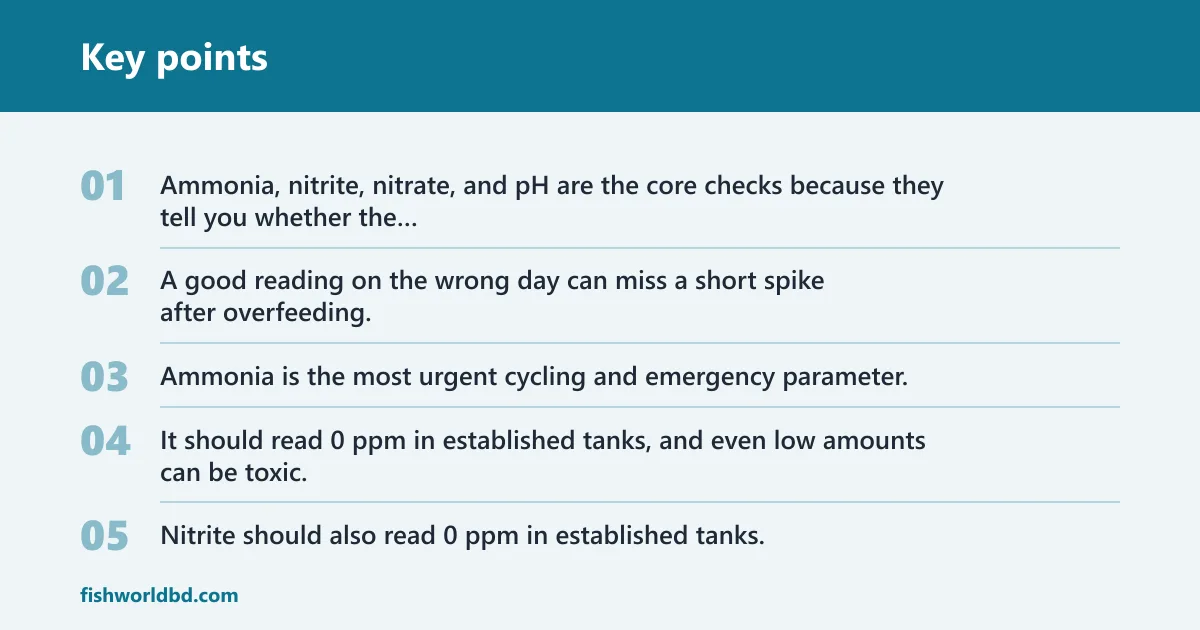
Clear water can still be unsafe. Ammonia, nitrite, nitrate, and pH are the core checks because they tell you whether the tank is cycling, stable, or drifting out of range before fish show obvious stress.
Timing matters as much as the result. A good reading on the wrong day can miss a short spike after overfeeding, a filter failure, or a new fish addition.
Ammonia is the most urgent cycling and emergency parameter. It should read 0 ppm in established tanks, and even low amounts can be toxic. Nitrite should also read 0 ppm in established tanks. If nitrite appears, the biofilter is not fully handling waste yet.
Nitrate is the end product of the nitrogen cycle. In established tanks, it is commonly checked weekly because rising nitrate can drive algae and stress. pH is different: it should stay stable rather than be adjusted often, because swings can stress fish and can change how toxic ammonia becomes.
Core rule for timing
Test before routine water changes, not after. That gives you a real reading of what the tank needs, and it helps you confirm whether your change or correction actually moved the numbers in the right direction.
Use liquid reagent kits for primary testing. They use drops in a tube and are more accurate than test strips. Strips are faster and easier, but they are better for rough checks than for deciding whether a tank is safe.
Water testing schedule matrix
This schedule separates tank stage, parameter, and action. Use it as your default plan, then move to immediate testing when something changes.
| Tank stage | Parameter | Test frequency | Trigger events | Test now or wait? |
|---|---|---|---|---|
| Cycling | Ammonia | Every 2–3 days | New setup, added food, added fish, filter change, cloudy water | Test now |
| Cycling | Nitrite | Every 2–3 days | After ammonia begins to fall, during any visible fish stress | Test now |
| Cycling | Nitrate | Weekly once it begins to appear | Later in cycle, after ammonia and nitrite are no longer spiking | Wait if still early; test now once nitrate is expected |
| Cycling | pH | At setup, then periodically | Before stock, after source-water changes, after a correction | Test now if pH is suspected to be unstable |
| Newly stocked | Ammonia | Daily for the first week after adding a new fish | New fish, heavier feeding, filter adjustment | Test now |
| Newly stocked | Nitrite | Every 2–3 days for the first stretch after stocking | Any sign of stress, reduced feeding, gill irritation | Test now |
| Newly stocked | Nitrate | Weekly | After stocking changes, before water change | Test now |
| Established | Ammonia | Monthly, or immediately if something seems off | Fish stress, death, filter cleaning, medication, overfeeding | Usually wait for monthly check; test now if triggered |
| Established | Nitrite | Monthly, or immediately if something seems off | Filter disruption, new fish, cloudy water, odd behavior | Usually wait for monthly check; test now if triggered |
| Established | Nitrate | Weekly | Routine maintenance, before water changes, after extra feeding | Test now |
| Established | pH | Monthly or when stability is questioned | Source-water change, new fish, unexplained stress | Test now if you suspect drift |
| Troubleshooting | Ammonia | Immediately, then daily until stable | Fish gasp, die, act lethargic, or after a filter issue | Test now |
| Troubleshooting | Nitrite | Immediately, then daily until stable | Recent stock loss, filter disruption, or an incomplete cycle | Test now |
| Troubleshooting | Nitrate | Immediately, then after correction | Heavy feeding, missed water changes, algae surge | Test now |
| Troubleshooting | pH | Immediately, then after correction | New substrate, tap-water change, unexplained stress | Test now |
| Any stage | Hardness | At setup and periodically | New source water, breeding goals, repeated pH drift | Test now if conditions changed |
How to read the matrix
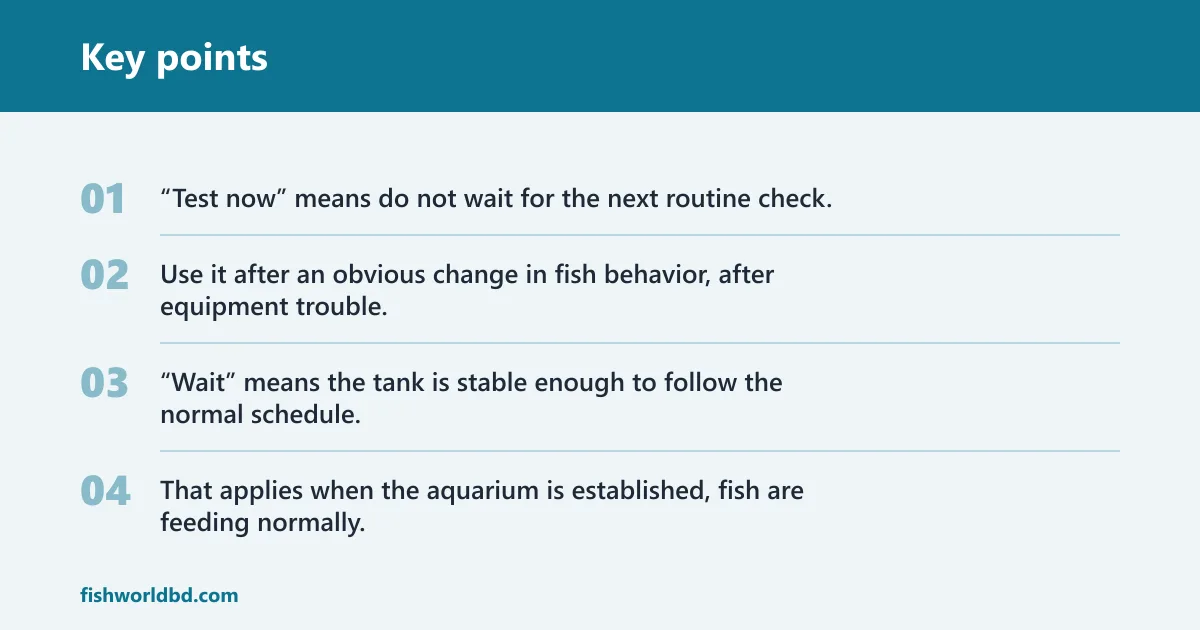
“Test now” means do not wait for the next routine check. Use it after an obvious change in fish behavior, after equipment trouble, or after a correction that could have shifted water chemistry.
“Wait” means the tank is stable enough to follow the normal schedule. That applies when the aquarium is established, fish are feeding normally, and your last readings matched the expected range.
How often should you test in a new aquarium?
In a new aquarium, test much more often because the biofilter is still forming and ammonia or nitrite can rise fast. During cycling, ammonia and nitrite are tested every 2–3 days, and nitrate is added later once the cycle begins to mature.
That frequency is not overkill. It is the only practical way to catch the middle stage of the nitrogen cycle, when ammonia starts falling but nitrite can still climb.
Once ammonia and nitrite stay at 0 ppm without repeated intervention, you can slow down. A stable setup can move toward weekly checks, then monthly full-panel testing once the tank is mature and steady.
When a new tank needs immediate testing
Say your 20-gallon tank was set up five days ago and two small fish were added yesterday. If one fish starts gasping near the surface, test ammonia right away and test nitrite the same day. Do not wait for the next planned check.
Test again after any correction. If you changed water, reduced feeding, or adjusted filtration, retesting confirms whether the tank actually improved.
How often should you test in an established aquarium?
In an established aquarium, test less often than in a new tank, but do not skip testing entirely. Nitrate is tested weekly in established tanks, and the full panel is tested monthly. That pattern catches slow drift before fish show stress.
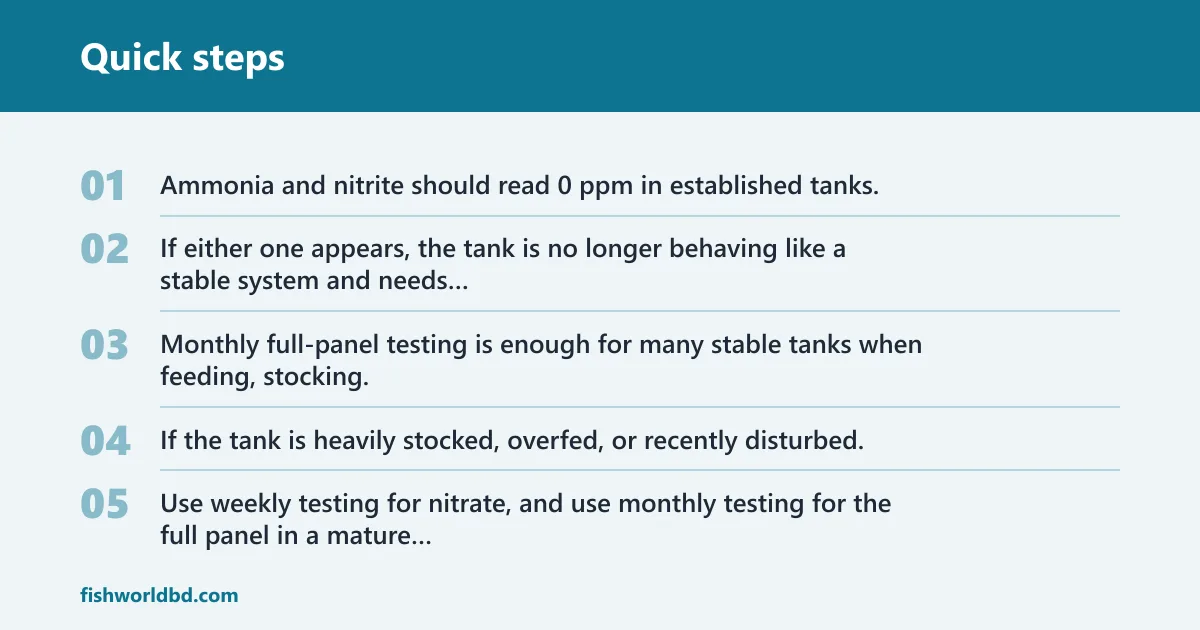
Ammonia and nitrite should read 0 ppm in established tanks. If either one appears, the tank is no longer behaving like a stable system and needs immediate follow-up.
Monthly full-panel testing is enough for many stable tanks when feeding, stocking, and filtration stay consistent. If the tank is heavily stocked, overfed, or recently disturbed, move back to immediate testing until values settle again.
Weekly or monthly?
Use weekly testing for nitrate, and use monthly testing for the full panel in a mature tank. That split works because nitrate changes more predictably, while ammonia and nitrite usually remain at zero unless something interrupts the biofilter.
Picture a 55-gallon community tank that has been stable for months. If the fish are active and the filter is unchanged, a weekly nitrate check and a monthly full panel are usually enough. If the filter is cleaned too aggressively, switch to immediate ammonia and nitrite checks.
How often should you test after adding fish or changing the tank?
After adding new fish, test much more often than normal. Ammonia should be tested daily for the first week after a new fish is added, because extra waste can push a stable tank out of range before the filter catches up.
After filter work, heavy feeding, medication, or a fish death, test immediately. Those events can change waste processing, oxygen demand, or bacterial load fast enough to make the next routine check too late.
After a big change, do not rely on a single reading. Retest after the correction so you know whether the tank recovered or whether another adjustment is needed.
Common trigger events
- Adding a new fish
- Cleaning or replacing filter media
- Overfeeding for several days
- Medication use
- A fish death
- Cloudy water after maintenance
- Strong surface breathing or clamped fins
When should you test before and after water changes?
Test before routine water changes. That tells you how much nitrate has built up and whether ammonia or nitrite has drifted from zero. If the numbers are off, you can adjust the change before more waste stays in the tank.
Retest after corrections when the original result was abnormal. If a water change, medication, or filter fix was meant to solve a problem, a follow-up reading shows whether the tank actually moved back to safe values.
If values do not move as expected, suspect the test kit first, then the tank. Expired reagents, poor storage, dirty tubes, or skipped instructions can create inconsistent results.
What to do when readings look wrong
- Check the expiration date on the reagents.
- Make sure the kit was stored dry and at room temperature unless the label says otherwise.
- Follow the manufacturer instructions and color chart exactly.
- Repeat the test with a fresh sample.
- If the result still looks abnormal, treat it as real and retest after correction.
How often should you test aquarium water if you use test strips?
If you use test strips, keep the same schedule, but treat the result as a rough check rather than your primary decision point. Strips are faster and easier, yet they are less accurate than liquid reagent kits, so they are better for screening than for final calls.
That means a strip can help you spot a possible problem, but a liquid kit should confirm ammonia, nitrite, nitrate, and pH before you act on a borderline reading.
If a strip suggests trouble during cycling, after adding fish, or after a filter issue, test again with a liquid kit the same day. Do not stretch the interval just because the strip was convenient.
When strips are acceptable
Strips are acceptable for quick checks when the tank is already stable and you want a rough trend. They are not the best choice for cycling tanks, for post-change troubleshooting, or for any moment when ammonia or nitrite could be rising.
Follow the manufacturer instructions and color chart every time. For any kit type, expired or poorly stored reagents can give misleading results.
Frequently asked questions
How often should I test my aquarium water with a kit?
For a stable freshwater tank, test nitrate weekly and do a full-panel check monthly. Test more often during cycling, after adding fish, or whenever fish act stressed. If you see an unusual reading, retest after the correction instead of waiting for the next routine date.
How often should I test water in a new aquarium?
During cycling, test ammonia and nitrite every 2–3 days. Add nitrate once it starts appearing later in the cycle. If fish are already in the tank, move to daily ammonia checks for the first week after stocking and keep watching nitrite closely.
How often should I test ammonia and nitrite in a cycled tank?
In a cycled, established tank, ammonia and nitrite should stay at 0 ppm. Test them monthly as part of a full panel, and test immediately if you add fish, clean the filter heavily, overfeed, or see stress. Any reading above zero needs attention.
Do I need to test before water changes?
Yes. Test before routine water changes so you know the starting point, especially for nitrate. If ammonia or nitrite is present, you need that information before you change water so you can judge whether the tank is stable or slipping out of range.
How often should I test after adding new fish?
Test ammonia daily for the first week after adding a new fish. That is the clearest way to catch a waste spike early. Keep an eye on nitrite during the same period, because the biofilter may not keep up right away with the added load.
How often should I test if my fish look stressed?
Test immediately if fish gasp, clamp fins, hide unusually, or die. Start with ammonia, nitrite, nitrate, and pH, because those are the core checks. Do not wait for a weekly or monthly schedule when the tank is already showing a problem.