How to Test Aquarium Water for pH and Why It Matters

Test aquarium water for pH with a liquid kit or fresh strips, then compare the result with your source water, KH, and fish behavior. Act on a drifting or unsuitable pH, not on one reading alone. Missed pH stress can lead to poor feeding, disease outbreaks, and sudden losses after water changes or filter problems. This guide shows how to test pH, read it with KH, and decide what to fix first.
How pH affects fish and water safety

pH measures how acidic or alkaline the water is on a 0-14 scale. Seven is generally considered neutral pH. Below 7 is acidic. Above 7 is generally considered alkaline, or basic. For most tropical fish and planted tank species, pH 6.5 to 7.5 is a common working range, but the species in the tank still set the real target.
pH matters because it affects fish stress and ammonia toxicity. A small shift can matter more than the exact number if the change is fast. That is why a stable reading often matters more than chasing a “perfect” one.
What pH does to fish health
Fish handle a range better than a swing. A tank that stays a little outside the preferred range may still do well if the change is slow and the fish are otherwise normal. A tank that moves quickly from one reading to another is more likely to cause breathing changes, clamped fins, poor feeding, and visible stress.
Why ammonia makes pH more urgent
pH changes how much toxic ammonia is present in the water. That is why a pH reading matters most when something else is already wrong, such as a new tank, a filter issue, overfeeding, or a recent water change. During cycling, ammonia and nitrite can spike while bacteria grow, so pH should be read with those risks in mind.
How do you test aquarium water for pH?
Use a liquid reagent test kit, test strips, or an electronic pH meter, then compare the result with the correct light and a clean sample. Liquid kits usually give a tighter reading than strips. Meters give precise digital readings, but they need regular calibration. The best choice depends on how exact the reading needs to be and how often you test.
Choose the right test type
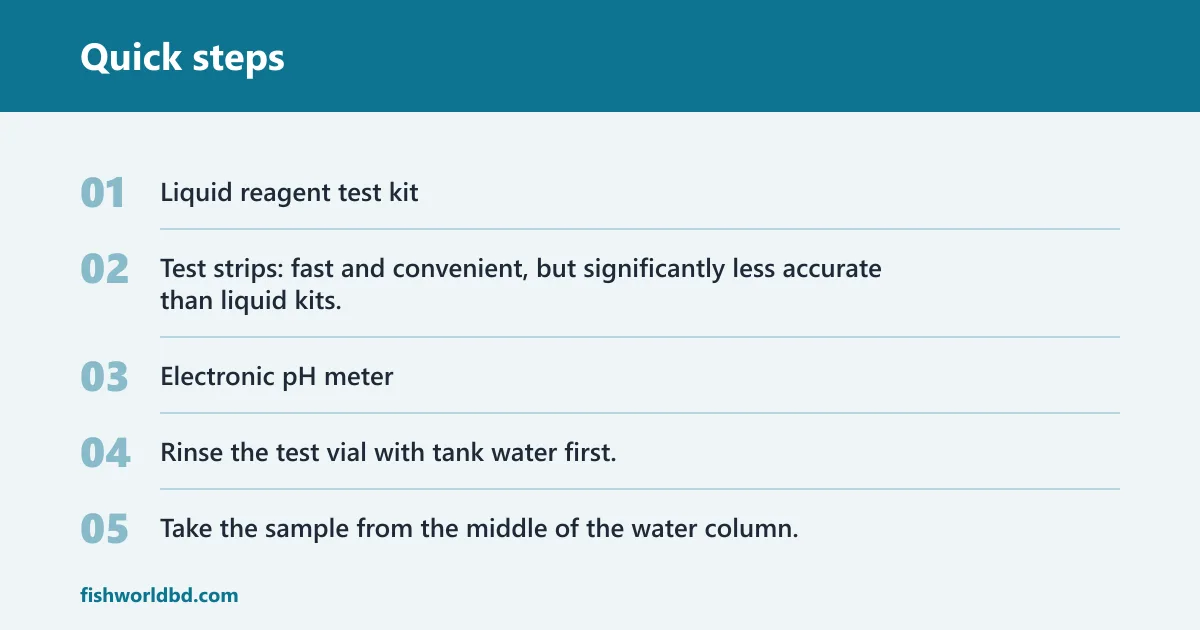
- Liquid reagent test kit: water changes color after reagents are added, then you compare it to a chart.
- Test strips: fast and convenient, but significantly less accurate than liquid kits.
- Electronic pH meter: gives a digital display and very precise readings, but needs regular calibration.
A liquid test kit can measure pH alongside ammonia, nitrite, nitrate, and high-range pH. That makes it useful when you want one kit for several tank checks.
Take a clean sample
- Rinse the test vial with tank water first.
- Take the sample from the middle of the water column.
- Avoid surface water, where gas exchange can skew the reading.
- Avoid substrate-level water, where trapped waste can change the result.
- Add the reagent or use the strip exactly as instructed.
Sampling matters. A dirty vial, leftover residue, or a sample taken right at the surface can give a reading that does not match the tank as a whole.
Read the result under proper light
Use daylight or neutral white light when comparing a color chart. Strip reading is affected by color perception, and poor room light can make a safe result look off. If the color is between two blocks on the chart, read it again under better light before changing anything.
Say your strip says pH 7.8 in a dim kitchen, but the liquid kit gives 7.2 under daylight. That mismatch is a sign to trust the better reading and retest before acting. A second method can prevent an unnecessary water change or chemical fix.
Aquarium pH checklist
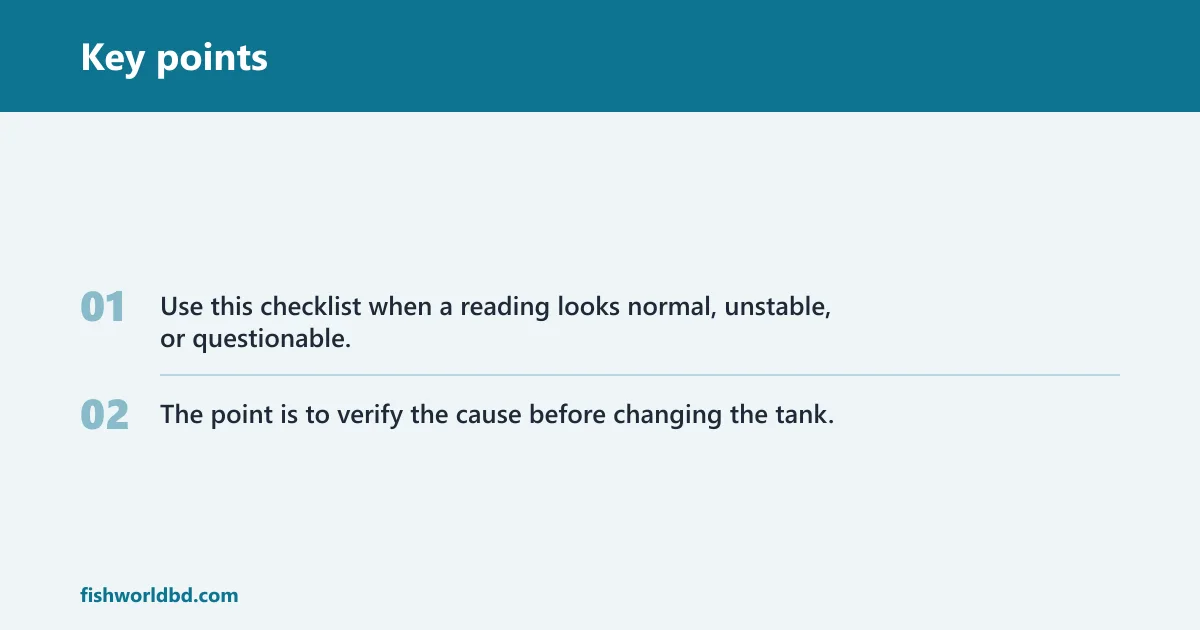
Use this checklist when a reading looks normal, unstable, or questionable. The point is to verify the cause before changing the tank.
| Symptom | Likely cause | Next test |
|---|---|---|
| pH is steady and fish act normal | Tank is likely buffered well enough for now | Log the reading, then retest on the normal schedule |
| pH is swinging between tests | Low KH or a change in source water | Test KH and retest source water before changing the tank |
| Strip reading and liquid reading do not match | Strip color misread, expired strip, or lighting problem | Repeat under daylight or neutral white light with a fresh liquid test |
| pH looks low and the tank also looks unstable | Low KH risk, often below 3 dKH | Test KH first; do not chase pH until buffering is understood |
| Tap water and tank water differ more than expected | Source water changed, or municipal treatment changed the result | Retest tap water separately before altering the aquarium |
What KH tells you about pH swings
KH, or carbonate hardness, buffers pH against sudden change. Low KH can let pH swing quickly, and below 3 dKH it is often unstable. A stable KH of 4–6 dKH is enough to buffer most aquariums. If pH is drifting, KH usually tells you more about the cause than the pH number alone.
When pH can wait and KH comes first
If fish are not showing stress and the pH is only a little outside the target, check KH before trying to “correct” the water. A tank with low KH may keep dropping or bouncing back after each water change. Fixing the buffer often matters more than adjusting pH directly.
A 20-gallon community tank that reads pH about 6.8 one day and about 7.4 the next can point to buffering trouble or a source-water shift. That pattern points to buffering trouble or a source-water shift, not a need for random additives.
How does GH fit into pH testing?
GH, or general hardness, measures calcium and magnesium. It is separate from pH. GH does not tell you whether the water is acidic or alkaline, but it matters for soft-water and hard-water species that need a certain mineral level to do well.
Why GH is not a pH fix
Do not use GH as a control knob for pH. It is a different measurement. A fish can live in the correct pH with the wrong GH, or the correct GH with the wrong pH. Soft-water species and hard-water species often need different targets, so both readings belong in the same test routine.
Should you test tap water too?
Yes. Source water can differ from tank water, and it can change seasonally. Municipal treatment changes can also affect aquarium pH. Testing tap water separately helps you tell whether the tank changed on its own or whether the source water changed first.
Why source-water checks prevent guesswork
If tap water comes in at a different pH than last month, the aquarium may be following that shift. If the tap is stable but the tank is not, the tank itself is usually the issue. Retest source water before changing the aquarium chemistry so you do not correct the wrong problem.
How often should you test aquarium pH?
For established tanks, testing once a week or every one to two weeks is commonly recommended. New tanks need more frequent checks, especially during cycling, because ammonia and nitrite can spike while bacteria grow. Test more often if fish are stressed, if water changes are large, or if the source water has changed.
What to record in an aquarium log
Keep a simple log with the date, the parameter, the reading, and any trend you notice over time. That record helps you spot slow drift, repeatable swings after water changes, and changes linked to tap water. A few lines in a notebook are often enough.
- Date
- pH reading
- KH reading
- GH reading
- Source-water reading
- Fish behavior notes
Frequently asked questions
What is the best way to test aquarium pH?
A liquid reagent kit is usually the best balance of accuracy and cost for most keepers. It is more accurate than strips, and one kit can often measure ammonia, nitrite, nitrate, and high-range pH too. Use a meter only if you will calibrate it regularly.
Should I use test strips or liquid kit for pH?
Use strips if you need a quick check, but do not treat them as the final word. They are fast and convenient, yet significantly less accurate than liquid kits. If the reading matters for a problem tank, verify it with liquid testing under proper light.
What pH is safe for fish tanks?
There is no single safe pH for every tank. Many tropical fish and planted tank species do well between pH 6.5 and 7.5, but species needs matter more than a generic target. Stability and consistency with KH usually matter more than forcing a perfect number.
Why does pH matter in an aquarium?
pH affects fish stress and ammonia toxicity, so it matters even when the number looks only slightly off. A stable reading within the species’ range is usually better than a perfect number that swings. That is why KH, source water, and behavior all belong in the same check.