Aquarium Sizes Chart: Standard Tank Dimensions

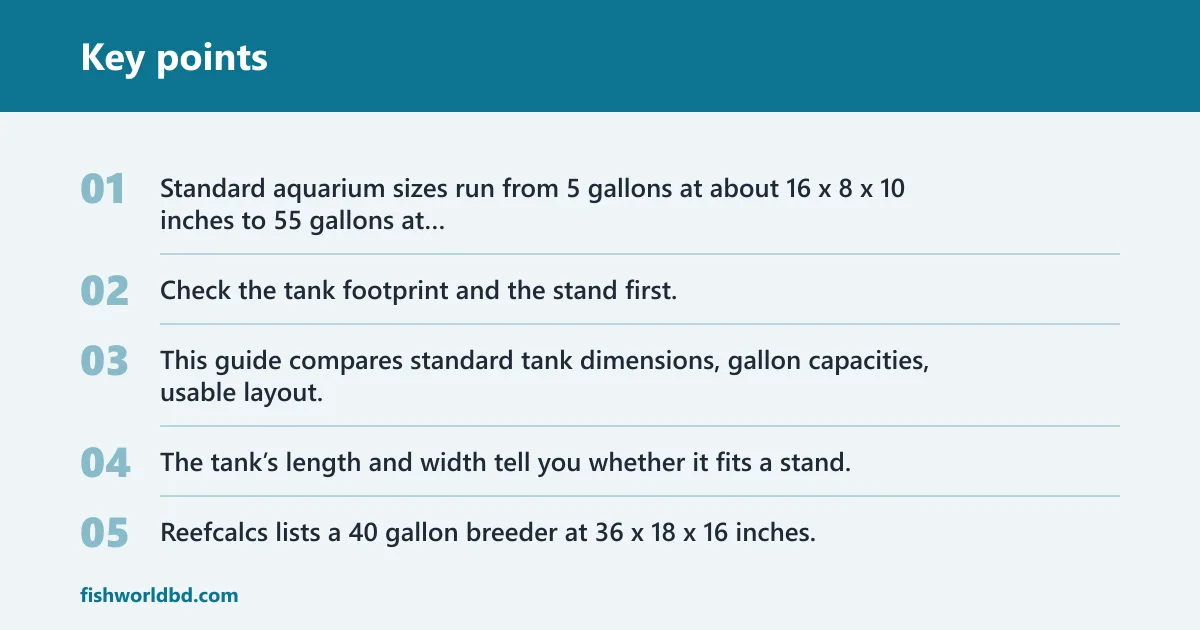
Standard aquarium sizes run from 5 gallons at about 16 x 8 x 10 inches to 55 gallons at about 48 x 13 x 20 inches. Check the tank footprint and the stand first, since those dimensions decide fit in the room, clearances through doorways, and how the load sits on the floor. This guide compares standard tank dimensions, gallon capacities, usable layout, and support risk.
Many buyers start with the gallon label. That order causes problems. The tank’s length and width tell you whether it fits a stand, whether two people can move it through a doorway, and how the weight spreads across the floor.
Common tank dimensions and capacities
| Common label | Nominal L x W x H | Footprint | Filled weight | Empty weight | Notes |
|---|---|---|---|---|---|
| 10 gallon | 20 x 10 x 12 inches | 200 sq in | 111 lb | Varies by brand | Compact footprint, useful for a small stand or desk-sized setup. |
| 20 gallon long | 30 x 12 x 12 inches | 360 sq in | about 225 lb | Varies by brand | More floor space than a taller 20-gallon variant; common starter choice. |
| 40 gallon breeder | 36 x 18 x 16 inches | 648 sq in | Varies by chart | Varies by brand | Wide layout gives more usable bottom area than a narrow 55. |
| 55 gallon | 48 x 13 x 21 inches | 624 sq in | about 625 lb | Varies by brand | Tall enough for a larger water column, but the footprint is narrow. |
| 75 gallon | 48 x 18 x 21 inches | 864 sq in | Varies by chart | Varies by brand | Same length as a 55, but much deeper from front to back. |
Those figures are nominal. Reefcalcs lists a 40 gallon breeder at 36 x 18 x 16 inches, while AquAnswers lists it at 36.25 x 18.25 x 17 inches. That small spread matters when you check a cabinet opening or a tight stand top.
Reefcalcs also notes that labeled gallons are rounded and actual water volume is about 10% less. That explains why two tanks with the same label can hold different amounts of water once glass thickness, trim, and internal space are factored in.
Why aquarium footprint matters more than gallons
Footprint is the length and width of the tank. Those two numbers tell you more about fit, working room, and load spread than the gallon label does. Height matters too, but mostly after the tank already fits the stand and the room.
Length and width versus tank height
A long, low tank gives fish more horizontal swimming space and more room for hardscape. A tall, narrow tank puts more water above the substrate, but that extra height does little for fish that move across the bottom or midwater.
Surface area also matters. Fishstores says surface area affects oxygenation and bottom-dweller territory. A wider top can exchange gas better and gives bottom fish more floor to use. That is one reason a breeder-style tank often feels easier to arrange than a tall narrow box of the same label.
Why two equal-gallon tanks can feel very different
Compare two 20-gallon tanks. One is long, and one is taller. The gallons may be similar, but the long tank gives more uninterrupted floor space for schooling fish and simpler aquascaping. The taller tank can feel cramped at the bottom even though the label matches.
A common first-timer mistake is to buy by gallon label, then discover that the stand is only 29 inches wide. A 30-inch tank will not fit well on that top unless the stand actually supports a slightly wider footprint.
Which aquarium size is best for beginners?
A 20 gallon long is often the safest starter size because it gives more footprint than a taller 20-gallon tank, is easier to stock sensibly, and leaves enough room for stable decor and maintenance access. The same source lists the 20 gallon Long as the most commonly recommended starter tank.
Why a 20 gallon long is often the safest starting point
The 30 x 12 x 12 format gives a beginner a stable layout without the awkward height penalty of a tall narrow tank. It is also large enough for schooling fish that need horizontal space, rather than only a small column of water.
The same source lists the 20 gallon Long at 30 x 12 x 12 inches with about 192 lb filled weight, while another chart in this guide uses about 225 lb filled. That difference is a reminder to treat filled weight as an estimate, not a single exact number. Water alone is not the whole load.
When a 40 gallon breeder makes more sense
A 40 gallon breeder is a better starter if you want more aquascaping room, a wider planting bed, or more forgiving stocking space. Its 36 x 18 x 16 footprint gives more usable floor area than a narrow tall tank, and the extra width makes planting and rock placement easier.
That wider layout is useful for fish that use the bottom and middle of the tank together. It also leaves more room for filter outflow, open swimming lanes, and a heater position that does not crowd the front glass.
Why very small tanks are less forgiving
Smaller tanks change faster. A little extra waste, a missed top-off, or a filter pause has a larger effect when the water volume is low. That is why very small standard tanks demand tighter maintenance and leave less room for error.
20 gallon long vs 20 gallon high
The 20 gallon long gives you more horizontal layout than a taller 20 gallon high, even when the gallon label is the same. For beginners, that usually means better fish movement, easier decor placement, and simpler stand matching. It is the version most buyers should compare first.
30 x 12 x 12 versus taller 20-gallon variants
The 20 gallon long measures 30 x 12 x 12 inches. That shape spreads the tank across more stand surface and gives more floor area for fish. A taller 20-gallon variant may keep the same nominal gallons, but it shifts space upward instead of outward.
That difference matters because aquarium footprint affects swimming room and oxygen exchange. If you are planning a planted community tank or a setup with schooling fish, the long shape usually gives the cleaner layout.
Usable layout, fish selection, and stand fit
A long tank is easier to plan around a hardscape bridge, open swimming lane, or a pair of planting zones. A taller tank can work for some displays, but it often limits the bottom plan before it limits water volume.
Stand fit is another reason the long shape wins. The footprint is easy to measure, and the weight is easier to spread across a broad top. That matters when the stand is a cabinet, not a dedicated aquarium frame.
When the long shape is the better buy
Choose the long tank when you want a straightforward beginner layout, a school of small fish, or a tank that has to sit on a narrower but still adequately supported stand. Choose the taller version only when the display plan needs more height than floor area.
40 gallon breeder and 55 gallon comparison
The 40 gallon breeder is the wider, easier-to-arrange option. The 55 gallon is the familiar tall rectangle, but its narrow footprint can be a drawback even though the gallon label sounds larger. In practice, the breeder often gives the more usable floor plan.
36 x 18 x 16 breeder dimensions
The same source lists the 40 gallon breeder at 36 x 18 x 16 inches. That 18-inch width is the key advantage. It creates room for rockwork, plants, and a cleaner front-to-back viewing lane than a narrow tank of similar or even larger gallon label.
48 x 13 x 21 standard 55 gallon dimensions
The 55 gallon aquarium is listed at 48 x 13 x 21 inches and about 625 lb filled. It is a popular size, but the 13-inch width leaves less room for layout and access than many buyers expect. The tank may be long, yet still feel cramped from front to back.
Space tradeoff, footprint, and weight differences
The 55 gallon gives more total water than a 40 breeder, but the breeder gives more usable bottom area per inch of height. That is why a breeder can be easier to aquascape, especially if you want open substrate and better access for cleaning.
Say your room can fit a 48-inch tank along one wall, but the stand depth is limited. The 55 gallon may fit the wall length, yet its narrow width can make the interior harder to work in. A breeder takes less wall length, but its wider body often gives a better result for the same amount of effort.
Aquarium sizes and weights guide
Filled aquarium weight is the number to plan around, not the empty glass weight alone. That total includes water, glass, substrate, and equipment. Many charts use roughly 10 to 12 lbs per gallon for a freshwater planning estimate, which is close enough for support checks and safer than guessing.
Freshwater filled weight estimates by size
Use the published filled number as a planning tool, then add a margin for substrate and decor. A 10 gallon tank is about 111 lb filled. A 20 gallon long is about 225 lb filled. A 55 gallon tank is about 625 lb filled.
The same source gives the 20 gallon Long as about 192 lb filled, which shows why charts can differ. Water label rounding, internal volume, and the exact assumptions behind substrate and glass all change the final estimate. Keep the estimate consistent across the tank sizes you compare.
Why glass, substrate, and equipment add up
Water is only part of the load. Glass panes, gravel or sand, a filter, a heater, hardscape, and a lid all add weight. That is why a “just water” number is too low for stand planning, and why a filled tank can surprise people the first time they move one.
How to use weight estimates for stand planning
- Measure the tank’s outside length and width.
- Check the stand top against that footprint, not against the gallon label.
- Use the filled-weight estimate as the minimum support number.
- Add extra margin for substrate, rocks, wood, and equipment.
- Confirm that the stand top is level and fully supported at the corners and along the frame.
How do I know if my stand and floor can support an aquarium?
Start with the footprint and the filled weight, then look at where the load will sit. A tank is safest on a dedicated aquarium stand or on furniture built to carry a wide, distributed load. For floors, the common live-load planning figure is about 40 lbs per square foot, but room layout matters as much as the number.
Apartment floors versus load-bearing walls
Residential floors are not all equal. The same source states residential floors are designed for approximately 40 lbs per square foot of live load. That is a broad planning figure, not a green light for every room. Upper floors and apartment layouts deserve more caution than a slab or a ground-level room.
For heavier tanks, placing the aquarium near a load-bearing wall is often a better choice than placing it in the middle of a span. That helps the load transfer more directly into the structure below.
Joist direction and why it matters
Joist direction affects how the load spreads. A tank that runs perpendicular to the joists usually spreads weight across more framing members than one that sits parallel to them. If you can see the joist direction, align the longest side of the tank accordingly when the room layout allows it.
When structural reinforcement is worth checking
If the tank is large, the room is on an upper floor, or the plan puts the aquarium far from a bearing wall, it is worth checking with a qualified builder or structural professional before you fill it. That is especially true for long tanks and setups that will sit on a heavy cabinet stand.
For custom tanks, a quick aquarium size calculator helps with the first pass. Multiply the outside length, width, and height in inches, then divide by 231 to estimate gallons. After that, estimate filled weight from the gallon count and the 10 to 12 lbs per gallon planning range, then compare that number to the stand and floor.
Aquarium sizes chart decision table
This table helps you choose by room constraint first, then by gallon label. Use the footprint, stand width, and support column together. A tank can be the right gallon size and still be the wrong fit for the room.
| Room constraint | Best standard format | Minimum footprint | Recommended stand width | Apartment floor | Load-bearing wall | Dedicated stand |
|---|---|---|---|---|---|---|
| Small apartment, tight walkway | 20 gallon long | 30 x 12 inches | At least 30 inches | Safer only with careful placement | Better than mid-room placement | Recommended |
| Starter planted tank with room to grow | 40 gallon breeder | 36 x 18 inches | At least 36 inches | Often manageable on lower floors | Good choice near a bearing wall | Recommended |
| Long wall, narrow cabinet top | 55 gallon | 48 x 13 inches | At least 48 inches | Higher caution because of weight | Prefer wall-backed placement | Strongly recommended |
| Large room, high confidence in support | 75 gallon | 48 x 18 inches | At least 48 inches | Usually not the first choice without floor review | Better than open-room placement | Yes |
Frequently asked questions
What are the standard aquarium sizes and dimensions?
Common standard tanks include 10 gallon at 20 x 10 x 12 inches, 20 gallon long at 30 x 12 x 12 inches, 40 gallon breeder at 36 x 18 x 16 inches, 55 gallon at 48 x 13 x 21 inches, and 75 gallon at 48 x 18 x 21 inches. Actual brand dimensions can vary slightly, so measure the tank you plan to buy.
How many gallons is a 30 x 12 x 18 aquarium?
Using the standard volume formula, a 30 x 12 x 18 inch tank holds about 28 gallons before displacement. The glass thickness, trim, substrate, and decor reduce usable water volume, so the practical amount of water is lower than the raw calculation.
What is the difference between a 20 gallon long and a 20 gallon high?
A 20 gallon long spreads the tank across more floor area, while a 20 gallon high puts more of the volume upward. The long version usually gives better swimming space, easier aquascaping, and a better fit on wider stands. The high version can work, but it is less forgiving for layout.
How much does a filled aquarium weigh by size?
A filled 10 gallon tank is about 111 lb, a 20 gallon long is about 225 lb, and a 55 gallon tank is about 625 lb. Those numbers are planning estimates that include water and the tank itself, while substrate and hardscape can push the total higher.
Why do two aquariums with the same gallons have different dimensions?
Gallons describe volume, not shape. Two tanks can hold similar water amounts while one is long and shallow and the other is tall and narrow. That shape change affects footprint, aquascaping room, surface area, and how the tank loads a stand or floor.
What is the most common standard aquarium size?
The 55 gallon is one of the most familiar standard sizes, but the most commonly recommended starter tank is often the 20 gallon long. The better “most common” choice depends on whether you mean retail popularity, beginner use, or a size that fits typical home stands and rooms.