
Best Substrate for Freshwater Planted Aquarium Options

Choose active aquasoil if your tank will hold carpeting plants or heavy root feeders, or if you want softer water. Use inert sand or fine gravel plus root tabs for epiphytes, low-demand plants, or a budget setup. The wrong substrate can slow roots, add maintenance, and push pH or hardness away from target. This guide compares planted-tank substrate options, how they differ, and which plants fit each one.
What substrate does for planted tanks
Substrate holds stems and rosettes in place, stores nutrients near the roots, and gives the plant base a stable grip. It also affects how steady the layout stays during cleaning, replanting, and filter flow. Decorative gravel alone can work in some tanks, but rooted plants usually need nutrient support or added fertilization.
Plant type changes the choice. Root feeders such as crypts and swords take up much of their nutrition through their roots. Epiphytes such as Anubias and Java fern should be tied to wood, rock, or hardscape, not buried. Carpeting plants usually do best in a nutrient-rich base or a system that keeps root access consistent.
Roots, nutrients, and anchoring
A planted tank substrate does three jobs at once. It anchors stems and rosettes, keeps nutrients near the roots, and helps the layout stay planted after water changes or maintenance. If the bottom layer is too coarse, roots slip through gaps. If it is too fine, it can compact and slow oxygen movement.
Aquasoil and other nutrient substrates feed roots directly. Inert gravel, sand, and Fluorite need a different nutrition plan, usually root tabs, water-column fertilizer, or both. That difference is why substrate choice should follow plant biology, not brand popularity.
Why plant type changes the choice
Root feeders generally need access to nutrients below the surface. Stem plants can take up more from the water column, so they are more forgiving in inert media. Epiphytes should not be buried at all, because their rhizomes need airflow and a firm attachment point. That simple split prevents many early tank failures.
Say your tank has dwarf chain swords in front, a few stem plants in back, and Java fern on driftwood. A nutrient substrate helps the swords most, but the fern should stay attached above the substrate. If the same tank used only sand, root tabs would become part of the routine.
Should you choose aquasoil?
Choose aquasoil if the tank will hold carpeting plants, heavy root feeders, or a layout that benefits from softer water. It is a nutrient-rich planted-tank substrate, supports root growth, and often lowers or stabilizes pH. The tradeoff is startup risk: all-in-one substrates can release ammonia at first use.
Best fit for carpeting and rooted plants
Aquasoil is often the strongest choice for carpet plants, crypts, swords, and other rooted species that need steady nutrition at the base. It gives the roots more than decorative support. It also helps new plantings settle faster because the substrate already contains usable nutrients near the root zone.
That advantage fades over time. Nutrients deplete, so long-running tanks often need fertilization later or substrate replacement. F9 notes that all-in-one substrates may need nutrient replacement every 12 to 18 months.
Startup ammonia and pH effects
New aquasoil can release ammonia at startup. That matters most in tanks with fish or shrimp added too early. A fishless cycle is generally the safer path when using active substrate, because it gives the biofilter time to handle that early release.
pH effects are also relevant. Aquasoil can lower pH, which may help some planted tanks and some soft-water shrimp setups, but it can also move water away from the target range if hard water is the goal. Do not assume every active substrate will suit every livestock plan.
Suppose a 60 cm aquascape uses aquasoil for a carpet of Monte Carlo and small crypts. If fish are added before the ammonia phase settles, the tank can fail before the plants establish. A short fishless start reduces that risk and gives the substrate time to stabilize.
When aquasoil is worth the cost
Aquasoil is worth the higher upfront cost when rooted plant density matters more than simplicity. It can reduce the need for root tabs at the start, but not forever. The total cost of ownership still includes later fertilizers, possible replacement, and the time needed for startup management.
Is gravel enough for a planted aquarium?
Yes, gravel can be enough for a planted aquarium if the plants are low to moderate demand and you add nutrition where roots need it. Gravel is commonly recommended for beginner fish tanks, but planted tanks need more than decorative gravel alone. In planted use, the usable grain range is 1 mm to 3 mm.
Best grain size for planted tanks
Gravel in about the 1 mm to 3 mm range can give roots more room than coarse stones while still holding plants better than very loose media. Gravel does not provide plants with needed nutrients, so it works best as a structural base, not as the nutrient source.
Very coarse gravel creates large gaps and weak root contact. Fine enough gravel supports anchoring better, but it still needs nutrition for rooted plants. That is why many planted tanks with gravel use root tabs from day one.
Root tabs and heavy root feeders
Root tabs are the simplest fix for inert gravel. Place them into the substrate near the root zone of heavy feeders such as crypts, swords, and similar rooted plants. The goal is to put nutrients where roots can reach them, instead of hoping the water column will do all the work.
If the tank is mostly stem plants or epiphytes, gravel can be a clean and practical choice. If the layout depends on lush root feeders, gravel alone is not enough.
When gravel beats nutrient substrates
Gravel can beat aquasoil when the tank goal is long-term stability, lower startup risk, or simple maintenance. It is easy to keep clean, does not usually release ammonia, and is less likely to alter pH. That makes it a better fit for many beginner setups and mixed community tanks.
When sand works better
Sand works well when the layout should look natural and the goal is simple shaping rather than heavy root feeding. It is inert, so it does not feed plants on its own. Fine grain sand can compact, form anaerobic pockets, and cut off roots’ access to nutrients, so it needs careful use.
Natural look and layout control
Sand gives a smooth foreground and clean visual transitions. It also makes slopes and open areas easier to shape than irregular gravel. That is useful in shrimp tanks, river-style layouts, and tanks that rely on rock or wood for structure.
Because sand is inert, it often pairs with root fertilization. Many planted tanks use it successfully for lower-demand plants, but rooted species still need nutrients delivered another way.
Compaction, cleaning, and root feeding
Sand can compact and cut off roots’ access to nutrients. Fine grain sand can also form anaerobic pockets if detritus settles and water movement is weak. That means you may need stronger filtration, more careful cleaning, or periodic surface stirring in open areas.
Do not bury deep root feeders in sand and then ignore the nutrient side. Root tabs work well here, especially under crypts or swords planted in open patches.
Mixing sand with plants safely
Sand works best when used with controlled planting zones. Keep deep root feeders in contained pockets or mixed sections, and avoid letting heavy waste build up across the whole base. For very dense planting, many aquarists prefer a nutrient layer below sand rather than sand alone.
Fluorite and other inert media
Fluorite is an inert aquarium substrate that suits planted tanks when you want a planted look without active-soil chemistry. It can be mixed with gravel, sand, or dirt, and it often pairs well with root tabs. Its job is support and surface area, not direct feeding.
What inert planted substrates do well
Inert media are predictable. They do not act like nutrient soil, so they are easier to plan around for hard-water tanks, shrimp setups, or layouts that should stay chemically stable. They also work well when the aquarist prefers to control nutrients through fertilizer dosing rather than through the substrate.
Fluorite can be a good middle ground between plain gravel and active aquasoil. It still needs external nutrition for demanding rooted plants, but it gives a planted layout more purpose than decorative stone alone.
Dust, rinsing, and root tabs
Fluorite should be rinsed well because it is dusty. Rinsing reduces clouding during setup and makes the first fill easier to manage. Once planted, it often works best with root tabs placed near heavier feeders.
That same approach applies to other inert media. Rinse dusty substrate before use, then feed the root zone directly instead of relying on the substrate to supply everything.
Decision matrix for substrate choices
This matrix ties substrate choice to plant biology and maintenance style. It also shows the hidden cost side: root tabs, fertilizers, and replacement all matter. Use it to match the bottom layer to the tank goal, not to the most popular product label.
| Tank scenario | Best substrate type | Required supplements | Risks | Startup steps |
|---|---|---|---|---|
| Beginner low-tech | Fine gravel or inert sand | Root tabs for rooted plants | Underfeeding roots if tabs are skipped | Rinse well, plant lightly, add tabs near root feeders |
| Carpet tank | Aquasoil | Basic water-column fertilizer later | Ammonia release at first use | Fishless cycle, plant densely, monitor early water changes |
| Shrimp tank | Inert sand or stable gravel | Targeted root tabs, if needed | pH shift from active substrate can affect compatibility | Rinse substrate, avoid abrupt chemistry changes |
| Cichlid-safe planted tank | Inert gravel | Root tabs for rooted plants | Mineral substrate may raise pH and hardness | Choose stable media, keep plants attached or rooted securely |
| Budget tank | Gravel 1 mm to 3 mm | Root tabs | Long-term fertilizer cost if tabs are ignored | Rinse, plant, insert tabs near swords, crypts, and similar plants |
| High-tech aquascape | Aquasoil | CO2 and fertilizer routine | Nutrient depletion over time | Fishless cycle, heavy planting, monitor algae during startup |
| Established tank rescape | Reuse old inert media or refresh with aquasoil pockets | Root tabs and liquid fertilizer | Clouding, root damage, nutrient shock | Remove waste, replant quickly, cap nutrient pockets if used |
| Sand-based layout | Fine sand with planted pockets | Root tabs under heavy feeders | Compaction and anaerobic pockets | Keep the bed shallow in open areas and clean the surface carefully |
How to read the tradeoffs
If the tank depends on rooted plants, nutrient substrate or root tabs matter more than appearance alone. If the goal is a low-maintenance shrimp or community tank, inert media can be the better choice. If pH control matters, test before and after setup rather than assuming the substrate will behave a certain way.
How to layer substrate safely
Layering works when you want nutrient storage below and a cleaner surface above. A nutrient-rich lower layer with a top cap can support rooted plants while reducing nutrient washout into the water. Common planted-tank depth is about 2 to 2.5 inches overall, with the lower planted layer about 1 to 2 inches high.
Nutrient-rich lower layer plus top cap
The lower layer feeds roots. The top cap, usually sand or gravel, anchors plants and reduces nutrient release into the water. That cap also helps keep the layout tidy during maintenance. The key is not to make the nutrient layer too thick or too exposed.
Use a cap that stays in place during planting and water changes. If the cap is too thin, nutrients can wash out. If it is too thick and dense, roots may struggle to move through it.
Depth targets for common layouts
For most planted tanks, 2 to 2.5 inches is a practical total depth. The lower planted layer should be about 1 to 2 inches high when using a layered setup. Shallow foregrounds can be thinner, while rooted background plants often need more depth.
Keep the back deeper than the front if you want slope and better root space. That gives tall plants more room and makes the layout look stronger from the front glass.
A simple startup sequence
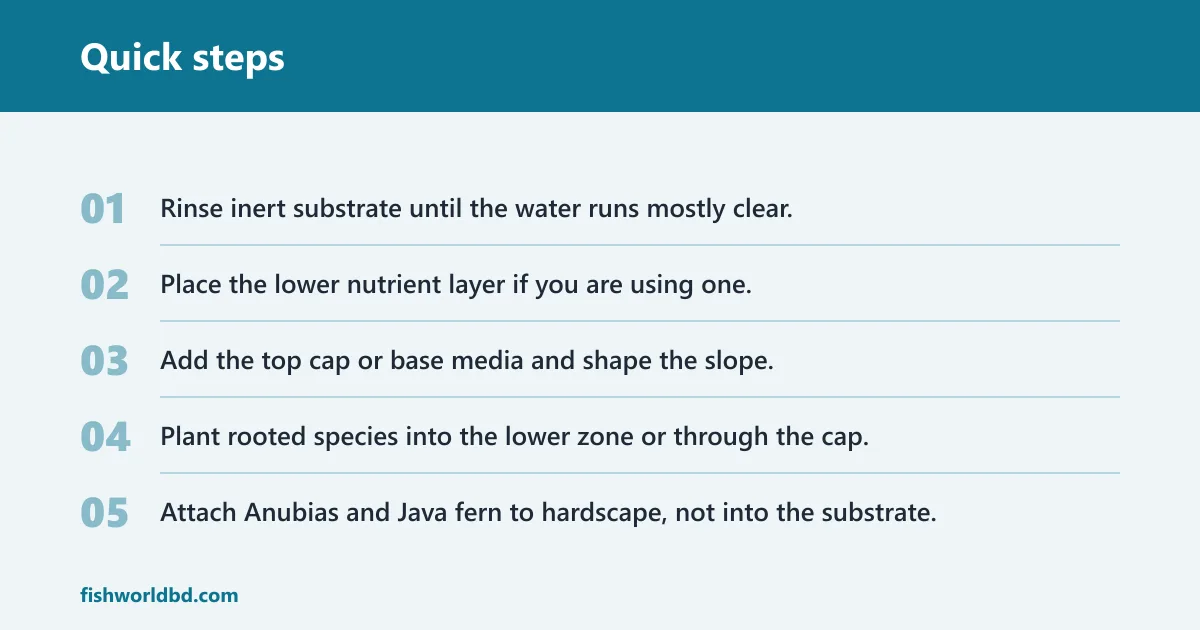
- Rinse inert substrate until the water runs mostly clear.
- Place the lower nutrient layer if you are using one.
- Add the top cap or base media and shape the slope.
- Plant rooted species into the lower zone or through the cap.
- Attach Anubias and Java fern to hardscape, not into the substrate.
- Add root tabs near heavy feeders if the substrate is inert.
- Start filtration and watch for clouding, compaction, or ammonia if using active aquasoil.
A common first-timer mistake is burying an Anubias rhizome in sand because the plant looks like it belongs in the bed. The leaves may stay green for a while, but the rhizome can rot. Attachment to wood or stone avoids that problem.
Frequently asked questions
What is the best substrate for a freshwater planted aquarium?
The best substrate depends on the plants and your maintenance style. Aquasoil is usually the strongest choice for rooted plants and carpeting plants. Inert sand or fine gravel can be better for epiphytes, budget tanks, shrimp tanks, or layouts where you want stable chemistry and are willing to add root tabs.
Should I use aquasoil, gravel, or sand for planted tanks?
Use aquasoil if you want built-in nutrition and easier root feeding for demanding plants. Use gravel if you want a simple, stable base that is easy to maintain and can be upgraded with root tabs. Use sand if you want a natural look and are prepared to manage compaction and root fertilization.
Can live aquarium plants grow in regular gravel?
Yes, live plants can grow in regular gravel, but the gravel itself does not provide needed nutrients. For planted tanks, usable gravel is usually 1 mm to 3 mm. Root tabs become important for heavy root feeders such as swords and crypts, while epiphytes should be attached to hardscape.
Do I need root tabs with inert substrate?
Usually, yes, if you keep rooted plants in inert substrate. Root tabs place nutrients near the roots where gravel or sand cannot provide them. They are most useful for swords, crypts, and similar plants. If the tank is mostly stem plants or epiphytes, the need is lower.
Which substrate is best for carpeting plants?
Aquasoil is often the best substrate for carpeting plants because it supports root growth and provides nutrients in the base layer. Carpets can grow in inert media too, but they usually need more fertilizer management and careful planting. A fishless cycle is safer when active substrate may release ammonia at startup.
Does aquarium substrate change pH for plants and shrimp?
It can, but the effect depends on the material. Aquasoil may lower or stabilize pH, while some mineral substrates can raise it. That matters for shrimp and plant compatibility. Inert gravel and sand are usually more predictable, so test water rather than assuming the substrate will stay neutral.