
Light Requirements for Low, Medium, and High Aquarium Plants

Low-light plants are often grown at about 20–40 PAR at the substrate, medium-light plants at about 40–70 PAR, and high-light plants at 70+ PAR, with CO2 often making the upper end easier to manage. Too much light for the plant and CO2 level leads to algae, stunted growth, and wasted electricity. This guide maps common aquarium plant groups to each light band and shows how to place them in mixed-depth tanks without overlighting the whole layout.
What PAR means for planted tanks

PAR is light in the 400-700 nm range that plants can use for photosynthesis. For planted aquariums, the number that matters is the PAR at substrate level, in µmol/m²/s, because rooted plants grow there and because depth loss changes everything.
Wattage and lumens are poor guides for planted tanks. Two LEDs with the same watt rating can send very different PAR to the bottom of the tank, and beam spread changes the result again. A fixture that looks bright above the water can still leave a deep tank underlit at the substrate.
Think in plant bands, not fixture labels. Low-light plants are often stable around 10-30 µmol/m²/s at the substrate, medium-light plants sit in a wider middle band, and high-light plants usually need much stronger light plus carbon support to stay compact.
Why wattage and lumens mislead
Wattage only tells you power use. It does not tell you how much usable plant light reaches the bottom of the tank. Lumens follow human vision, so they can make a fixture seem “strong” while submerged plants still stretch or stall.
A practical target is underwater PAR at several points on the substrate, not a box label. That matters even more in taller tanks, where the same fixture can give very different readings near the front glass, under hardscape, and in open water.
Low-light aquarium plants and their PAR
Low-light aquarium plants generally thrive around 10-30 µmol/m²/s at the substrate, with many hobby guides and retailer charts landing in a similar 15-30 PAR band. These plants fit simple setups, shaded zones, and stock lighting that reaches the bottom without forcing a high-output fixture.
Common low-light choices include Anubias, Java fern, Java moss, and many Cryptocoryne. They do not require pressurized CO2 to stay healthy, and they are often the safest plants for mixed tanks with wood, stone, and areas of dappled shade.
What fails when the light is too weak
Underlighting shows up as slow new growth, small leaves, leggy stems, and lower-stem dieback in stem plants. Red plants fade toward green or brown because they never get enough usable light to hold color. In rooted plants, the issue often looks like a plant that stays alive but never fills out.
A common first-timer mistake is placing Java fern and a few Cryptocoryne under a heavily shaded canopy, then assuming the tank needs more fertilizer. If the substrate PAR is too low, nutrients will not fix the pace of growth. The plant still needs enough light to use those nutrients.
Medium-light aquarium plants and their PAR
Medium-light aquarium plants are often kept at roughly 30-80 PAR, with many common stems and swords performing best near the middle of that range. This band works well for mixed planted tanks that aim for steady growth without the maintenance load of a high-light, CO2-heavy layout.
Amazon sword, Vallisneria, Hygrophila, and Bacopa are standard medium-light plants. Some species stay compact in stronger light, while others simply grow faster. Many will benefit from moderate CO2 or liquid carbon, especially if the tank is deep or the light reaches only the top third well.
When liquid carbon helps
Liquid carbon can help some medium-light setups keep steadier growth, but it is not the same as pressurized CO2. It is most useful when you want a modest boost without moving into a high-tech tank. Even then, light, nutrients, and flow still need to stay balanced.
Medium-light plants usually fail in two ways. First, they can stretch upward and lose shape if the light is too weak. Second, they can grow fast at the top and thin out below if the fixture creates a strong upper band but poor penetration at the substrate.
High-light aquarium plants and CO2
High-light aquarium plants may need 80-150+ µmol/m²/s at the substrate. In practice, that level usually calls for pressurized CO2 around 20-30 ppm, because stronger light increases the plant’s demand for carbon and other nutrients. Without that support, growth can become unstable fast.
This band is where compact stems, tight internodes, and stronger red coloration are most likely. It is also where mistakes become obvious sooner. If light rises but carbon does not, plants often stall while algae uses the extra energy.
Why pressurized CO2 matters here
CO2 injection raises the amount of light a plant can use well. It lets the plant process stronger light instead of wasting it, which helps keep growth tighter and more even. It also reduces the chance that high PAR turns into algae pressure rather than plant growth.
High-light plants are not the right answer for every tank. If you want red stems, carpeting species, or compact growth in an open-scape aquarium, they can fit well. If you want low maintenance, a lower light band is usually the better choice.
Plant light band matrix
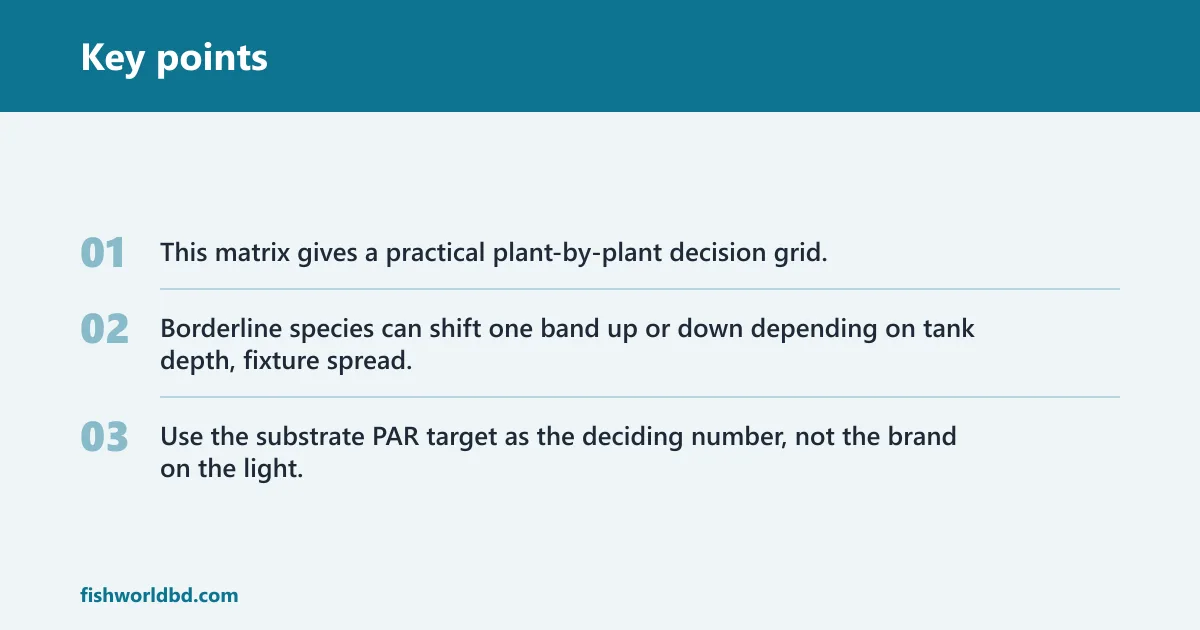
This matrix gives a practical plant-by-plant decision grid. Borderline species can shift one band up or down depending on tank depth, fixture spread, hardscape shade, and whether you run CO2. Use the substrate PAR target as the deciding number, not the brand on the light.
| Plant | Light band | Recommended PAR at substrate | CO2 need | Placement zone | Common mistake if mislit |
|---|---|---|---|---|---|
| Anubias nana | Low | 10-25 | None required | Attached / midground | Too much light causes algae on slow leaves |
| Java fern | Low | 15-25 | None required | Attached / midground | Strong light can bleach or coat fronds with algae |
| Java moss | Low | 10-25 | None required | Attached / foreground | Too much light traps debris and algae in the mat |
| Cryptocoryne wendtii | Low to medium | 15-35 | Not required | Foreground / midground | Low light slows spread and makes leaves smaller |
| Bolbitis heudelotii | Low | 15-30 | Not required | Attached / midground | Too much light can trigger algae on fine foliage |
| Amazon sword | Medium | 30-60 | Optional | Background | Too little light leads to broad but weak growth |
| Vallisneria | Medium | 30-60 | Optional | Background | Low light causes thin, stretched leaves |
| Hygrophila polysperma | Medium | 40-70 | Helpful | Background | Weak light makes lower stems bare |
| Bacopa caroliniana | Medium | 40-70 | Helpful | Midground / background | Low light reduces compact growth and color |
| Ludwigia repens | High | 70-120 | Usually needed | Midground / background | Underlighting leaves it dull and loosely spaced |
| Rotala rotundifolia | High | 80-120+ | Usually needed | Background | Too little light causes green tops and leggy stems |
| Alternanthera reineckii | High | 80-150+ | Usually needed | Midground / background | Low PAR fades red color and slows growth |
| Hemianthus callitrichoides | High | 80-150+ | Usually needed | Foreground | Low light makes it lift, thin out, and spread poorly |
| Glossostigma elatinoides | High | 80-150+ | Usually needed | Foreground | Weak light causes upward growth instead of carpet form |
| Monte Carlo | Medium to high | 50-100 | Helpful to needed | Foreground | Too little light slows spread and thickening |
| Salvinia | Low | 10-30 | Not required | Floating | Strong light at the surface can crowd out lower plants |
| Amazon frogbit | Low | 10-30 | Not required | Floating | Too much surface light can cause root loss and crowding |
| Red root floater | Low to medium | 20-40 | Not required | Floating | Low light dulls red tones and slows root growth |
How tank depth changes light
Deeper tanks need stronger lighting because intensity falls with depth. A PAR reading at the water surface is not enough. The same fixture can look fine above a shallow tank and fall short at the substrate in a taller one.

Fixture height also changes effective PAR. Raising the light widens spread but lowers intensity at the bottom. Lowering the light increases intensity, but it can also tighten the beam and leave the front and sides uneven if the tank is wide or heavily hardscaped.
Shading from hardscape and floaters
Wood, stone, and dense plant groups create shade pockets. So do floating plants. A tank can have a strong center reading while the corners, under driftwood, or beneath floating cover sit in a lower band.
That matters in mixed-species aquariums. A high-light stem can sit in an open rear zone while Anubias and Java fern live under shade in the front. The same tank can support several light bands if you place each group where the PAR matches its needs.
Picture a 20-inch-deep planted tank with a single bright LED. The open background may reach the target for Rotala, while the foreground under a piece of driftwood only lands in low light. That layout can work if the foreground plants are low-light species, but it fails if you expect a carpet to stay dense there.
Say your 55-gallon tank has Amazon sword in the background, Cryptocoryne in the midground, and Anubias under a rock arch. One light setting can work for all three if the substrate PAR varies by zone, but only if you measure those zones and place each plant where its band fits.
Use a quantum PAR meter or quantum sensor, not guesswork. The Apogee MQ-510 is named as the industry standard PAR meter, and it is the right type of tool for underwater checks at substrate level. Take readings in multiple tank locations, not one point only.
A practical check is simple: measure front, center, back, and any shaded area under hardscape or floaters. Then compare those readings to the plant band you want in each zone. That tells you whether to move the fixture, thin floating cover, or change plant placement.
Step-by-step reading method
- Place the sensor at the substrate, not at the water surface.
- Measure the front, center, back, and any shaded pockets.
- Record each reading in µmol/m²/s.
- Compare each zone to the plant group you want there.
- Adjust fixture height, spread, or plant placement before adding more light.
Frequently asked questions
What light do low, medium, and high light aquarium plants need?
Low-light plants generally do well around 10-30 PAR at the substrate, medium-light plants around 30-80 PAR, and high-light plants around 80-150+ PAR. The exact match depends on depth, shade, and CO2. A planted tank should be set by the substrate reading, not by the label on the fixture.
How many PAR do aquarium plants need?
Aquarium plants do not all need the same PAR. Low-light species can thrive at 10-30 µmol/m²/s, medium-light plants often sit in the 30-80 range, and high-light plants may need 80-150+ µmol/m²/s. The right target is the one that matches the species in each zone of the tank.
Which plants count as low light aquarium plants?
Common low-light aquarium plants include Anubias, Java fern, Java moss, Cryptocoryne, and many Bolbitis types. These plants generally do not require pressurized CO2 and are well suited to shaded placements, driftwood, rocks, and lower-output stock lighting that still reaches the substrate.
Which aquarium plants need medium light?
Amazon sword, Vallisneria, Hygrophila, and Bacopa are common medium-light plants. They usually do well around 30-80 PAR at the substrate, though deeper tanks may need a stronger fixture to hold that number at the bottom. Some benefit from moderate CO2 or liquid carbon.
Which aquarium plants need high light and CO2?
High-light plants include Rotala rotundifolia, Alternanthera reineckii, Hemianthus callitrichoides, and Glossostigma elatinoides. These plants often need 80-150+ PAR and pressurized CO2 around 20-30 ppm to keep compact growth, strong color, and stable form. Without that support, they often stretch, fade, or stall.
How do I know if my aquarium light is too weak for plants?
Signs of weak light include slow new growth, small leaves, leggy stems, lower-stem dieback, and red plants turning greener or duller. If the tank is fertilized and still stalls, measure PAR at the substrate. A strong-looking light can still be too weak once it passes through water and hardscape.
Can I grow low light plants with the stock aquarium light?
Often yes, if the stock light delivers enough PAR at substrate level. Low-light plants such as Anubias and Java fern are the safest match for many standard fixtures. The key is not the brand of light but the underwater reading, especially in deeper tanks or under dense floating cover.
What PAR should I target at the substrate for planted tanks?
Start with the plants you want, then set the substrate target to match them. A practical target is about 10-30 PAR for low-light species, 30-80 PAR for medium-light species, and 80-150+ PAR for high-light species. Deeper tanks need stronger lighting to reach the same number at the bottom.