
Are Glass or Acrylic Fish Tanks Better for Beginners?

For most beginners, glass is the safer first tank because it resists scratches, usually costs less, and tolerates ordinary cleaning mistakes better. Choose acrylic only if you need a lighter tank and can avoid abrasive care. Bad material choices can lead to cracked seams, deep scratches, cloudy panels, and extra replacement cost. This guide compares glass and acrylic through beginner failure cases, setup, cleaning, and living-space tradeoffs.
Choosing the right tank material for beginners
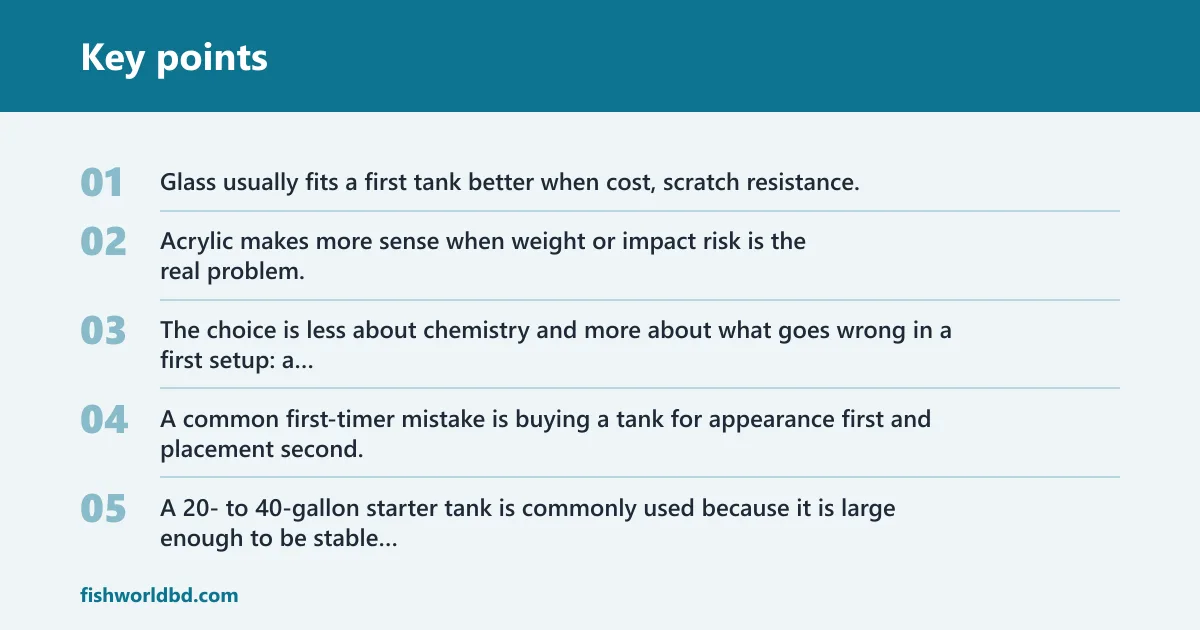
Glass usually fits a first tank better when cost, scratch resistance, and easy cleaning matter most. Acrylic makes more sense when weight or impact risk is the real problem. The choice is less about chemistry and more about what goes wrong in a first setup: a wrong scraper, a weak stand, a tight stairwell, or a curious child.
| Criterion | Glass aquarium | Acrylic aquarium |
|---|---|---|
| Typical cost for common sizes | Often cheaper per gallon | Often costs more for the same volume |
| Weight | Heavier | Lighter |
| Scratch risk | More scratch-resistant | Scratches more easily |
| Impact resistance | Less impact-resistant | More impact-resistant |
| Cleaning tools | Metal blade scrapers are recommended | Soft cloths and plastic-safe cleaners are needed |
| Clarity in thicker panels | Good, but panels become thicker quickly as height increases | Can appear clearer and show less visual distortion at thick depths |
| Repairability | Minor cosmetic wear is less of a problem, but cracks are a serious issue | Minor scratches can sometimes be polished |
| Beginner fit | Usually the safer default | Best when weight or impact risk matters more than scratch resistance |
A common first-timer mistake is buying a tank for appearance first and placement second. A 20- to 40-gallon starter tank is commonly used because it is large enough to be stable without becoming overwhelming, but the material still needs to match the room, stand, and cleaning routine.
Which tank is easier to clean?
Glass is easier to clean for most beginners because it handles blade scrapers and firmer routine cleaning better. Acrylic needs softer tools and gentler products, so the wrong pad or scraper can leave marks fast. If a beginner expects to use firm pressure or sharp blades, glass is the safer choice.
Use the right scraper for the material
Metal blade scrapers are recommended for glass. They remove algae well and are less likely to cause trouble on the surface. Acrylic needs soft cloths and plastic-safe cleaners instead, because abrasive pads and hard blades can leave scratches that stay visible.
Suppose a 20-gallon glass tank has algae film on the front pane. A blade scraper can remove it cleanly. Now change only one variable: the same tank is acrylic, and the same blade is used. That small mistake can turn a routine cleaning into a scratch that catches light every day.
What beginners usually get wrong
The most common mistake is treating acrylic like glass. A scrub pad that feels harmless on glass can cloud acrylic. Another mistake is using the same cleaner on both materials without checking that it is safe for plastic. These errors matter more than the material itself.
How do scratches, repairs, and impacts compare?

Glass is better when the main worry is cosmetic wear. Acrylic is better when the main worry is impact, because it is more resistant to shattering. Beginners should think about what kind of failure is more likely in their room: scratches from cleaning or a hit from a child, pet, or moving object.
Scratch resistance versus impact resistance
Glass resists scratches better than acrylic, so it holds up well under frequent cleaning. Acrylic is more impact-resistant, so it is less likely to shatter if bumped. That tradeoff matters more than abstract strength claims. One material handles scrapers better; the other handles knocks better.
When polishing matters
Minor acrylic scratches can sometimes be polished, which is useful if the marks are shallow. But polishing is still extra work, and deep scratches can remain visible. Glass usually keeps its clear look longer under normal cleaning, which is why many beginners find it easier to live with.
Homes with kids or pets change the decision
Are glass aquariums safer than acrylic for kids? Not by default. Glass is safer from a scratch standpoint, but acrylic is less likely to shatter if a child or pet bumps the tank. If the tank sits in a busy area, impact resistance can matter more than cleaning convenience.
Picture a 10-gallon desktop tank on a low shelf in a room with a large dog. A shoulder bump into the stand is less of a problem with acrylic than with glass. Change only one variable, though: if the tank sits on a sturdy stand in a quiet room, glass is often the simpler beginner pick.
Does size change the better choice?
Yes. Size changes the material choice because weight, panel thickness, and maintenance time all rise as tanks get larger. Beginners are often advised to choose a tank sized between 80 and 150 liters, which overlaps with the common 20 to 40 gallons range. Larger tanks are more stable, but they also demand more space and more upkeep time.
Why weight and space matter
A 50-gallon glass tank weighs a lot when filled, so the stand, floor, and path into the room matter before purchase. Acrylic is lighter than glass for the same volume, which can help in upstairs apartments, narrow hallways, and tight stair turns. That advantage is practical, not cosmetic.
When larger tanks can favor acrylic
As tank height increases, glass panels become thicker quickly. Acrylic can appear clearer and show less visual distortion at thick depths. For a larger starter tank, acrylic’s lighter weight can also make setup less awkward, especially if the final location is on an upper floor.
Beginners should remember that a larger tank does not reduce maintenance to zero. It is often more stable, but it also means more water to change, more glass or acrylic surface to clean, and more weight to support. Size can make acrylic more appealing, but it does not erase the care needed.
What tank shape should beginners buy?
Rectangular tanks are usually easier to clean, inspect, and fit on standard stands. Curved or custom shapes often favor acrylic because the material is easier to form into nonstandard designs. Shape affects both maintenance and viewing, so beginners should choose the simplest form that fits the room.
Rectangular tanks are easier to live
Rectangular tanks give you flat panels, straight edges, and simpler scraper paths. That makes algae removal easier and reduces missed corners. For a first aquarium, that simplicity matters more than a dramatic shape.
Curved and custom shapes lean toward acrylic
Curved or custom shapes are more common in acrylic because the material can be formed more easily. That can improve viewing in some layouts, but it also makes cleaning more annoying if the surface curves away from a scraper. Beginners who want low-effort maintenance should usually start with rectangular glass.
Acrylic beginner decision scenarios
This table focuses on beginner failure cases, not abstract material traits. Each scenario shows which material fits better, the mistake to avoid, and the main risk level. Use it to match the tank to budget, placement, and cleaning habits before you buy.
| Scenario | Better material | Why it fits | Likely mistake to avoid | Maintenance risk level |
|---|---|---|---|---|
| Budget-first | Glass | Often cheaper per gallon for common sizes | Paying extra for acrylic when weight is not a problem | Low |
| Apartment upstairs | Acrylic | Lighter for the same volume and easier to move through stairs or narrow doors | Choosing a large glass tank that is hard to place safely | Medium |
| Kids or pets | Acrylic | More impact-resistant if bumped | Placing it where hard knocks are likely and still using abrasive cleaning tools | Medium |
| Heavy-cleaning habits | Glass | Better for frequent scraper use and firmer cleaning | Using metal blades on acrylic by habit | Low |
| Small desk tank | Glass | Less expensive and easier to clean for a small, simple setup | Buying acrylic for a tiny tank when weight savings are minor | Low |
| Larger starter tank | Acrylic | Lighter than glass, and thick acrylic can look clearer at larger sizes | Ignoring stand strength and room placement because the tank is lighter | Medium to high |
Choose glass if… / Choose acrylic if…
Choose glass if you want the lower-cost option for a common beginner size, you expect to clean with blade scrapers, you want better scratch resistance, and the tank will sit on a level, sturdy stand in a room with normal traffic.
Choose acrylic if the tank must move through stairs or narrow doorways, the setup is in a place where impact risk matters, you want a larger tank with less weight, or the shape is curved or custom and you are willing to clean it more carefully.
Last checks before you buy
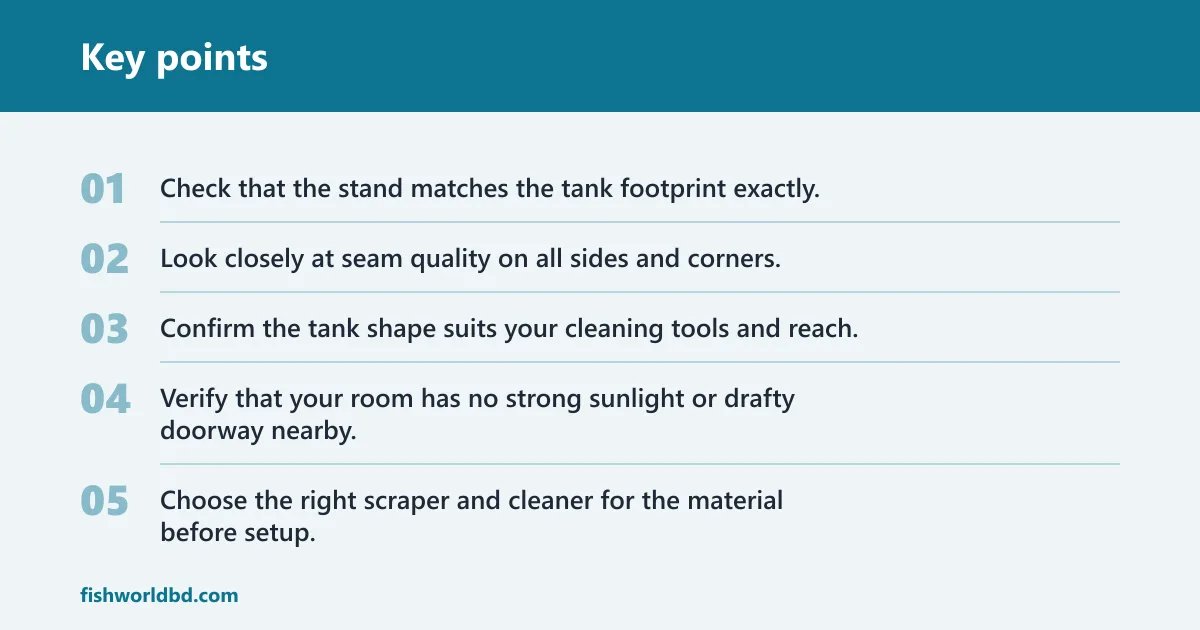
Inspect the seams, stand fit, and warranty terms before purchase. Seams should look even and clean, with no obvious gaps or crooked lines. The stand should fully support the base. Warranty terms should be clear about cracks, seams, and material defects.
- Check that the stand matches the tank footprint exactly.
- Look closely at seam quality on all sides and corners.
- Confirm the tank shape suits your cleaning tools and reach.
- Verify that your room has no strong sunlight or drafty doorway nearby.
- Choose the right scraper and cleaner for the material before setup.
Aqueon advises considering budget, space, and placement before choosing an aquarium, and it also warns to avoid sunny windows and drafty doorways. Those points matter here because material choice only works when the tank sits in the right place and can be maintained with the right tools.
Frequently asked questions
Are glass or acrylic fish tanks better for beginners?
Glass is usually better for beginners because it costs less for common sizes, resists scratches better, and is more forgiving of ordinary cleaning mistakes. Acrylic makes sense when weight or impact risk matters more. If the setup is simple and the tank will stay put, glass is usually the easier first choice.
Which is cheaper, glass or acrylic fish tank?
Glass is often cheaper per gallon for common sizes. That matters most in the beginner range, where budget often decides the first purchase. Acrylic can cost more upfront, so it is usually chosen for weight savings, impact resistance, or special shapes rather than for price.
Do acrylic fish tanks scratch easily?
Yes. Acrylic scratches more easily than glass, especially when cleaned with abrasive pads or the wrong scraper. Those marks can stay visible and may need polishing if they are minor. If you want to clean aggressively or often, glass is usually the safer material choice.
Are glass aquariums safer than acrylic for kids?
It depends on the risk you mean. Glass is safer against scratching, but acrylic is more impact-resistant and less likely to shatter if bumped. In a home with kids, the better choice depends on whether the bigger concern is rough cleaning or accidental hits.
Is acrylic worth it for a small beginner tank?
Usually not. In a small beginner tank, the weight savings are modest, while the scratch risk remains. Glass is often the better default for a 5-, 10-, or 20-gallon starter tank unless the tank has to sit in a place where impact risk is unusually high.
What size tank should I buy if I’m choosing glass or acrylic?
A common rule of thumb for beginners is about 20 to 40 gallons, which can balance stability and manageability. Smaller tanks are lighter and cheaper, but they can be less forgiving. Larger tanks are more stable, yet heavier and more time-consuming to maintain, especially if you choose glass.