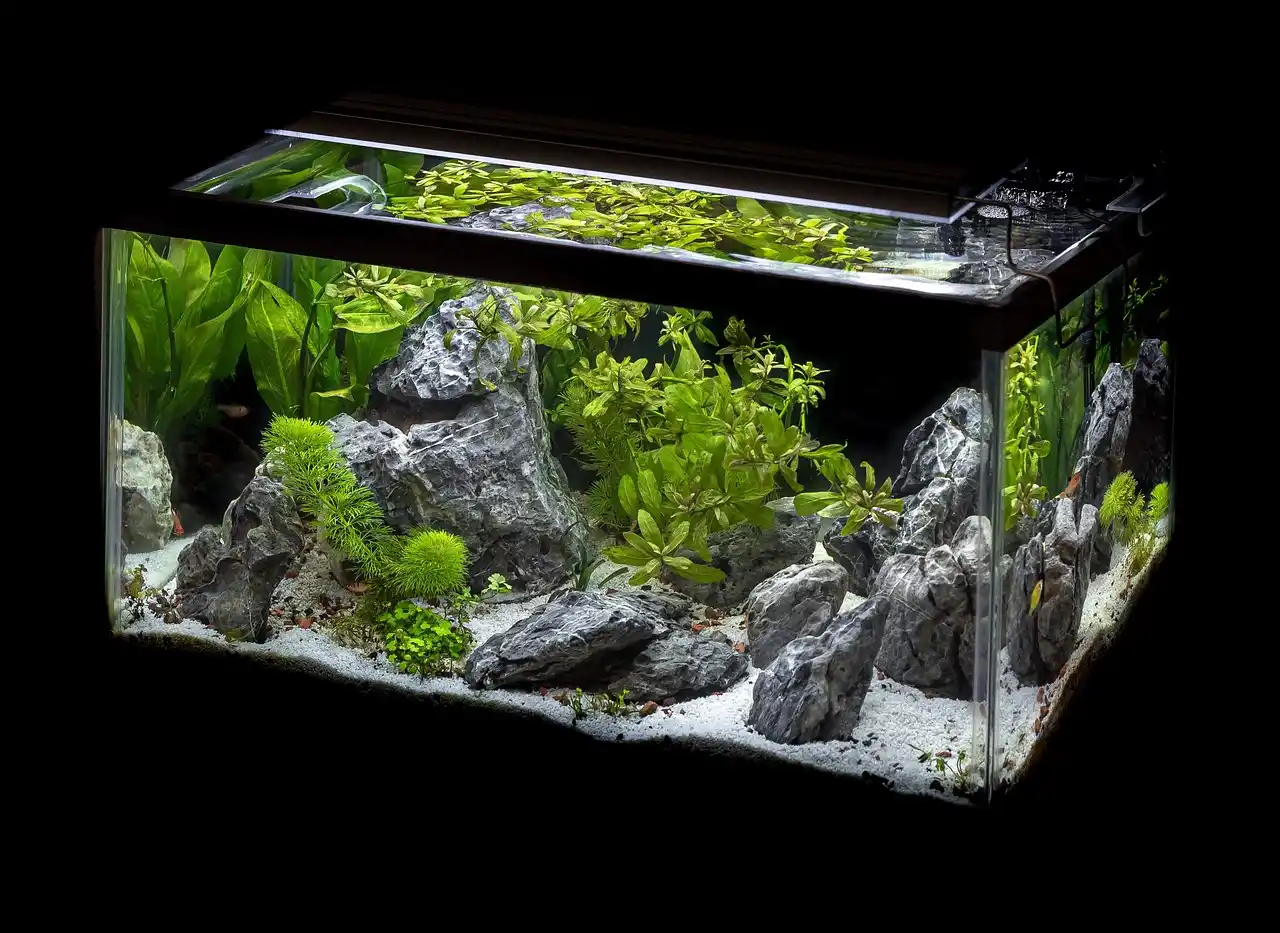
Can Aquarium Plants Get Too Much Light? Signs and Solutions

Yes—aquarium plants can get too much light when intensity is too high, the photoperiod runs past roughly 8–10 hours, or the fixture sits too close. The usual result is algae, scorched leaves, pale tops, and stalled growth. This guide shows how to tell intensity, duration, and placement apart, then pick the safest fix.
Can aquarium plants get too much light?
Yes. Plants use light to power growth, but too much usable light can outpace what the leaves can process. That is where photoinhibition can start: the plant takes in more light than it can use, so growth may slow and the tissue may pale, tighten up, or stop extending normally.
That problem is easy to misread as “the tank needs more light.” Often, it needs less exposure, better spacing, or a plant match that fits the tank. Check intensity, photoperiod, and fixture placement one at a time.
What excess light does to plant growth
Photoinhibition usually shows up first at the growing points. New leaves may come in pale, smaller, or twisted. Tips can stall even while older leaves stay intact for a while. In severe cases, the plant stops expanding cleanly later in the day.
Light stress can also push algae onto slow-growing leaves, especially on species that tolerate lower light. That does not prove the light is the only issue, but it does suggest the plant is getting more light than it can turn into growth.
Why light stress is often confused with algae
Algae is a symptom, not a diagnosis. Excess light often appears as green film on the glass, dusting on leaves, or filamentous growth on older tissue. But algae can also rise when CO2 fluctuates or nutrients are out of balance, so the light setting should not be blamed from one symptom alone.
Signs of too much light in plants
The clearest plant signs are pale new growth, shortened stems or runners, and leaves that look stressed at the edges or tips. If the tank has enough nutrients and stable CO2, but growth still looks tight, washed out, or halted, light stress becomes a stronger suspect.
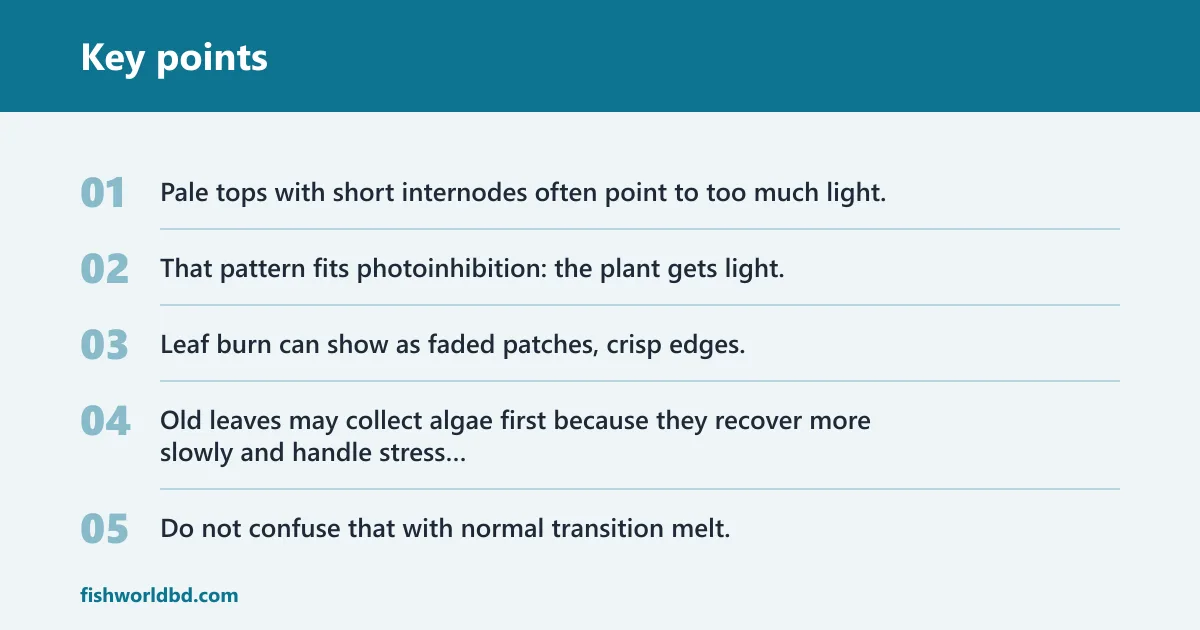
Pale new growth and stunted tips
Pale tops with short internodes often point to too much light, especially in a shallow tank or one with the fixture close to the water. That pattern fits photoinhibition: the plant gets light, but cannot process it efficiently enough to push healthy extension.
Leaf burn, old-leaf algae, and melt-like symptoms
Leaf burn can show as faded patches, crisp edges, or tissue that breaks down after a bright surge, though many aquarium plant problems blamed on burn are actually algae, nutrient, CO2, or transition issues. Old leaves may collect algae first because they recover more slowly and handle stress poorly. Do not confuse that with normal transition melt, which is common after a plant adjusts to new water, flow, or chemistry.
A common first-timer mistake is raising the light because the lower leaves look weak, then watching algae spread on the older leaves within a week. If the newest growth is also pale or stunted, the issue is more likely excess light than a simple nutrient shortage.
How to separate light stress from nutrient or CO2 issues
Use the symptom pattern. Light stress usually hits the top growth first and can flatten growth even when nutrients are present. Nutrient shortage often causes broader chlorosis, pinholes, or distorted leaves across the plant. CO2 instability tends to cause erratic growth, pearling changes, and algae that appears after fluctuations rather than after one clear lighting change.
Suppose a 20-inch shallow nano tank has a bright LED moved about 2 inches closer to the surface. If the next symptom is pale tops and algae on the oldest leaves while nutrient dosing stayed the same, the fixture change is the first thing to correct. If the leaves are pale across the whole plant with no algae spike, check nutrients and CO2 first.
Signs of too much light in fish
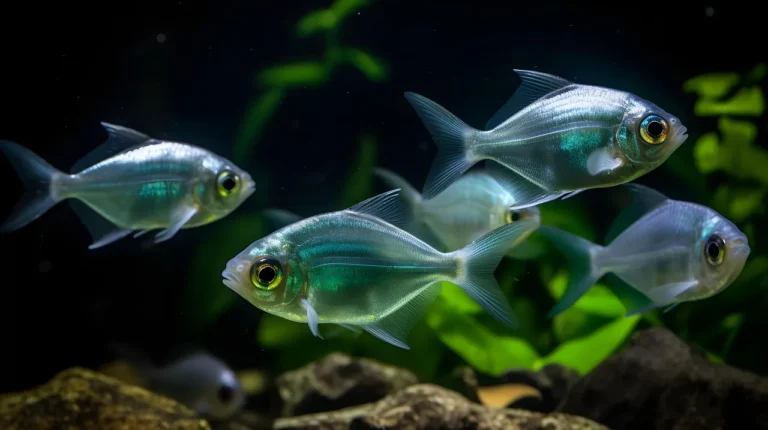
Strong light can make timid fish hide more, especially when the tank lacks cover or has open swimming space with little shade. That said, fish behavior alone does not prove the light is too strong. Stocking, flow, surface movement, and tank layout can cause the same response.
Hiding, skittish behavior, and reduced activity
If fish stay under driftwood, in plant thickets, or near the back glass after a lighting change, the fixture may be too intense at the water surface. This is more likely in open-top tanks, shallow setups, or tanks with little floating cover.
Still, do not treat hidden fish as a lighting diagnosis by itself. If the fish began hiding after a new species was added, or after a change in flow or tankmates, the lighting may be fine.
Light troubleshooting matrix
This matrix helps separate intensity, photoperiod, fixture placement, and shade. Match the symptom to the first test, then change only the smallest variable that fits the pattern.
| Symptom | Likely cause | First test | Safest fix |
|---|---|---|---|
| Algae on old leaves | Too much light on slow-growing tissue | Check whether the light is close and the photoperiod exceeds the tank’s needs | Shorten hours first; then raise the fixture or dim slightly |
| Algae on glass | Excess intensity or long daily exposure | Compare glass growth after one week at fewer hours | Cut the photoperiod before changing plant nutrition |
| Pale new growth | Photoinhibition or nutrient imbalance | Check if only the top growth is pale while lower leaves stay normal | Lower intensity a little; if the whole plant is pale, check nutrients and CO2 |
| Leaf burn | Fixture too close or sudden light jump | Look for recent changes in height, brightness, or spectrum | Raise the fixture or dim it, then keep hours steady |
| Stunted growth | Light stress, low CO2, or nutrient shortage | See whether new leaves are small despite stable water conditions | Check CO2 and nutrients first; reduce light only if other factors are steady |
| Fish hiding | Too much surface brightness or too little cover | Watch whether behavior changes after the light comes on | Add partial shade or raise the fixture; preserve open gas exchange |
| Green water | Strong light with excess available nutrients and suspended algae | See whether the bloom followed a lighting increase | Shorten hours, reduce intensity, and improve filtration follow-through |
| Sudden worsening after a lighting change | Intensity jump, closer fixture, or longer photoperiod | Compare the new setting with the previous one one variable at a time | Return to the prior height or hours, then adjust slowly |
How many hours should aquarium lights be on?
A common planted-tank baseline is 8 to 10 hours of light each day. The right number depends on plant type, tank depth, and fixture strength.
Using 8-10 hours as a starting point
Start with a fixed daily window, not an all-day schedule. A timer helps keep the photoperiod consistent and prevents accidental overexposure. If the tank is new, lightly planted, or filled with low-light plants, the lower end of the range often makes more sense at the start.
When a problem tank should drop to 6-8 hours
If algae is spreading, leaves look pale at the top, or the tank changed from stable to stressed after a lighting increase, shorten the photoperiod first. A shorter day reduces total exposure without changing the whole setup. That is often safer than dimming aggressively when you do not yet know whether intensity is the real problem.
Why a timer matters more than guesswork
Consistent hours are easier to troubleshoot than irregular hours. Without a timer, light can run longer than planned, especially during setup changes or busy days. A timer gives you a clean baseline so you can see whether one hour less, or one hour more, changes the tank.
Should you dim, shorten, or move the light?
Choose the smallest change that matches the symptom. Shorten the photoperiod if algae or stress appears across the tank. Dim the LED aquarium light if every plant is getting too much usable light. Move the fixture higher if the problem is strongest at the surface or in a shallow tank.
When to reduce brightness
Dim the light when the tank is otherwise well balanced, but intensity still looks excessive for the plant mix. This is useful with an LED aquarium light because many models offer adjustable brightness and adjustable spectrum. Spectrum changes matter most when you are trying to shift the look of the tank or tailor the light distribution; intensity changes matter when the plants simply need less total light. LEDs also give lower heat than older metal-halide setups, which makes them easier to fine-tune.
When to cut photoperiod first
Shorten the day first if the plants are basically healthy but algae is increasing, especially on glass and old leaves. Duration changes are easy to reverse and often reveal whether the tank simply receives too much total light. Keep the fixture where it is while you test hours.
When fixture height or tank depth is the real issue
Tank depth matters because the usable light at leaf level changes with distance from the fixture. A shallow tank gets stronger effective light at the plants than a deeper tank with the same lamp. If the fixture sits very close to the water, raise it before making a larger change.
Picture a shallow 10-gallon tank with Java moss, Anubias, and a bright LED mounted low over the rim. If algae appears on the glass and the moss stalls while the Anubias stays clean, the tank likely needs either less intensity at the surface or a slightly higher fixture, not more light overall.
How do plant type and measurement tools change the diagnosis?
Plant type sets the target. Low-light plants such as Anubias, Java fern, and Java moss are commonly treated as lower-light species, may tolerate shorter or lower-intensity lighting, and can be more likely to show algae under excess light. High-light plants such as Dwarf Baby Tears and Glossostigma need more careful matching to CO2 and nutrients before they can use stronger light well.

What light intensity is too much for low-light aquarium plants?
There is no single safe number for every tank. For low-light species, the usable goal is often below the level that pushes algae and pale tops.
Because those figures are broad, use a meter instead of guessing. PAR, or Photosynthetically Active Radiation, is the more plant-relevant way to compare intensity. A meter-based reading is far more useful than a visual impression, especially when you are comparing two fixtures or two mounting heights.
How to measure with PAR or a lux meter
PAR is the better tool when you want a plant-focused reading. A lux meter is cheaper and useful for rough checks, but it is less specific to plant growth and lux readings are not directly comparable across fixtures with different spectra. If you only need to know whether one setting is clearly higher than another, lux can still help you monitor trends and avoid accidental overexposure.
| Tool | Best use | Strength | Limit |
|---|---|---|---|
| PAR meter | Comparing plant light at leaf level | Plant-relevant intensity reading | Costs more than a basic meter |
| Lux meter | Rough brightness checks and change tracking | Budget-friendly | Less plant-specific than PAR |
Frequently asked questions
What are the signs my aquarium light is too strong?
The common signs are pale new growth, short or stalled tips, algae on old leaves, and glass that greens up fast. Fish may hide more under a bright surface. Check whether the symptom began after a change in brightness, height, or daily hours.
How many hours should aquarium lights be on for planted tanks?
A common starting point is 8 to 10 hours daily. A timer keeps the schedule consistent so you can judge the result fairly.
Will too much light cause algae on aquarium plants?
Yes, excess light can push algae onto leaves, especially older tissue and slower growers. That said, algae also rises when CO2 is unstable or nutrients are out of balance. If the problem followed a lighting change, shorten the photoperiod or reduce intensity before making larger changes.
Should I dim my aquarium light or shorten the photoperiod?
Shorten the photoperiod first if the tank is otherwise stable and algae is the main issue. Dim the light if all plants look overexposed even with normal hours. If the fixture is too close or the tank is shallow, raise the light before making a bigger adjustment.
How do I tell if plant problems are caused by light or nutrients?
Light stress usually starts at the top growth and often brings algae with it. Nutrient problems often show broader yellowing, holes, or distorted leaves across the plant. If CO2 varies, symptoms can look mixed, so check water stability before blaming the light alone.
Do floating plants help reduce too much aquarium light?
Yes, floating plants can reduce light at the leaves and soften a bright tank. They work best as a partial fix, not a cure. Leave enough open surface so gas exchange stays strong, and use them alongside a correct photoperiod or fixture adjustment.
Do floating plants help reduce too much aquarium light?
Yes, but only as a partial shade tool. Floating plants can lower light at leaf level and soften a bright surface. They must not block gas exchange, so leave open areas for surface movement and oxygen transfer. Use them to trim excess light, not to hide an oversized lighting mistake.