Aquarium Heater Wattage Chart for Different Tank Sizes

Start with 3–5 watts per gallon for tropical tanks, then increase output as the room gets colder than the fish’s target water temperature. For tanks over about 100 gallons or in colder rooms, use two heaters. Undersizing causes temperature swings and stressed fish; oversizing can overheat a tank if a thermostat sticks. This guide gives a heater wattage chart, room-temperature adjustments, species-based targets, and a safer two-heater setup.
Aquarium heater wattage basics
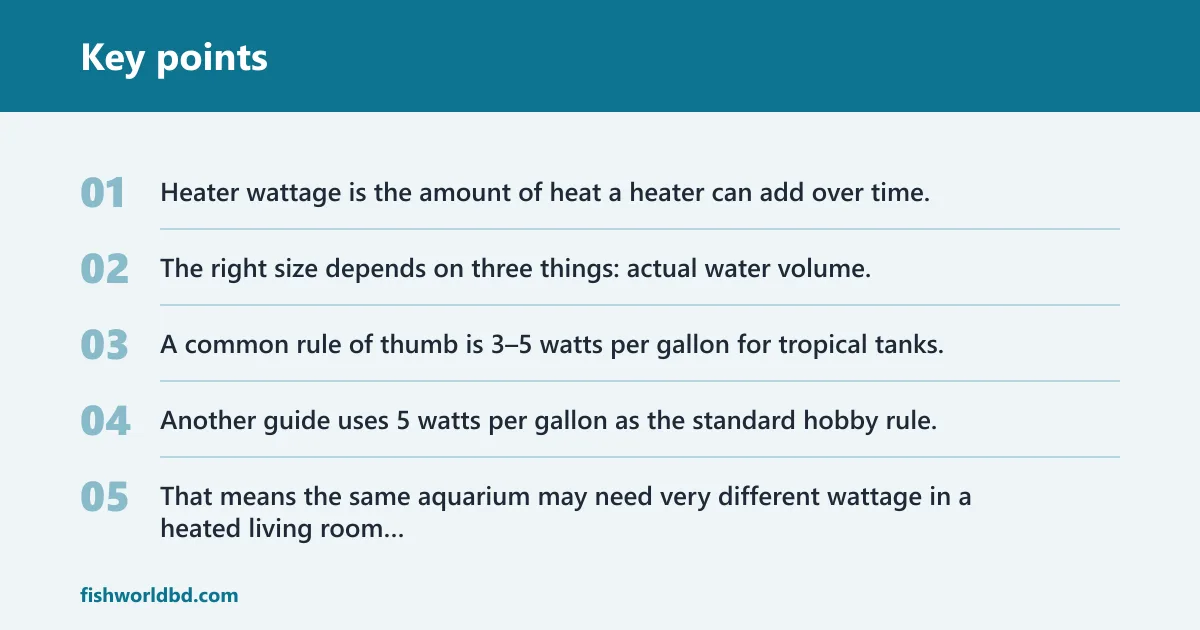
Heater wattage is the amount of heat a heater can add over time. The right size depends on three things: actual water volume, the coldest room temperature, and the target water temperature for the fish.
A common rule of thumb is 3–5 watts per gallon for tropical tanks. Another guide uses 5 watts per gallon as the standard hobby rule, and one calculator says heater size depends on how far you are heating above the coldest room temperature. That means the same aquarium may need very different wattage in a heated living room versus a basement.
Target species temperature changes the answer
Species matter. Goldfish, hillstream loaches, and many temperate fish need cooler water than discus, angelfish, or many planted tropical setups. If the tank target is warmer, the heater must work against a larger temperature gap.
A 78°F target in a 68°F room is a 10°F lift. The same target in a 58°F room is a 20°F lift. That extra 10°F of lift can push you from a small single heater into a larger heater class or a dual-heater setup.
Use actual water volume, not box size
Nominal tank size can mislead. A 55-gallon tank does not always contain 55 gallons of water once substrate, hardscape, and decor take up space. Size the heater from the water line and the filled volume, not the label on the glass.
Gravel, sand, rocks, wood, and dense planting all displace water. That displacement can matter more in aquascaped tanks and unusual shapes, where the filled volume is smaller than the retail size suggests.
When odd shapes need a sizing check
Long, shallow tanks and tall, narrow tanks do not behave the same way. Heat loss depends on exposed surface area, room draft, and water movement. If the tank is heavily aquascaped or oddly proportioned, treat the heater size as a starting point and move up one standard heater size if the room runs cool.
- Measure the actual filled volume, not the box size.
- Note the coldest room temperature, not the daytime average.
- Set the target water temperature for the fish you keep.
- Estimate the temperature lift in °F.
- Round to the next standard heater size.
- Use a separate thermometer to confirm the result.
Heater wattage by tank size
The chart below gives a practical starting point for common tank sizes. It assumes a tropical target near the upper 70s, then adjusts upward as the room gets colder. Round to the next common heater size: 25W, 50W, 75W, 100W, 150W, 200W, 250W, 300W, or 400W.
Common sizes and rounding
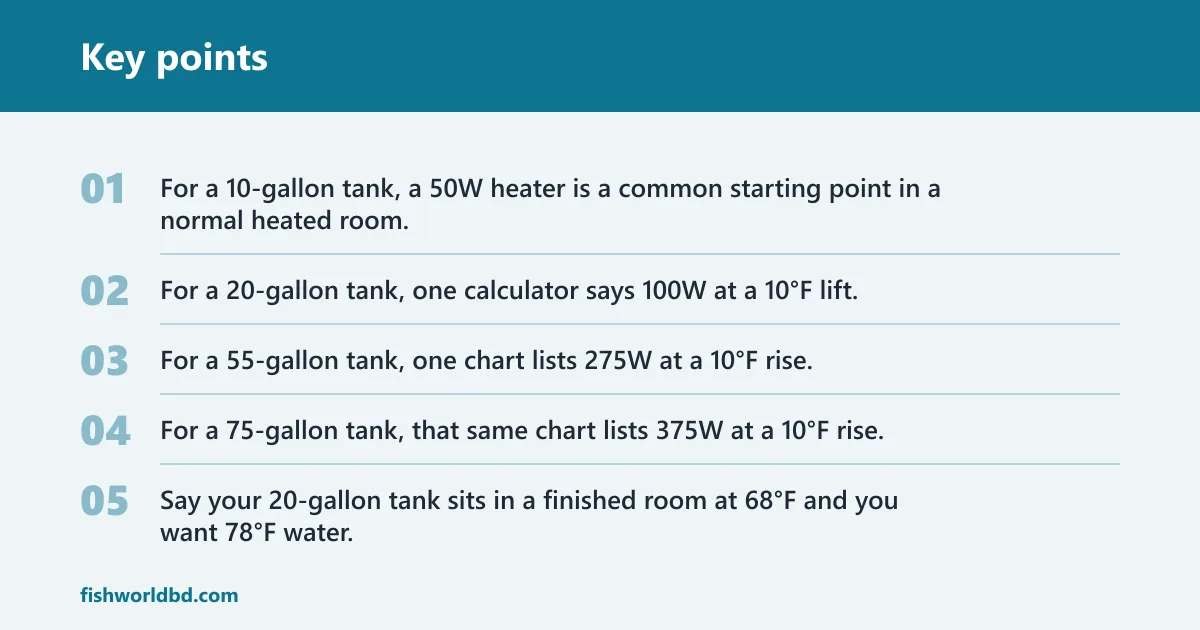
For a 10-gallon tank, a 50W heater is a common starting point in a normal heated room. For a 20-gallon tank, one calculator says 100W at a 10°F lift, and one chart uses the same 5W-per-gallon idea in a cold basement. For a 55-gallon tank, one chart lists 275W at a 10°F rise. For a 75-gallon tank, that same chart lists 375W at a 10°F rise.
| Actual gallons | Coldest room temperature | Target water temperature | Recommended total wattage | Setup | Failure-safe reason |
|---|---|---|---|---|---|
| 10 | 68°F | 78°F | 50W | Single 50W heater | Small tank, modest lift, and a single unit is easy to verify with a separate thermometer. |
| 20 | 68°F | 78°F | 100W | Single 100W heater | Matches the 10°F lift example; a single heater is fine when the room is steady and warm. |
| 29 | 65°F | 78°F | 150W | Single 150W heater | Round up because the tank is larger and the room sits cooler than a typical living area. |
| 40 | 65°F | 78°F | 200W | Single 200W heater | Provides margin for normal heat loss without jumping to an oversized unit. |
| 55 | 65°F | 78°F | 275W | Dual 150W heaters | Splitting the load adds backup if one heater stops heating and reduces the chance of a single unit dominating the tank. |
| 75 | 62°F | 78°F | 375W | Dual 200W heaters | Large volume and colder room call for redundancy; one failed heater should not leave the tank without heat. |
| 125 | 60°F | 78°F | 500W | Dual 250W heaters | Big tanks benefit from split output and backup, especially if the aquarium sits on an exterior wall or in a basement. |
Say your 20-gallon tank sits in a finished room at 68°F and you want 78°F water. A 100W heater is the cleaner choice than a smaller unit pushed to its limit. If the same tank moves to a basement at 60°F, you need a larger heater class or better room heat, lid coverage, and insulation.
Suppose a 55-gallon tank is packed with rock and wood. The glass label says 55 gallons, but the true filled volume may be lower. Size from the actual water level, then round up only one step if the room is cool. That is better than buying a giant heater that cycles hard and runs hot when a thermostat sticks.
How many watts do you need?
Estimate the temperature lift first. A 5°F lift is easier to cover than a 20°F lift, so the wattage band changes with room temperature. Once you know the lift, match the heater to the next standard size and leave a little room for heat loss through the lid, glass, and plumbing.
A cold basement or an exterior-wall tank often needs the next size up. If the room is chilly, the aquarium loses heat faster through the tank walls and surface, and the heater must run longer to keep up.
Quick lift guide
Use this as a sizing check, not as a substitute for the full chart. Small lifts usually work with the lower end of the watts-per-gallon rule. Bigger lifts call for the upper end, and cold rooms can push you past it.
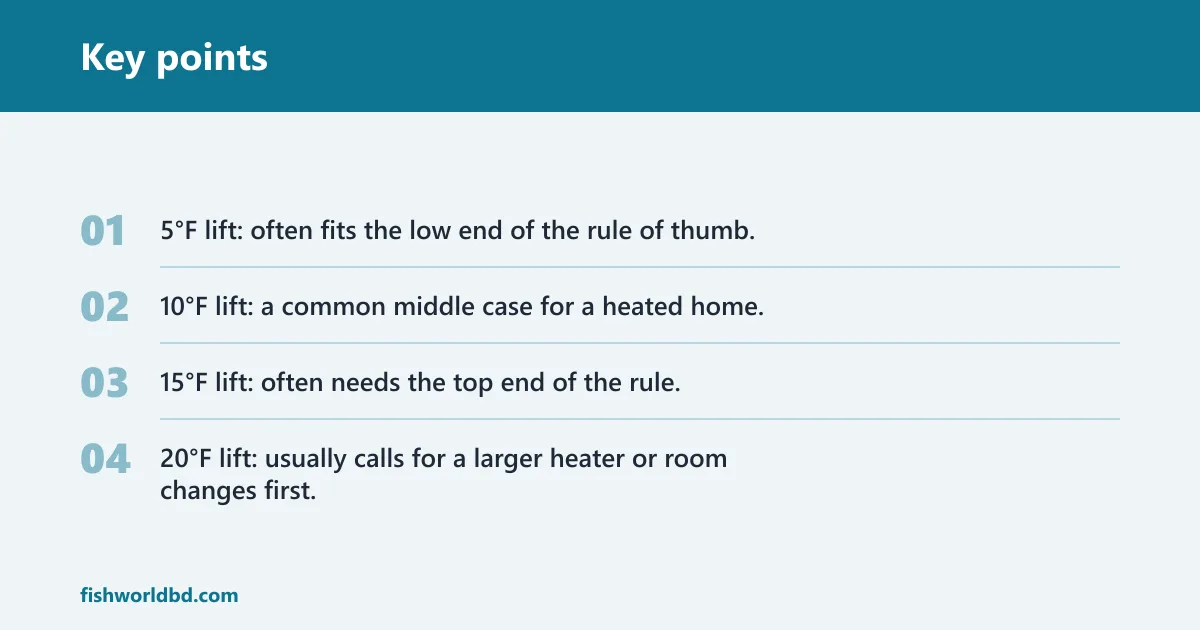
- 5°F lift: often fits the low end of the rule of thumb.
- 10°F lift: a common middle case for a heated home.
- 15°F lift: often needs the top end of the rule.
- 20°F lift: usually calls for a larger heater or room changes first.
If the room is very cold, a lid, more room heat, or better insulation can be cheaper than buying a much larger heater. That is often the smarter move for basement tanks and tanks near drafty windows.
Heater setup for safety
One heater works well on smaller tanks. Two heaters make more sense as tank size rises, and many setups around 75 gallons and above benefit from redundancy. A split setup also spreads heat more evenly across the tank.
The main safety issue is failure mode. A heater can fail stuck-off or stuck-on. If it fails stuck-off, the water cools. If it fails stuck-on, the tank can overheat. Two smaller heaters and an external controller reduce the damage if one unit fails.
Single heater versus dual heaters
Use one heater when the tank is small, the room stays steady, and the heater is not carrying a large lift. Use two heaters when the tank is large, the room is cool, or the aquarium must keep running safely if one heater quits.
An external temperature controller adds another layer of cutoff. It uses an independent thermostat, so if the heater dial sticks on, the controller can stop power before the tank keeps climbing. A separate aquarium thermometer is still needed to verify the built-in dial, because the dial is only a setting, not a guarantee.
Where should you place the heater?
Place the heater near filter outlet flow or a powerhead so warmed water moves through the tank. Good circulation prevents hot spots near the heater and helps stop stratification, where warm water sits near the top and cooler water stays lower.
Mounting near flow matters even more in long tanks and heavily decorated tanks. Water must move past the heater and across the whole tank for the thermostat to read the tank more accurately.
Placement checks
- Keep the heater in moving water.
- Use the far-end thermometer to check the warmest and coolest areas.
- Do not trap the heater behind dense decor with no flow.
- On long tanks, split heaters near opposite ends for more even heating.
Heater wattage chart
This decision table combines tank size, room temperature, target water temperature, wattage, setup, and fail-safe logic. Use the filled water volume, not the empty box size, then round to the next standard heater size if the room is colder than the examples below.
| Actual gallons | Coldest room temperature | Target water temperature | Recommended total wattage | Single or dual | Why this setup |
|---|---|---|---|---|---|
| 10 | 70°F | 78°F | 50W | Single | Small volume, mild lift, and simple monitoring with one heater and one thermometer. |
| 20 | 68°F | 78°F | 100W | Single | Matches the 10°F lift example and gives enough margin for normal heat loss. |
| 29 | 65°F | 78°F | 150W | Single | The cooler room calls for the next size up so the heater does not run at the edge of its range. |
| 40 | 65°F | 78°F | 200W | Single | Works well when the tank is covered and the room is not drafty. |
| 55 | 65°F | 78°F | 275W | Dual | Two heaters cut the chance that one stuck-on unit overheats the whole tank. |
| 75 | 62°F | 78°F | 375W | Dual | This is near the point where two heaters make more sense than one large unit alone. |
| 125 | 60°F | 78°F | 500W | Dual | Large water volume and a cold room make redundancy the safer choice. |
Frequently asked questions
How many watts do I need for my aquarium heater?
Start with 3–5 watts per gallon for tropical tanks, then adjust for the room’s coldest temperature and the fish’s target water temperature. A 10°F lift often lands near the middle of that range, while colder rooms push you toward the top end or a second heater.
What size heater do I need for a 10 gallon tank?
A 10-gallon tank usually works with a 50W heater in a typical heated room. If the tank sits in a cooler basement or near an exterior wall, move up only if the room temperature makes the target water hard to hold, and verify with a separate thermometer.
What size heater do I need for a 20 gallon tank?
A 20-gallon tank commonly uses 100W when the lift is about 10°F, which matches one calculator’s example. If the room is warmer, a smaller size may work; if the room is colder, round to a larger size or improve the room conditions first.
What size heater do I need for a 55 gallon tank?
A 55-gallon tank often lands around 275W at a 10°F rise. Many aquariums that size do better with two heaters instead of one large unit, since split heating adds backup if one thermostat fails and helps spread heat through the tank.
Should I use one heater or two heaters in a large aquarium?
Use two heaters for larger aquariums, especially around 75 gallons and above. Two smaller heaters give you backup if one fails stuck-off, and an external controller can stop overheating if one fails stuck-on. Place them at opposite ends when the tank is long.
What wattage heater is safe for a cold room or basement tank?
Cold rooms and basements usually need the next size up, plus a lid, better room heat, or insulation if the lift is large. A 20-gallon tank in a cold basement may want 100W, and bigger tanks often need dual heaters rather than one oversized unit.