What Size Heater for Aquarium: Matching Wattage to Tank Gallons

Start with actual water volume and the coldest room temperature your tank faces. In a warm room, many aquariums land near about 3 to 5 watts per gallon; in a colder room, about 5 to 10 watts per gallon is a common rule of thumb. Larger tanks often need two heaters so heat spreads more evenly. Wrong wattage can leave fish in unstable temperatures, drive higher power use, and shorten heater life. This guide shows how to match heater wattage to tank gallons and room temperature with a simple decision method.
Heater sizing matrix
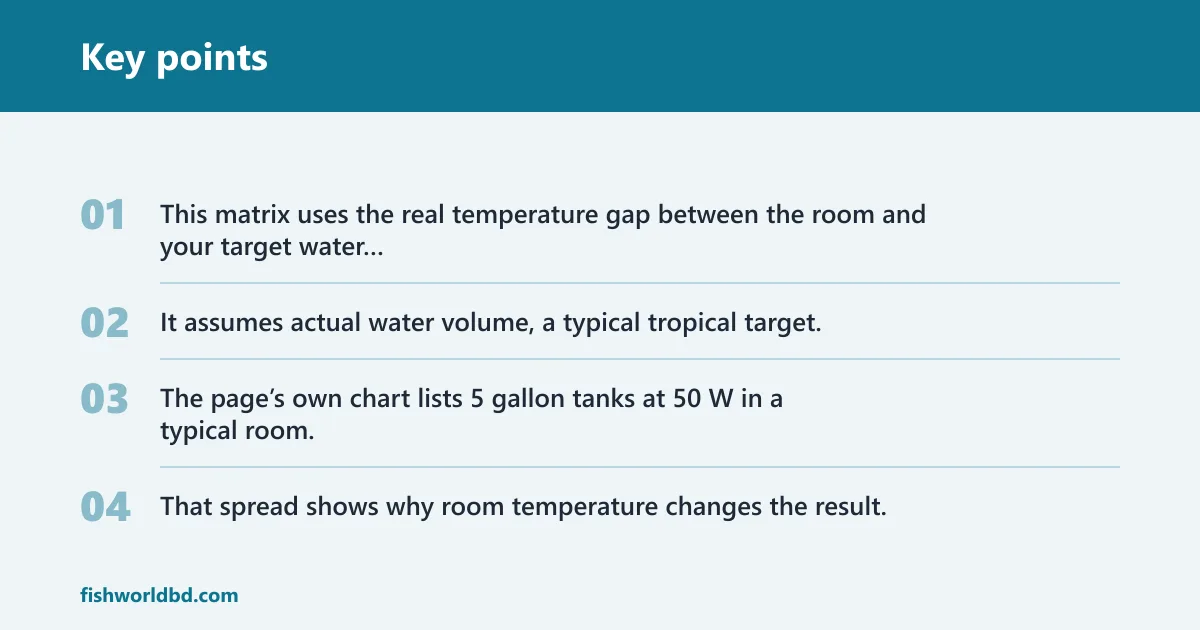
This matrix uses the real temperature gap between the room and your target water temperature, not tank gallons alone. It assumes actual water volume, a typical tropical target, and standard heater sizes rounded up from the calculated need. A 20 gallon tank at a 10°F lift needs 100 W.
| Room-to-target gap | 5 gallons | 10 gallons | 20 gallons | 40 gallons | 75 gallons |
|---|---|---|---|---|---|
| 5°F gap | 25 W, one heater | 50 W, one heater | 50 W, one heater | 100 W, one heater | 150 W + 150 W, two heaters |
| 10°F gap | 50 W, one heater | 50 W, one heater | 100 W, one heater | 200 W, one heater | 200 W + 200 W, two heaters |
| 15°F gap | 50 W, one heater | 75 W, one heater | 150 W, one heater | 250 W, split to two heaters | 250 W + 250 W, two heaters |
| 20°F gap | 50 W, one heater | 100 W, one heater | 200 W, one heater | 300 W, split to two heaters | 300 W + 300 W, two heaters or controller-backed split |
Use the table as a fallback, not a promise. The page’s own chart lists 5 gallon tanks at 50 W in a typical room, 20 gallon tanks at 100 W in a typical room, 40 gallon tanks at 200 W in a typical room, and 75 gallon tanks at 400 W in a cold room. That spread shows why room temperature changes the result.
What size heater do I need for my aquarium?
Start with actual water volume, then check the coldest realistic room temperature and your target water temperature. Round up to the next standard heater size, because heater output is sold in fixed steps such as 25, 50, 75, 100, 150, 200, 250, and 300 W.
Start with actual water volume
Use the tank’s real water volume whenever possible, not the label size. A tank marked 40 gallons may hold less once substrate, decor, and empty headspace are included. That difference matters more on small aquariums, where a few gallons can change the needed wattage.
Match wattage to the coldest room temperature
Set the baseline from the coldest room the tank actually sits in, including winter overnight low. If the room drops well below your target water temperature, choose the next higher standard size rather than the nearest exact math result. The calculator rounds to standard heater sizes up to 300 W.
Round up to the nearest standard size
Rounding up is safer than rounding down because an undersized heater may run nonstop and still miss target temperature. For many tanks under about 55 gallons, a single 150 W heater is enough, but that assumes a normal gap and a not-too-cold room. Warmer target water needs more wattage.
Say your aquarium holds about 20 gallons of actual water and the room sits 10°F below your target. The 100 W choice fits that case. If the same tank sits in a cooler room, the next standard size is the safer pick, especially if the tank has an open top or thin lid.
How many watts per gallon should you use?
A common shortcut is 3 to 5 watts per gallon for a warm room and 5 to 10 watts per gallon for a cold room. Most tanks need 3 to 5 watts per gallon, and it states 10 gallons need a 50 watt heater while 20 gallon tanks need a 100 watt heater or two 50 W units.
Simple watts-per-gallon shortcut
The shortcut helps when you need a quick answer. A 10 gallon tank often lands near 50 W, and a 20 gallon tank often lands near 100 W in a typical room.
Where the shortcut breaks down
Watts per gallon is only a starting point. The calculator says heater size is not just watts per gallon, because the room-to-target gap matters. A tank in a warm room may need less than a tank of the same size in a cold basement or drafty living room.
Why lids and tank shape change the result
Open tops lose heat faster than covered tanks. A tight lid usually lowers the wattage needed, while a large surface area and shallow shape push the number up. Tank shape also changes circulation, so a heater near poor flow may struggle even if the wattage seems correct on paper.
Does room temperature change aquarium heater size?
Yes. Room temperature changes heater size because the heater must close the gap between ambient air and your target water temperature. A tank in a warm room needs less wattage than the same tank in a cold room, and species that need warmer water need more output still.
Cold room versus warm room
In a warm room, the heater only nudges the water upward. In a cold room, it must work harder and longer. That is why the chart pushes larger wattages for the same tank size when the room-to-target gap grows from 5°F to 20°F.
Winter overnight low as the real baseline
Do not size from daytime comfort if the room drops much lower at night. Use the coldest realistic overnight temperature, because that is when the heater must do the most work. If the tank barely holds target temperature during that low point, increase wattage or split the load.
Target temperature and species needs
Most tropical community fish sit in a moderate range, but species-specific setpoints can run warmer. A warmer target raises the heating gap and raises wattage demand. For that reason, a “good enough” heater on a standard tropical tank may be too small for a warmer species setup.
One heater or two heaters?
One heater is enough for many smaller aquariums. Two heaters are safer for larger tanks, because they spread heat more evenly and reduce the chance that one failed unit leaves the tank unheated or overheated. The page recommends two heaters at around 75 gallons and up.
When one heater is enough
Under about 55 gallons, a single 150 W heater is often enough if the room is not extremely cold and the tank has normal cover. That includes many 10, 20, and 40 gallon tanks. In those cases, one correctly sized heater is simpler and usually sufficient.
When two heaters are the safer choice
At around 75 gallons and up, split the load across two heaters instead of relying on one large unit. This gives redundancy if one thermostat sticks, and it spreads heat through a larger water mass more evenly. The page’s own guidance says tanks over 75 gallons should use two heaters.
Picture a 75 gallon aquarium in a cold room. A single large heater can keep water warm, but if that heater fails on, the tank can overshoot before anyone notices. Two smaller heaters reduce that failure mode, and they make a partial failure easier to spot from a drifting thermometer reading.
Why splitting wattage helps larger tanks
Two heaters do not just duplicate power. They place heat at two points in the tank, which can help avoid hot spots and cold corners. On big tanks, that matters more than shaving a few dollars off the heater count.
Where should you place an aquarium heater in the tank?
Place the heater near strong water flow, keep it fully submerged, and keep it clear of decor. Flow moves warmed water through the tank, which helps the thermostat read a more stable temperature and reduces hot spots around the glass or heater body.
Near filter flow
Put the heater where filter output or circulation reaches it. That position helps distribute heat through the tank instead of warming only one pocket of water. A dead zone behind rocks or dense plants can leave the thermostat blind to the actual tank temperature.
Vertical versus horizontal placement
Vertical placement is common and works well in many aquariums, especially when flow is strong nearby. Horizontal placement can help in long tanks or low-water setups where vertical space is tight. Either way, the heater should sit where moving water can carry warmth across the whole tank.
Keep it fully submerged and clear of decor
Keep the heater fully submerged if the model is designed for that use, and do not let decorations block it. During water changes, do not leave it exposed to dry air or low water for longer than the manufacturer allows. Dry exposure can crack glass or damage the unit.
Heater thermostat and safety gear
The thermostat inside the heater cycles the unit on and off, but it should not be the only safety layer. Use a separate thermometer to confirm the actual water temperature, and for valuable livestock, add an external temperature controller that can cut power if the heater sticks on.
Why a separate thermometer matters
A built-in thermostat can drift or fail. A separate thermometer gives you a second reading, so you can catch a heater that is running too hot or not warm enough. Check it in the same area of the tank where the fish spend time, not only at the heater’s end.
When to add a temperature controller
A plug-in controller is a hard upper limit, which is useful when the livestock is expensive or hard to replace. It does not replace a good heater; it adds a backup cutoff if the heater thermostat fails. That is a safety upgrade, not an optional accessory for luxury tanks.
How heater guards fit into the setup
Heater guards can help protect fish and reduce contact with hard glass surfaces. They are not a fix for the wrong wattage, but they are useful in tanks with active species or crowded layouts. Use them together with the correct heater size and a thermometer, not instead of them.
What size heater for 10, 20, 40, and 75 gallon tanks?
These tank sizes are common reference points, but actual water volume and room temperature still control the final choice.
10 gallon heater picks
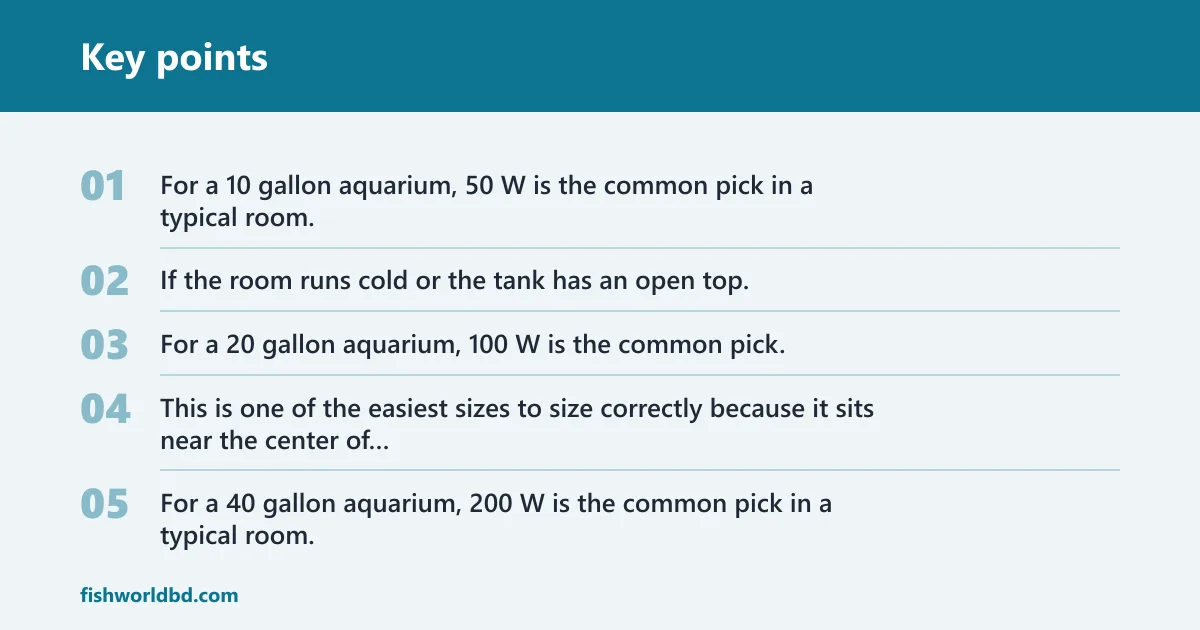
For a 10 gallon aquarium, 50 W is the common pick in a typical room. If the room runs cold or the tank has an open top, move up to the next standard size or check whether a small second heater is cleaner for redundancy.
20 gallon heater picks
For a 20 gallon aquarium, 100 W is the common pick, and the calculator says a 20 gallon tank at a 10°F lift needs 100 W. This is one of the easiest sizes to size correctly because it sits near the center of the standard heater range.
40 gallon heater picks
For a 40 gallon aquarium, 200 W is the common pick in a typical room. If the room is colder than usual or the tank loses heat through an open top, consider splitting the load into two smaller heaters rather than relying on one larger unit.
75 gallon heater picks
For a 75 gallon aquarium, two heaters are usually the better route. The page recommends two heaters at around 75 gallons and up, and its cold-room chart lists 75 gallon tanks at 400 W. Split that into two matched heaters for more even heat and better fault tolerance.
What happens if my aquarium heater is too small?
An undersized heater may run nonstop and still fail to reach the target water temperature. That creates unstable conditions, especially overnight or during cold spells. Fish may face repeated temperature swings, and the heater itself can wear out sooner from constant operation.
A common first-timer mistake is buying by tank label alone, then putting a 50 W heater on a 20 gallon tank in a cold room. The tank can hover below the target even though the heater is “on.” If the water still reads low on a separate thermometer, the fix is more wattage or a second heater, not more waiting.
Frequently asked questions
How many watts per gallon should an aquarium heater have?
As a shortcut, 3 to 5 watts per gallon works in a warm room and 5 to 10 watts per gallon works in a cold room. The shortcut is only a starting point, because the calculator says heater size is not just watts per gallon. Room gap and tank cover matter too.
What size heater for a 10 gallon aquarium?
A 10 gallon aquarium commonly uses a 50 W heater in a typical room. If the room is cold, the tank is open top, or the target fish need warmer water, move up to the next standard size or split the heating load across two smaller units if that fits the setup better.
What size heater for a 20 gallon aquarium?
A 20 gallon aquarium commonly uses a 100 W heater, and the calculator says a 20 gallon tank at a 10°F lift needs 100 W. If the room is colder than the normal baseline, choose the next higher standard size or consider two smaller heaters for better distribution.
What size heater for a 75 gallon aquarium?
A 75 gallon aquarium often does better with two heaters. The page recommends two heaters at around 75 gallons and up, and its cold-room chart lists 75 gallon tanks at 400 W. Splitting that wattage improves heat spread and gives backup if one unit fails.