Where to Place Aquarium Heater for Even Water Temperature

Place your aquarium heater where water moves across it, usually beside the filter outflow or circulation pump. In larger tanks, use two heaters at opposite ends for a steadier temperature. Bad placement creates cold spots, warm layers, and stressed fish. This guide shows where to place the heater by tank shape and flow, how to avoid dead zones, and how to check that the whole tank stays stable.
Why heater placement matters
Heater placement matters because warm water rises and poor circulation lets heat pool near the heater. That creates temperature stratification: one part of the tank reads warm while another stays cooler. A heater in moving water spreads heat faster and gives the thermostat a truer reading.
A submersible aquarium heater sits inside the tank and must stay below its maximum water line. If it sits too close to a glass lid, a blocked corner, or dense rockwork, the surrounding water may warm unevenly. The heater can then switch off too early while colder water remains elsewhere.
How dead water zones change the result
Dead water zones are low-circulation areas behind rocks, under thick plants, in a corner opposite the filter, or beneath hardscape that blocks flow. A heater placed there warms only that pocket. The tank may look stable near the glass, while fish in the other half sit in cooler water.
That matters even more in tall tanks and heavily aquascaped tanks, where hardscape can split the flow path. The heater should warm water that is moving, not water that is trapped.
Heater placement checklist
| Tank layout | Recommended heater position | Thermometer position | Likely dead zones | Verification step |
|---|---|---|---|---|
| Standard rectangular tank | Near the filter outflow or return flow, in the path of moving water | On the opposite side of the tank, away from the heater | Back corner behind decor; low-flow area under the outflow’s far side | Check the thermometer after 24 hours, then compare the warm end and the far end |
| Long tank | Place one heater near one end with strong flow, or use two heaters at opposite ends | Near the middle, but not beside either heater | Center section if the flow runs only at the ends; shaded end behind plants or rock | Measure both ends and the center after the water stabilizes |
| Heavily aquascaped tank | Mount where flow can pass through open water, not behind dense rockwork | In open water on the side that does not touch the heater’s flow path | Behind hardscape, under shelves, in plant thickets, and under blocked substrate zones | Compare readings in an open zone and a sheltered zone, then adjust flow if they differ |
Say your 20-gallon tank has a hang-on-back filter on the left and a heater on the right side, tucked behind a piece of wood. The left side may stay warm while the right stays cooler. Moving the heater into the outflow path usually gives a more even result than simply lowering the set temperature.
Where should the heater go?
For most tanks, the best place is where water movement passes directly over the heater body. That usually means beside the filter outflow, a return jet, or a circulation pump. In a standard rectangular tank, one side with steady flow is often better than the far back corner.
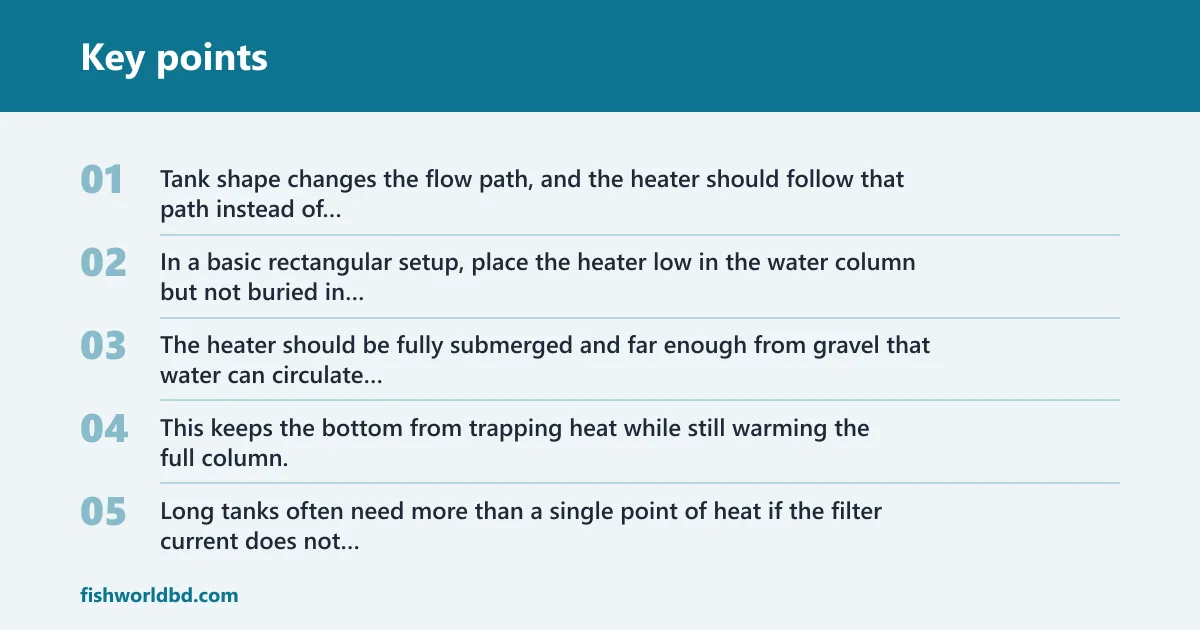
Do not treat every aquarium the same. Tank shape changes the flow path, and the heater should follow that path instead of fighting it.
Standard rectangular tank
In a basic rectangular setup, place the heater low in the water column but not buried in the substrate. The heater should be fully submerged and far enough from gravel that water can circulate around it. This keeps the bottom from trapping heat while still warming the full column.
Long tank
Long tanks often need more than a single point of heat if the filter current does not reach the far end. If you use one heater, place it where the return flow pushes warm water along the full length. If the tank is very long, a dual-heater setup at opposite ends usually gives a steadier spread.
Heavily aquascaped tank
Dense stone stacks, driftwood, and thick plant masses can hide the heater from flow. Put the heater where open water connects both sides of the tank. If the heater sits behind hardscape, it may warm a pocket while the rest of the aquarium stays cooler.
Tank with sump or strong return flow
With a sump, the return flow can do much of the mixing work. Place the heater where the return line sends water back into the display, or in a section of the sump with strong, steady movement if the system is designed for that. The key is circulation through the heater, not simply heater location in a hidden chamber.
Should the heater go near the filter output?
Yes, in most aquariums the heater works best near filter outflow or return flow because moving water carries heat across the tank. That helps reduce temperature stratification and keeps the thermostat from reading one small warm pocket. The heater should sit in active flow, not in a still corner.
But strong flow can hide a bad setup. If the output is aimed into a blocked corner, the heater may be close to the filter and still sit in a dead water zone. The goal is not distance from the filter. The goal is water that actually moves across the heater and then through the tank.
What to avoid around the output
Do not place the heater where the outflow hits only the glass and turns back. That can create a local hot spot without moving heat into the rest of the aquarium. Also avoid hanging the heater under thick decor that breaks the return current before it reaches the open water.
A common first-timer mistake is to place the heater next to the intake because it looks tidy. Intake placement can work only if the outgoing flow still sweeps across the heater and into the display. Otherwise, the heater sits in a weak circulation pocket.
Horizontal or vertical mounting?
Either orientation can work, but the heater model and tank layout decide the better choice. Some submersible heaters are designed for vertical use, while others can be mounted horizontally or at an angle. The right answer is the one that keeps the whole heating element submerged and in moving water.
When vertical placement works well
Vertical mounting fits many standard tanks because it keeps the heater low, fully submerged, and easy to place near the outflow. It works well when the filter current runs across the body and the aquarium has enough depth to keep the maximum line covered at all times.
When horizontal placement is better
Horizontal placement can be better in shallow tanks, long tanks, or aquascapes where vertical space is crowded. It can also help when you need to keep the heater low and out of view while still exposing it to flow. The heater still needs full submersion and should not rest on the substrate.
How the heater model changes the answer
Do not assume every heater can mount either way. Some manufacturers allow horizontal use; others specify vertical only. The unit’s instructions matter because the internal thermostat and heating element may depend on orientation for even sensing and safe operation.
Picture a planted 40-gallon breeder with a low wood arch across the back. A vertical heater may fit poorly behind the arch and sit in weak flow. A horizontal mount near the return path can keep the heater submerged and exposed to moving water without trapping heat under the hardscape.
Thermometer and controller setup
Place the aquarium thermometer away from the heater so it reads tank temperature, not the heater’s immediate output. A glass or digital thermometer both work if they are positioned in open water and checked after the heater has stabilized. A thermometer beside the heater can give a false high reading.
How long to wait before trusting the reading
After installing a new heater, wait 24 hours before trusting the temperature reading. That gives the water time to mix and the heater time to cycle normally. If you read the tank too soon, you may see the heater’s local heat rather than the aquarium’s true average.
How to verify temperature across the tank
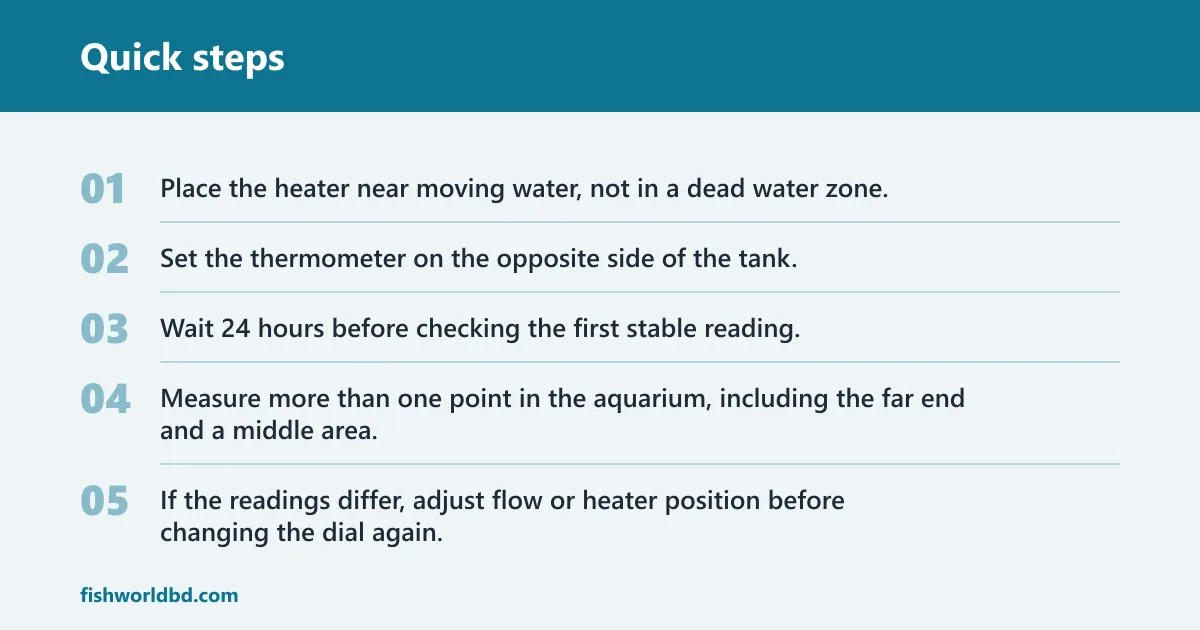
- Place the heater near moving water, not in a dead water zone.
- Set the thermometer on the opposite side of the tank.
- Wait 24 hours before checking the first stable reading.
- Measure more than one point in the aquarium, including the far end and a middle area.
- If the readings differ, adjust flow or heater position before changing the dial again.
When to use a controller or thermostat
An aquarium controller or thermostat adds a separate probe-based control layer. A single-stage controller turns the heater on and off based on one temperature setting. That can improve accuracy and safety, especially with larger tanks or heaters that run a little warm or a little cool.
For aquariums where the heater dial is hard to trust, a probe-based controller helps steady the temperature. Some controllers list a wide control range; for example, the Finnex controller has a temperature control range of 67-93F. The point is not the brand. The point is having an independent reading away from the heater body.
When one heater is not enough
One heater is usually enough for smaller tanks if the wattage matches the tank size and room temperature. A common rule of thumb is 3 to 5 watts per gallon for most tanks. For a 20-gallon tank, a 50 to 100 watt heater is usually right. Colder rooms often need more wattage.
For a 75-gallon tank, the guide suggests one 200 watt or two smaller heaters. A dual-heater setup adds redundancy if one unit fails and can make it easier to spread heat across a long or obstructed tank. Larger tanks benefit from that extra distribution more than from one oversized heater in one spot.
| Tank size | Common heater choice | Placement note | Best verification habit |
|---|---|---|---|
| 20 gallons | 50 to 100 watt heater | Near active flow, with the thermometer on the opposite side | Check once the tank has stabilized, then compare two spots |
| 75 gallons | One 200 watt or two smaller heaters | Split heating across the tank when shape or décor blocks flow | Check both ends and the center after setup |
| Cold room setup | Often the higher end of the wattage range | Place heaters where moving water can carry warmth throughout the tank | Watch for cold layers near the bottom or far end |
Most aquariums need a stable aquarium heater temperature between 74°F and 78°F for tropical fish. South American species and bettas are often kept warmer, at 78°F to 82°F. Discus and some Amazon fish may need 82°F to 86°F. Freshwater plants and mixed tanks are often kept at 72°F to 78°F, while reef tanks are commonly kept at 76°F to 80°F.
Coldwater fish like goldfish do not need tropical heat and may live at 60°F to 72°F. The target range matters, but the placement rules stay the same: keep the heater submerged, keep it in flow, and keep the thermometer away from direct heater output.
Frequently asked questions
Where should I place an aquarium heater for even water temperature?
Place the heater where water moves across it, usually beside the filter outflow, return flow, or a circulation pump. That position helps spread heat and reduces temperature stratification. Avoid dead water zones, blocked corners, and areas hidden behind heavy rockwork or dense plants.
Should an aquarium heater go near the filter output?
Yes, in most tanks that is the best starting point because outflow helps mix warm water through the aquarium. Keep the heater in the moving stream, not just near the filter housing. If the output is blocked by decor, move the heater or redirect the flow.
Can I install an aquarium heater horizontally?
Often yes, but only if the heater model allows it. Horizontal placement can work well in shallow tanks, long tanks, or crowded aquascapes. The heater still needs full submersion and enough open water around it for flow. Check the manufacturer’s orientation guidance first.
Is vertical heater placement better than horizontal?
Not always. Vertical placement works well in many standard tanks because it is easy to keep submerged and close to flow. Horizontal placement can be better when height is limited or hardscape blocks a vertical mount. The better choice is the one that follows the tank’s flow path.
How far should a heater be from the substrate?
Keep it far enough above the substrate that gravel or sand does not trap heat around the lower end. The heater should not sit on the bottom. Leave open space beneath it so water can circulate and so the substrate does not become a hot spot.
How long should I wait before trusting the heater temperature reading?
Wait 24 hours after setup before trusting the reading from a new heater. That gives the tank time to mix fully and lets the heater cycle normally. Check the thermometer in a spot away from the heater, then compare another point in the tank to confirm even heating.