How Does a Hang on Back Filter Work?

A hang-on-back filter pulls tank water into a filter box, catches debris, converts ammonia and nitrite with beneficial bacteria, then sends cleaner water back to the aquarium; its main features are adjustable flow, media compartments, and easy upkeep. If it is oversized, set badly, or too strong for the tank, it can stress fish, disturb shrimp, and leave waste in dead spots. This guide explains the four jobs of a HOB filter and how each one changes in shrimp, betta, and sand-bottom tanks.
How water moves through the filter
A HOB filter hangs on the aquarium rim. A motorized pump draws water up an intake tube, moves it through media, and sends it back over the tank edge. A HOB filter typically performs four jobs in order: drawing, trapping, biologically converting, and returning water.
The water path from tank to return
Water enters through the intake tube and intake guard, which sits below the surface and inside the tank. It then passes through a cartridge or media chamber where debris is caught and bacteria can colonize. The pump pushes the cleaned water over a return lip so it falls or glides back into the aquarium.
The return does more than move water. It stirs the surface, which helps gas exchange and can raise oxygen availability. That same movement can also add noise, splashing, or bubbles if the waterline is too low or the output is set too high.
What the pump does
The motorized pump is the part that keeps the water path moving. In many models, flow is adjustable, so the same filter can be tuned for a lightly stocked tank or a tank with more waste and more open water movement. Some models need priming after cleaning or an outage, while others use an internal pump design that reduces restart hassle.
What are the main parts of a hang on back filter?
A HOB filter typically includes the intake tube and guard, a cartridge or media chamber, the impeller and motor, and the return lip. Each part affects one visible problem: clogging, flow loss, noise, or restart trouble. If one part is out of step with the tank, the whole filter becomes less useful.
Intake tube and intake guard
The intake tube pulls water from the aquarium into the filter. The guard lowers the risk of fish injury and helps keep larger debris out. In sand-bottom tanks, the same intake can pull up fine particles if it sits too low or if the flow is too aggressive.
Filter cartridge and media
A cartridge usually contains mechanical media and may include chemical media such as carbon. Mechanical media catches suspended debris. Chemical media can polish water or remove some dissolved compounds, but it needs routine replacement or rinsing according to the model and use case.
Impeller and return lip
The impeller is the spinning part that drives water through the filter. If it gets grit, snails, or plant debris inside the chamber, flow drops and noise often rises. The return lip shapes the outflow; if the water falls too far, splashing increases.
Does a HOB filter provide mechanical and biological filtration?
HOB filters commonly combine mechanical and biological filtration, and many also include chemical media. Mechanical filtration traps visible waste in the cartridge or sponge. Biological filtration happens on high-surface-area media where beneficial bacteria process ammonia and nitrite as water moves through the chamber.
Mechanical trapping in the cartridge and sponge
Mechanical media catches food bits, plant fragments, and suspended waste before they settle. A sponge prefilter on the intake adds a second layer of mechanical capture and helps protect small fish and shrimp. It also slows sand from entering the intake, which can protect the impeller.
Biological filtration in the media chamber
Bio-media works best when it offers a lot of surface area and steady water contact. That is why ceramic rings, porous blocks, and similar media are common in HOB chambers. The useful bacteria need oxygenated water, so flow matters here too; a dead, clogged chamber will not support them as well.
Where chemical media fits
Chemical media, often carbon, sits alongside the other media or inside a cartridge. It is not the core of the filter’s cleaning job. Think of it as a support layer for specific water issues, while mechanical capture and bacterial conversion do the main work.
Flow rate, oxygenation, and noise
Flow rate, usually listed in GPH, should match tank size, livestock, and layout. Higher flow can improve surface agitation and oxygenation, but too much flow can pin bettas to corners, push shrimp around, or blast fry into hard edges. Noise usually comes from splash, bubbles, or a vibrating impeller.
Choosing GPH for tank size and livestock
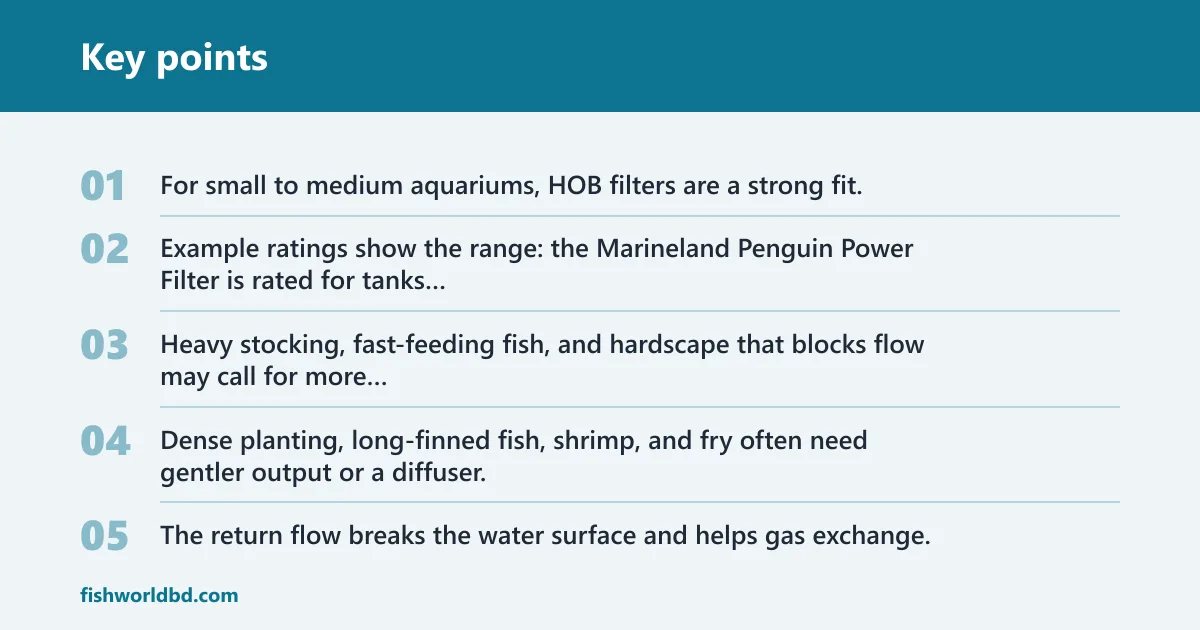
GPH varies by model and is often adjustable. For small to medium aquariums, HOB filters are a strong fit. Example ratings show the range: the Marineland Penguin Power Filter is rated for tanks up to 70 gallons and moves up to 350 GPH; the Aqueon QuietFlow LED PRO is rated for tanks up to 75 gallons and has a 400 GPH maximum flow rate; the AquaClear HOB is rated for tanks up to 70 gallons and has a 500 GPH maximum flow rate; the Penn Plax Cascade Hang-on-Back is rated for tanks up to 100 gallons and moves up to 300 GPH; the Tetra Whisper Power Filter is rated for tanks up to 60 gallons and has a 330 GPH maximum flow rate.
That label is only a starting point. Heavy stocking, fast-feeding fish, and hardscape that blocks flow may call for more circulation. Dense planting, long-finned fish, shrimp, and fry often need gentler output or a diffuser.
Surface agitation and gas exchange
The return flow breaks the water surface and helps gas exchange. That is useful in warm tanks, crowded tanks, and tanks with limited plant mass. If the outflow sits too low or the waterline drops, you can get louder splashing without a matching gain in useful circulation.
Say your 10-gallon betta tank has a HOB rated for much more flow than the fish can handle. If the outflow lands hard and ruffles the whole surface, the betta may avoid that side of the tank. Lower the flow, raise the waterline, or add a baffle before assuming the filter is wrong for the tank.
When splash or hum becomes a problem
Noise becomes a real issue when it changes the room, not only when it is noticeable. A steady hum from the motor is usually less important than a loud waterfall effect that dries the rim, spooks fish, or sends fine mist onto the lid. In apartments or bedrooms, that difference matters.
Function checklist
| Component | What it does | Common failure sign | Best fix |
|---|---|---|---|
| Intake tube | Pulls aquarium water into the filter housing | Flow drops, especially after feeding or sand disturbance | Remove debris, rinse the tube, and check for kinks or blockage |
| Sponge prefilter | Protects small fish and shrimp, catches coarse waste, slows sand intake | Weak inflow, visible grime on the sponge, tighter surface ripple | Rinse in removed tank water and clean it often |
| Impeller | Spins to move water through the filter | Rattling, chatter, or reduced output | Open the chamber, clear grit or snails, and reseat the impeller |
| Cartridge/media | Traps debris and supports bacteria growth on media surfaces | Cloudy water, slow flow, or sudden output loss | Rinse mechanical media gently; replace worn cartridges as needed |
| Return lip | Sends cleaned water back over the tank edge | Splashing, loud waterfall sound, or bubbles at the outlet | Raise the waterline, reduce flow, or use a baffle |
| Waterline height | Sets how far water falls on return | Extra noise, air draw, or poor surface movement | Keep the water near the return level recommended by the filter design |
| Tank type fit | Matches output and intake behavior to livestock and substrate | Bettas avoid flow; shrimp hide; fry get pulled in; sand clouds up | Use a sponge prefilter, lower flow, or choose gentler circulation |
How HOB filters fit betta, shrimp, fry, and sand tanks
HOB filters can work in all four setups, but the setup changes. Bettas usually need softer flow and a calmer surface. Shrimp and fry need intake protection. Sand-bottom tanks need careful intake placement and a prefilter if the substrate is light enough to move.
Betta tanks
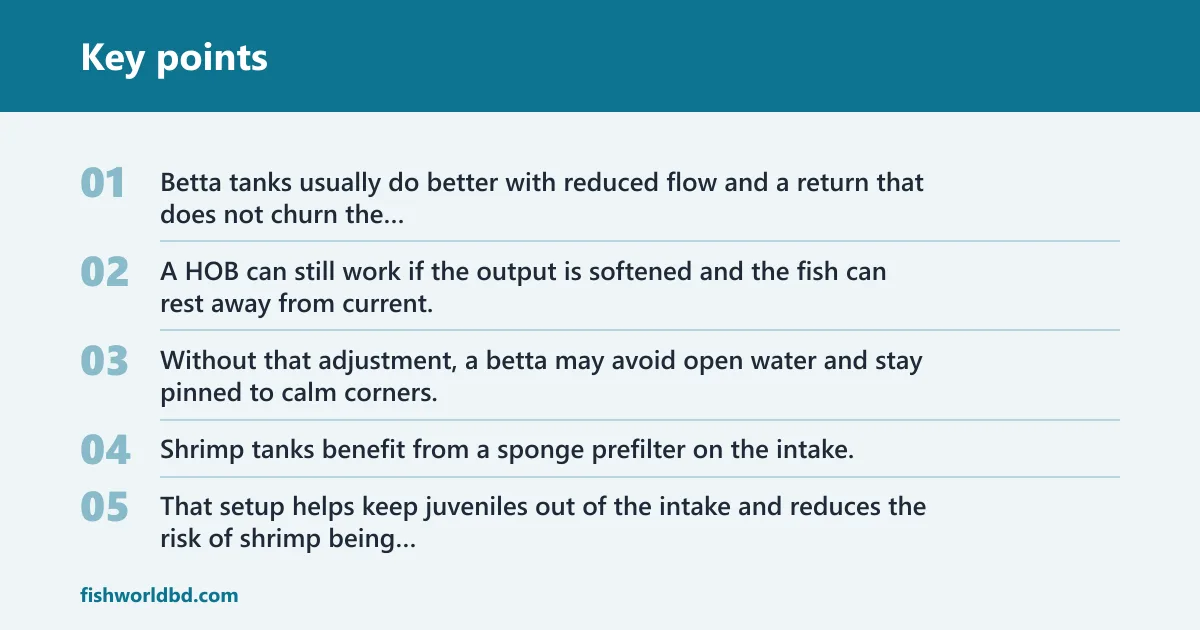
Betta tanks usually do better with reduced flow and a return that does not churn the whole surface. A HOB can still work if the output is softened and the fish can rest away from current. Without that adjustment, a betta may avoid open water and stay pinned to calm corners.
Shrimp tanks
Shrimp tanks benefit from a sponge prefilter on the intake. That setup helps keep juveniles out of the intake and reduces the risk of shrimp being pulled against the guard. Shrimp also do better when the filter does not create a strong pull across the whole tank.
Fry tanks
Fry are small enough to slip into gaps that larger fish ignore. A sponge prefilter helps protect them and catches fine food bits before they vanish into the intake. In fry tanks, a HOB should run gently, with the intake screened and the return soft enough to avoid pushing fry around.
Sand-bottom tanks
Sand substrates can clog an intake guard and send fine particles into the filter if the tube sits too close to the bottom. A sponge prefilter helps reduce sand ingestion. If the sand still gets stirred, move the intake higher and lower the flow rather than letting the impeller chew grit.
A common first-timer mistake is placing the intake close to the sand in a small tank and then turning the flow up to clear cloudy water. The sand gets pulled toward the tube, the impeller starts to rattle, and the filter loses output. Moving the intake and slowing the flow usually fixes more than the cartridge does.
Cleaning, priming, and restart issues
Clean the intake parts before they become visibly restricted, and clean mechanical media when flow starts to fall. Cartridges and media need routine attention because waste buildup narrows the water path. After cleaning or power loss, some HOBs restart on their own, while others need priming.
How often to clean intake parts and media
The intake tube, guard, and sponge prefilter usually need the most frequent cleaning because they catch the first layer of debris. The cartridge or media chamber should be checked before flow becomes weak. Clean mechanical parts more often in heavy-feeding tanks, sand-bottom tanks, and tanks with fine plant debris.
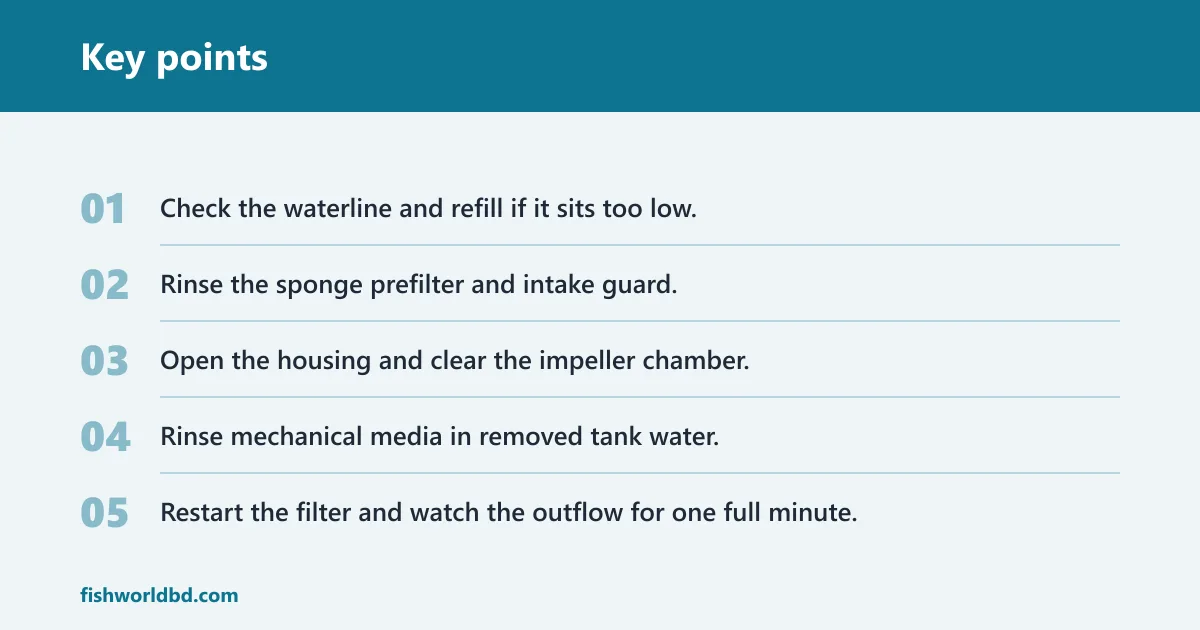
Use this order when flow drops:
- Check the waterline and refill if it sits too low.
- Rinse the sponge prefilter and intake guard.
- Open the housing and clear the impeller chamber.
- Rinse mechanical media in removed tank water.
- Restart the filter and watch the outflow for one full minute.
What to do after a power outage
If the filter loses power, trapped air and lost siphon can stop restart. Some models need manual priming after a power loss, while others resume once the chamber refills. If it does not restart, check that the intake is submerged, the pump chamber is full enough, and the impeller is seated correctly.
Common clog and impeller problems
Reduced flow usually comes from three places: a clogged intake, a packed cartridge, or debris in the impeller. Splashing usually comes from an outflow that is too high above the waterline. Restart failures often follow a power cut, an air pocket, or an impeller jam.
Suppose a shrimp tank loses power for ten minutes and the HOB does not restart after the outage. Before replacing anything, refill the chamber if needed, check the impeller for grit, and make sure the sponge prefilter has not collapsed into the intake. Many restart problems are mechanical, not electrical.
How loud is a hang on back filter compared with a sponge filter?
A sponge filter is usually quieter because it uses air-driven flow and does not have a waterfall return. A HOB can be quiet too, but its sound changes with waterline height, splash, and impeller condition. If the outflow is loud or the pump rattles, a sponge filter will usually be the calmer choice.
Frequently asked questions
How does a hang on back filter work?
It pulls water up an intake tube, moves that water through mechanical and biological media, then returns it over the aquarium edge. That path removes debris, supports beneficial bacteria, and adds surface movement. Flow strength, media choice, and waterline height shape the final result.
Can a hang on back filter be used in a shrimp or betta tank?
Yes, if the flow is gentle and the intake is protected. Shrimp do best with a sponge prefilter to prevent injury and reduce intake loss. Bettas usually need lower flow and less surface churn, so the outflow may need to be softened or redirected.
How often should you clean the intake and cartridges on a HOB filter?
Clean the intake parts and sponge prefilter as soon as flow starts to weaken or debris becomes visible. Check the cartridge or media chamber before the filter is heavily restricted. In sandy, heavily fed, or shrimp-heavy tanks, those parts often need more frequent attention than the rest of the filter.
Do hang on back filters work better with sand or gravel?
They usually behave more easily over gravel because gravel is less likely to be pulled into the intake. Sand can still work, but it needs a higher intake position, careful flow control, and often a sponge prefilter. Otherwise, fine substrate can clog the intake or wear the impeller.
What flow rate should I choose for my aquarium size?
Choose flow by tank size, livestock, and aquascape, not by gallon number alone. A calm betta tank needs less output than a busy community tank of the same size. If plants, wood, or rocks block movement, you may need a filter with higher rated flow to reach the whole tank.
What happens if a hang on back filter loses power?
Some HOB filters restart on their own after power returns. Others need priming because air trapped in the chamber breaks the siphon or blocks the pump. If restart fails, check the waterline, clear the impeller, and make sure the intake and chamber are filled the way the model requires.