

Do Water Conditioners Work for Removing Chlorine and Chloramine?

Yes, water conditioners work only if the label says they neutralize both chlorine and chloramine, because chloramine needs dechlorination plus ammonia detoxification. If you use a chlorine-only product on chloraminated tap water, fish can be exposed to chlorine or released ammonia during water changes. This guide shows how to read the bottle, spot chloramine treatment, and choose the right dose for municipal tap water.
Match the conditioner to your tap water

They do, but only when the product matches the disinfectant in your tap water. Chlorine-only treatment is enough for water that uses free chlorine. Chloraminated water needs a conditioner that explicitly says it treats chloramine, or a filter setup that removes it before the water enters the tank.
That difference matters because a bottle can fit one tap supply and fail in another. The label is the deciding factor, not the word “conditioner” by itself.
Chlorine and chloramine basics
Chlorine and chloramine are both harmful to fish and other aquatic life. Chlorine is the simpler case: it is a free disinfectant in tap water, and it can often be removed by letting water stand about 24 hours, preferably with aeration.
Chloramine behaves differently. It lasts longer than chlorine, and many municipalities use it because it stays in the water supply longer. It does not disappear overnight, and standing water or room-temperature storage does not remove it.
Fish react badly to both because municipal disinfectants are meant to kill microbes, not protect aquarium animals. That is why tap water should be treated before it reaches the tank, especially during top-offs and partial water changes.
What happens if a conditioner misses chloramine?
If a product removes only the chlorine part of chloramine, ammonia can be left behind in the treated water. That matters most during large water changes, because the released ammonia can be dangerous before the tank’s biological filter has time to handle it.

A chlorine-only bottle can look fine on paper and still fail in chloraminated water. The water may lose its chlorine smell, yet the ammonia portion is still present unless the conditioner also detoxifies ammonia or the water was treated by another method that removes chloramine fully.
Picture a 40-gallon freshwater tank getting a 50% change from municipal tap water that uses chloramine. If the conditioner is only a sodium thiosulphate dechlorinator, it neutralizes the chlorine part but can leave ammonia from the broken chloramine molecule. That is a poor trade when the goal is to protect fish during a big refill.
Why ammonia can appear after treatment
Traditional dechlorinators based on sodium thiosulphate neutralize only the chlorine part of chloramine. That is useful for free chlorine, but it is incomplete for chloraminated water. In that case, the treatment can turn one problem into another unless the conditioner also handles ammonia.
Many aquarium water conditioners do that second job by binding or detoxifying ammonia. Not all products do, so the bottle has to say so plainly. If it does not mention chloramine or ammonia detoxification, treat it as chlorine-only until proven otherwise.
When this matters most
The risk rises with water-change size. Small top-offs may dilute the problem, but large changes can add enough released ammonia to matter quickly. New tanks, weak filters, stressed fish, and tanks with little bacterial reserve are the least forgiving situations.
A common first-timer mistake is to buy a “dechlorinator” and assume the name covers every tap water issue. It does not. The label has to match the local disinfectant, and the dose has to match the full volume of new water being treated.
Conditioner decision table
Use this before a water change. Match the water source first, then the disinfectant, then the size of the change. The safest method is the one that covers both the disinfectant and any ammonia released when chloramine is broken apart.
| Water source | Disinfectant type | Water-change size | Safest treatment method | Red-flag product claims |
|---|---|---|---|---|
| Municipal tap water | Chlorine-only | Any routine change | Conditioner that neutralizes chlorine, or standing water with aeration for about 24 hours before use | “For all tap water” with no chloramine mention; no dosing chart |
| Municipal city water | Chloramine | Small or large change | Conditioner that explicitly treats chloramine and detoxifies ammonia, or activated carbon with enough contact time before the tank | “Removes chlorine” only; “dechlorinates” with no chloramine claim |
| Unknown tap water | Not confirmed | Any change | Check the water report first, then use a conditioner labeled for chlorine and chloramine if the report is unclear | “Safe for any water” without proof; no mention of ammonia handling |
How to read the red flags
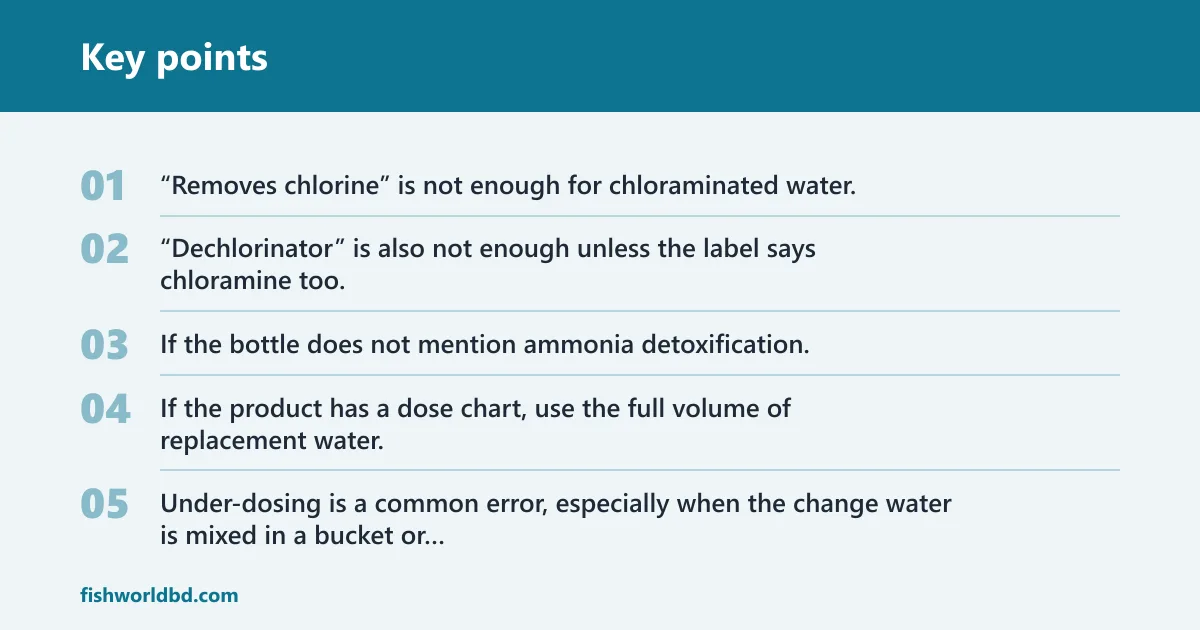
“Removes chlorine” is not enough for chloraminated water. “Dechlorinator” is also not enough unless the label says chloramine too. If the bottle does not mention ammonia detoxification, it may leave a chloramine byproduct behind after treatment.
If the product has a dose chart, use the full volume of replacement water, not the tank’s total capacity unless the instructions say otherwise. Under-dosing is a common error, especially when the change water is mixed in a bucket or reservoir before it reaches the aquarium.
Can you let tap water sit overnight?
Yes for chlorine in many cases, but not as a chloramine solution. Chlorine can often dissipate by standing water or aeration over about 24 hours. Chloramine is more stable, and it does not disappear overnight. Boiling water does not remove monochloramine either.
Aeration helps with free chlorine because it speeds release to the air. With chloramine, the problem is the stronger bond in the molecule, so the same trick is not a reliable fix. At room temperature, standing water does not remove chloramine either.
Suppose a beginner fills a bucket the night before a water change and runs an airstone in it. That may be enough for chlorine-only water, but it is still a gamble if the city uses chloramine. The bucket can sit for hours and still carry the disinfectant into the tank the next day.
Why aeration is not enough for chloramine
Aeration and standing time are practical for free chlorine, not for chloramine. Some chloramine breakdown may occur over long periods, but routine fish care needs a method that is predictable, not one that depends on waiting several days and hoping the tap supply behaves the same way each time.
That is why conditioners are the normal answer for aquarium prep. They are faster, simpler, and easier to dose correctly when the tap water source changes or when a water change has to happen on schedule.
How to check your tap water report
The best way to confirm chloramine use is the municipal water report, often called a Consumer Confidence Report. It may list the disinfectant used by the utility, and it can change seasonally or during maintenance. That report tells you what the tap is likely carrying before you start mixing water.
If the report says chloramine, choose a conditioner that specifically treats chloramine and ammonia. If the report says chlorine, a chlorine-only conditioner may be enough, though a combined chlorine-and-chloramine product is still a safe general choice for many aquariums.
Municipal treatment can shift during the year. A utility may change disinfection methods, blend sources, or alter dosing during maintenance. That is why an old report is not a permanent answer. Check the current report when the bottle label and the tap water do not clearly match.
What wording to look
Search the report for terms like “chloramine,” “monochloramine,” or “combined chlorine.” Those words point to a water supply that needs more than a simple chlorine neutralizer. If the report is hard to read, call the utility and ask which disinfectant is in use right now.
That extra step is worth it because the wrong assumption can affect every water change after that. A bottle that works in one city may be the wrong pick in the next neighborhood over.
Do activated carbon filters remove chlorine and chloramine for aquariums?
Yes, activated carbon can remove chlorine and chloramine, but contact time matters. It works best in a separate container or a slow-flow setup where the water stays in contact with the carbon long enough to do the job. It is not an automatic fix at fast aquarium flow rates.
Catalytic carbon is commonly chosen for chloramine reduction. The reason is simple: chloramine removal depends on flow rate and residence time through the filter. Faster flow gives the carbon less time to work, so removal drops as water moves through more quickly.
Why flow rate matters
A carbon block tested at 1 gpm removed 66.9% chloramine in one test. The same carbon block tested at 0.5 gpm removed 99.6% chloramine. That is the same media, but the slower flow gave it far more contact time.
One whole-house catalytic carbon system reported 98.2% chloramine removal on the first test, and that same system reached below the detection level in later tests. Those results show the direction clearly: chloramine removal is possible, but it depends on contact time, setup, and the water path through the carbon.
For aquarium prep, that means a small carbon cartridge in a fast fill line may not be enough by itself. A slow drip into a treatment container or a purpose-built filtration stage gives the carbon a better chance to do its job.
How long should you wait after adding water conditioner before putting fish in?
Usually, you do not need to wait long if the conditioner is mixed into the replacement water at the correct dose. Many aquarium conditioners are designed to work as soon as they are distributed through the water. The key is full coverage, not a long delay.
Check the bottle for the dose and treat the entire volume of new water before it reaches the tank, or dose the tank for the exact amount of new water added if the label permits that method. Do not guess at the dose, because under-treatment is the real risk.
Practical pre-change steps
- Find out whether your tap water uses chlorine or chloramine.
- Read the conditioner label for chlorine-only or chloramine coverage.
- Measure the replacement water volume before dosing.
- Mix the conditioner through the new water fully.
- Use the treated water for the change without assuming it is safe if the label does not cover chloramine.
That sequence is safer than relying on standing water alone. It also keeps the decision tied to the actual disinfectant in the tap, which is what controls the outcome.
Frequently asked questions
Do water conditioners remove chlorine and chloramine from tap water?
Some do, but not all. A conditioner must explicitly say it neutralizes both chlorine and chloramine to be a safe choice for chloraminated municipal water. If it only says chlorine, it may leave the chloramine part untouched and can leave ammonia behind after treatment.
Does aquarium water conditioner neutralize chloramine safely?
It can, if the product is formulated for chloramine and ammonia detoxification. The safest bottles state that they treat both disinfectants. Traditional sodium thiosulphate products neutralize only the chlorine part, so they are not enough on their own for many city water supplies.
Will conditioner remove chlorine immediately before adding fish?
Yes, when used at the correct dose and mixed through the full water volume. Most conditioners are made for immediate use during water changes. The better question is whether the bottle handles the right disinfectant, because a fast result is useless if chloramine is present and ammonia is not addressed.
Does chloramine leave ammonia behind after treatment?
It can. When chloramine is broken apart, the chlorine portion is neutralized, but released ammonia may remain unless the conditioner also detoxifies it. That is why large water changes in chloraminated water need a product that covers both steps, not just dechlorination.
How do I know if my tap water uses chloramine?
Check the municipal Consumer Confidence Report or water quality report. Look for “chloramine,” “monochloramine,” or “combined chlorine.” If the report is unclear or outdated, ask the utility directly, because treatment can change during the year or during maintenance work.
Can I just let tap water sit overnight to remove chloramine?
No. Standing water can help with chlorine, but chloramine is more persistent and does not disappear overnight. Room-temperature storage and aeration are not reliable chloramine fixes, so routine aquarium water changes need a conditioner or filter method that specifically treats chloramine.


